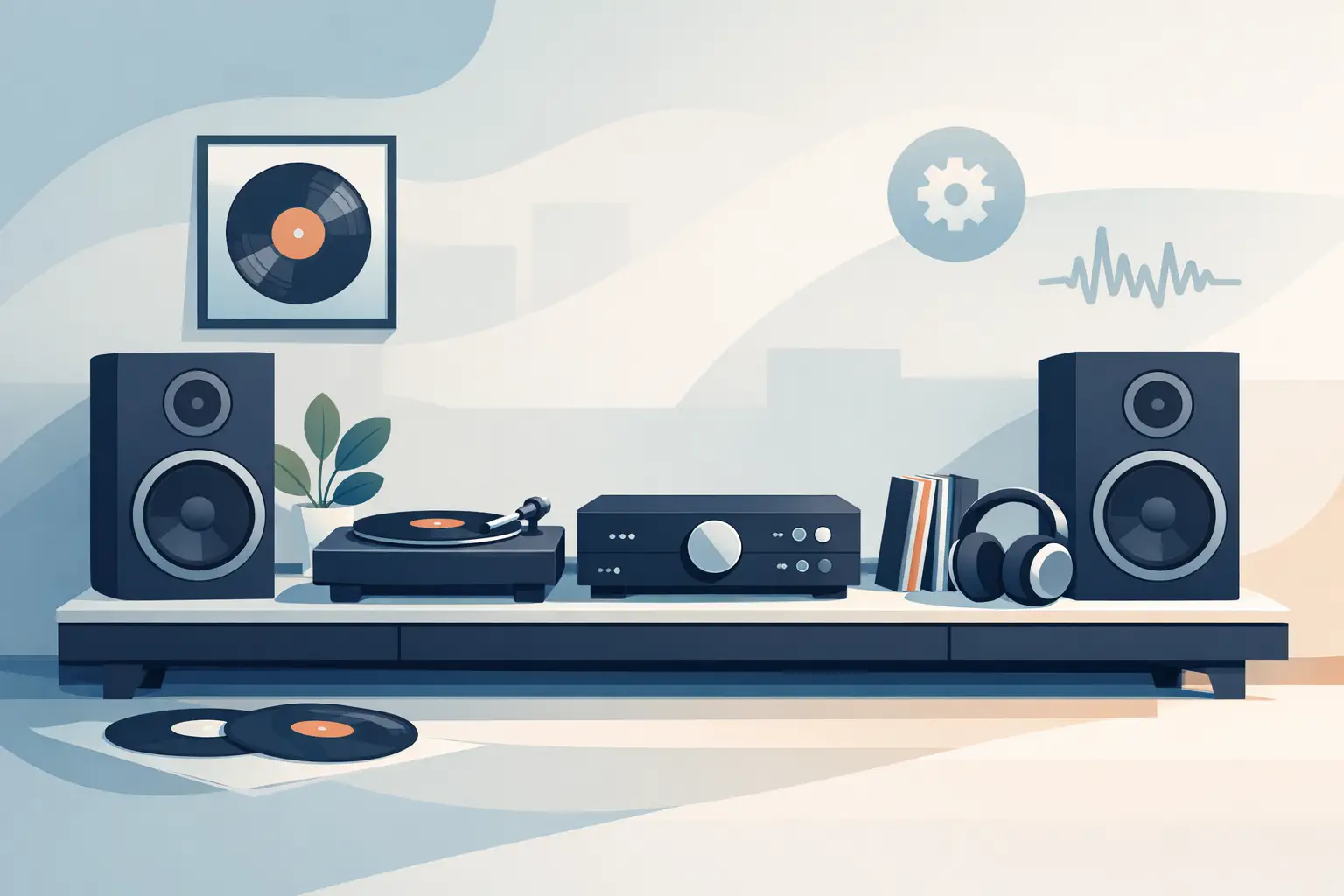
A serious system usually goes wrong before the first note plays. Not because the components are bad, but because they were chosen in isolation - a powerful amplifier with a difficult speaker load, a revealing source feeding a bright room, a large loudspeaker forced against the front wall. If you want to know how to build a hi fi system that delivers long-term satisfaction, start by treating it as a complete signal chain in a real room, not a stack of prestige boxes.
How to build a hi fi system from the room outward
The shortest path to disappointment is to shop by component category alone. The better approach is to begin with the listening room, your listening habits, and the scale of presentation you want. A system designed for a dedicated listening room behaves very differently from one intended for a shared living space, and both can be excellent if the constraints are respected early.
Room size sets useful boundaries. In a smaller room, a speaker with deep bass extension and wide radiation may create more problems than advantages, especially if placement options are limited. In a larger room, a compact monitor can sound refined yet dynamically restrained if it is asked to energize too much air. Ceiling height, floor construction, and the amount of glass or open space also matter because they affect bass behavior, image stability, and tonal balance.
Listening distance matters just as much. If you sit close, coherence, dispersion, and driver integration become critical. If you sit farther away, dynamic headroom and room interaction become more dominant. This is one reason ribbon-based loudspeaker systems can be so compelling when properly matched and positioned - low mass diaphragms can preserve speed and microdynamic detail, but they still require careful integration with the room and the rest of the chain.
Before you choose a single component, define three things clearly: how loud you listen, what music matters most to you, and whether this is a final destination system or a foundation for future upgrades. Those answers will shape every smart decision that follows.
Choose the speaker first, but not in a vacuum
For most listeners, the loudspeaker is still the most consequential voicing element in the system. It interacts directly with the room, sets the scale of the presentation, and places real demands on amplification. That does not mean the speaker should be chosen carelessly and everything else forced around it. It means the speaker should be chosen first within the context of room size, placement flexibility, and amplifier compatibility.
Sensitivity and impedance deserve more attention than marketing descriptions. A speaker that dips low in impedance or presents a complex load may need an amplifier with substantial current delivery, not just high wattage on paper. A speaker with benign impedance and higher sensitivity opens the door to a broader range of amplification options, including lower-powered designs that may excel in tonal density or refinement.
You should also think beyond frequency response. Dispersion affects how much reflected energy reaches the listening position and how stable the tonal balance remains off axis. Cabinet behavior, crossover execution, and transient accuracy shape how convincing instruments sound in space. If your priorities are speed, transparency, and low-level resolution, that may lead you in a different direction than if your focus is ultimate bass weight or very high playback levels.
A premium system begins with honest matching, not with the most expensive speaker you can stretch to buy.
Amplification is about control, not just power
One of the most common mistakes in how to build a hi fi system is reducing amplifier selection to a wattage number. Power matters, but control matters more. The amplifier must be able to maintain composure through dynamic swings, preserve tonal integrity at realistic listening levels, and grip the speaker well enough to keep bass articulate rather than merely forceful.
A 50-watt amplifier can outperform a higher-rated alternative if it has better current capability and is a superior match for the speaker. The reverse is also true. Some speakers simply wake up with more reserve. They image better, track transients more naturally, and sound less mechanically constrained when driven by an amplifier with real authority.
This is where system goals matter. If you value low-level intimacy and harmonic texture, certain amplifier topologies may be deeply appealing. If you want large-scale orchestral swings, electronic bass impact, or wide dynamic contrast in a large room, you may need considerably more grip and headroom. Neither choice is inherently better. The right answer depends on the speaker load, room volume, and your listening habits.
Integrated amplifiers make sense for many serious systems because they reduce box count and cable complexity while preserving a high level of performance. Separates can offer more upgrade flexibility and, at higher levels, better isolation between preamplification and power delivery. The trade-off is cost, space, and setup complexity.
Build the front end around the source you actually use
Source quality still matters, even in systems with outstanding speakers and amplification. A weak front end limits everything downstream. If most of your listening is digital, prioritize the streaming platform, digital transport stability, and DAC implementation rather than treating them as interchangeable utilities. If you are committed to vinyl, allocate realistic budget to the turntable, tonearm, cartridge, and phono stage as a complete analog chain.
Digital has its own hierarchy. Noise management, clocking, power supply quality, and analog output stage design all influence texture, dimensionality, and timing. A technically competent DAC can sound clean yet emotionally flat if the rest of the implementation is compromised. Better digital front ends often sound less like digital not because they are softened, but because they preserve low-level information and spatial coherence more convincingly.
Analog introduces different demands. Cartridge matching, setup precision, isolation, and phono gain structure are not secondary details. They determine whether vinyl playback sounds expansive and alive or merely romantic and blurred. If records are a major source, this part of the system deserves patience and proper calibration.
In many premium systems, the best path is not choosing between analog and digital, but doing one source exceptionally well at first and adding the second later.
Cabling, power, and support are not magic, but they are not trivial
Cables should not be used as tone controls for fixing a fundamentally mismatched system. That said, they are part of the electrical interface between components, and their impact rises as system resolution increases. Speaker cable characteristics, amplifier stability, termination quality, and interconnect shielding can all influence the final result.
The sane approach is to solve the major engineering questions first, then use cabling to preserve rather than invent performance. The same principle applies to power. Dedicated lines, proper grounding, and sensible power conditioning can lower noise and improve consistency, but the wrong conditioning device can also restrict dynamics. It depends on the components and the quality of the incoming AC.
Equipment support and isolation matter most when they address actual mechanical problems. Turntables are obvious examples, but digital and tube components can also respond to better vibration control. The point is not accessory accumulation. The point is removing small bottlenecks once the core system is already coherent.
How to build a hi fi system with room setup in mind
Placement is not an afterthought. It is a tuning tool as powerful as many component changes, and it costs nothing but time. Start with symmetry around the listening position if the room allows it. Give speakers enough breathing room from the front wall and side walls to avoid exaggerated bass and collapsed imaging. Then listen for changes in tonal balance, center image density, and stage depth as you move them in small increments.
Toe-in should be adjusted by ear, not by habit. More toe-in can sharpen focus and reduce sidewall effects, but too much can narrow the stage or overemphasize the top end. Less toe-in can sound more spacious, though sometimes at the expense of image specificity. Ribbon loudspeakers, in particular, can be revealing of these changes because dispersion behavior strongly affects how direct and reflected energy combine in the room.
Basic room treatment often yields larger gains than enthusiasts expect. First reflection control, bass trapping, and managing large reflective surfaces can improve clarity, timing, and image precision without stripping life from the room. The best results usually come from balance, not overdamping.
Budget for system balance and future moves
A well-built system does not have to be assembled all at once, but it should be assembled with a plan. If one component massively outruns the rest, you may hear its limitations more than its strengths. That is why balanced allocation usually beats trophy purchasing.
As a starting point, many listeners do well by putting the largest share of budget into speakers and amplification, with the source close behind. But rigid formulas are less useful than honest priorities. A vinyl-first listener may need to shift more budget forward. A digital-only system in a difficult room may benefit more from speaker and acoustic investment.
Leave room for two kinds of upgrades: functional and aspirational. Functional upgrades solve clear constraints, such as insufficient amplifier current or poor room acoustics. Aspirational upgrades chase a higher level of refinement once the system is already working as a whole. The first category should always come first.
If you are building at the premium end, dealer support and access to technical resources matter. Setup guidance, room-specific advice, manuals, and a strong ownership ecosystem often make the difference between theoretical performance and actual performance. Brands such as Clarisys Audio understand that serious listening does not end at delivery.
The best systems are rarely the ones with the most boxes. They are the ones built with discipline, matched with intent, and given enough care to reveal what the recording actually contains. Build for the room you have, the music you love, and the level of truth you want to hear every evening.