ENGINEERING
THE
TECHNOLOGY
THE RIBBON PRINCIPLE
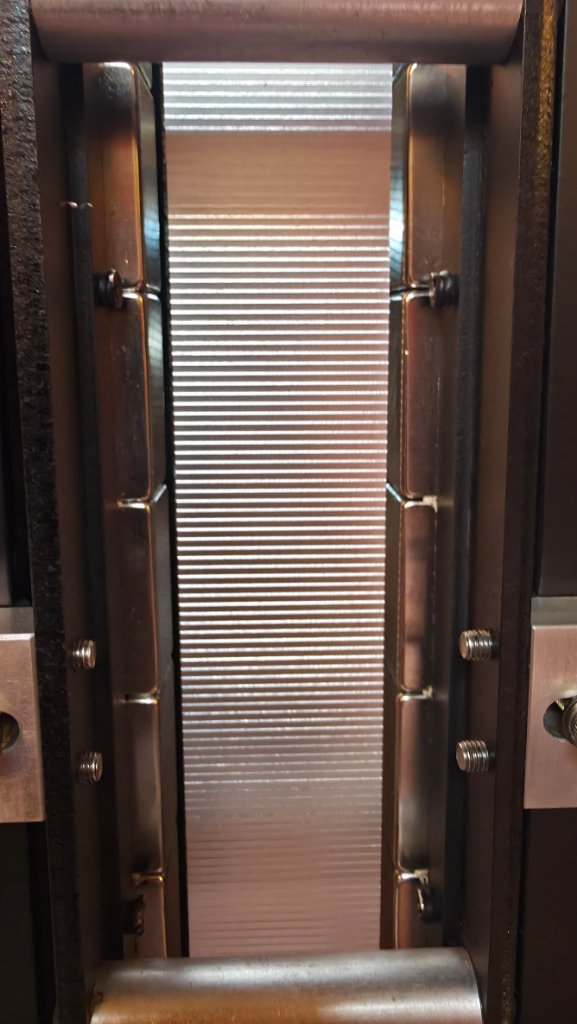
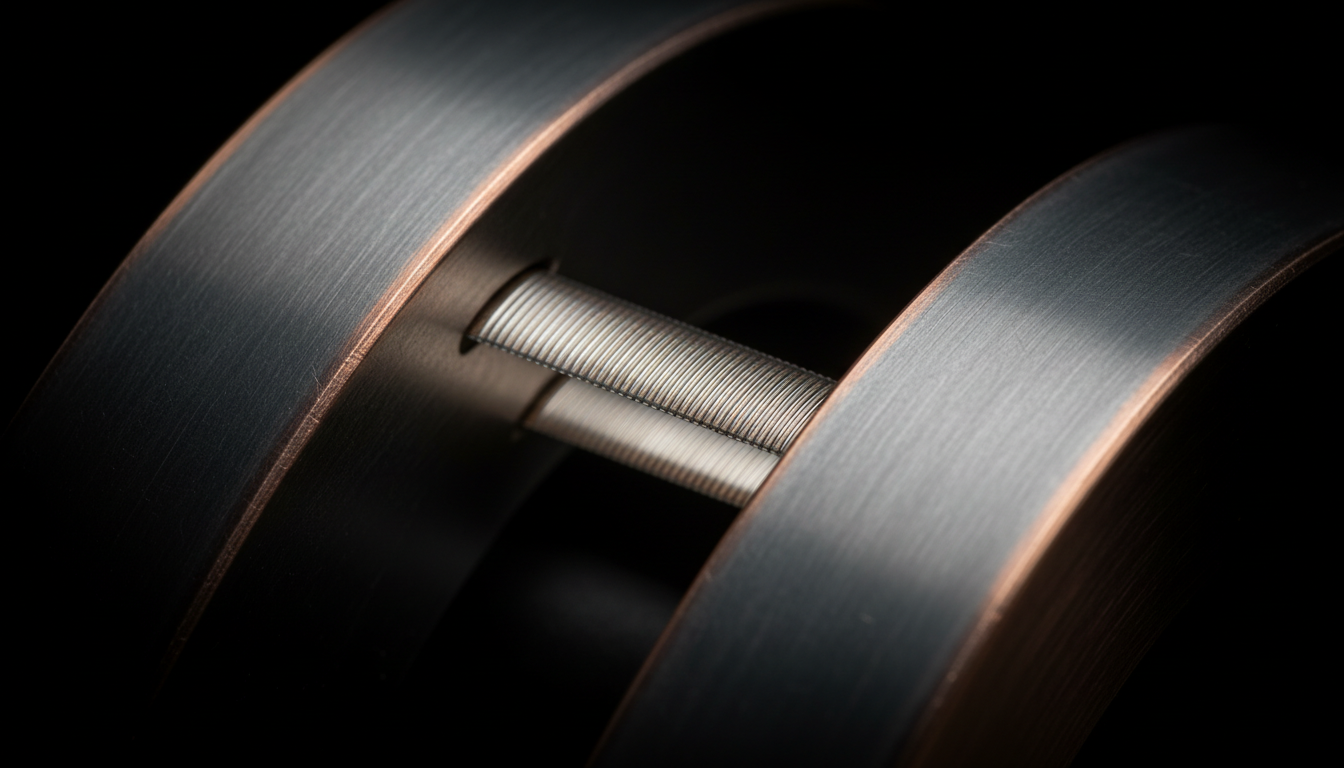
Unlike conventional cone and dome drivers that use a heavy voice coil to move a separate diaphragm, our ribbon drivers use an ultra-thin aluminum membrane that is itself the conductor. Suspended in a powerful magnetic field, this virtually massless element responds to the audio signal with near-zero inertia, producing sound waves with extraordinary speed and accuracy.
MAGNETIC ARCHITECTURE
Our proprietary N52 neodymium magnet array — the strongest grade of permanent neodymium magnet — generates an intensely uniform magnetic field across the entire ribbon surface. This promotes highly linear excursion at all frequencies and volume levels, dramatically reducing the distortion and compression that plague traditional transducers. All models achieve approximately 93 dB at 1 kHz with a 2.83 V AC input.
CROSSOVER ENGINEERING
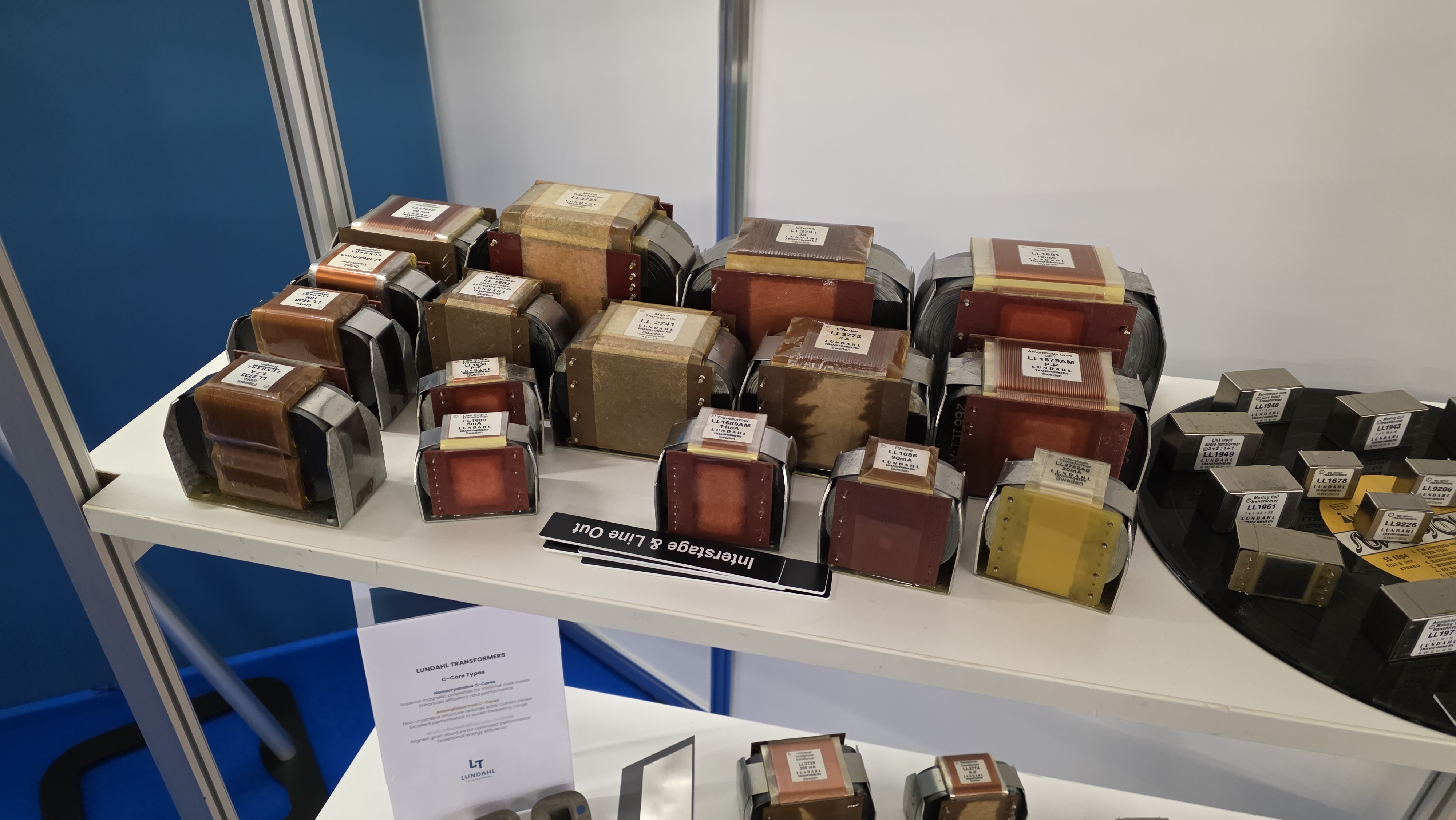
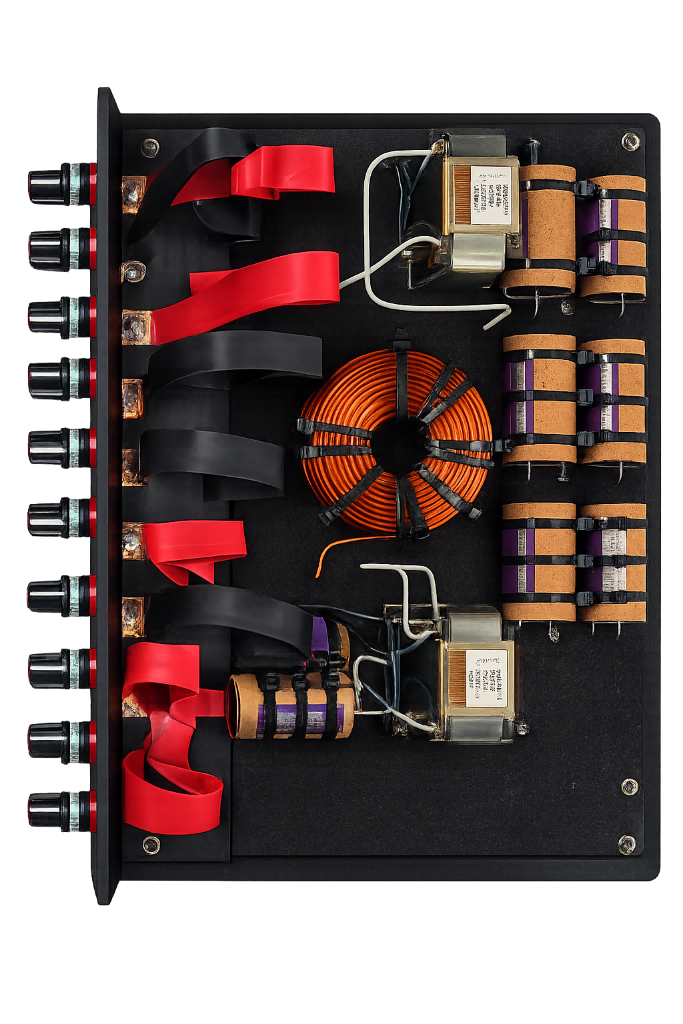
From Q1 2026, every crossover network is built exclusively with Duelund capacitors and inductors — there are no resistors anywhere in the signal path. All transformers are custom-wound by Lundahl in Sweden to our precise specifications. This zero-compromise approach minimises resistive losses and coloration, preserving the energy and integrity of the signal delivered to each ribbon driver.
CABINET DESIGN
The open-baffle architecture avoids the box colorations inherent in enclosed cabinets, allowing the ribbon to operate in free air. The supporting structure is engineered from aerospace-grade aluminum and damped composites, providing the rigidity necessary for micro-detail resolution with minimal resonant character of its own.
THE CASE FOR RIBBON
WHY RIBBON
IS SUPERIOR
Six fundamental physics advantages that give ribbon drivers a significant edge over cone designs — regardless of price or pedigree.
| DYNAMIC CONE | RIBBON (CLARISYS) | |
|---|---|---|
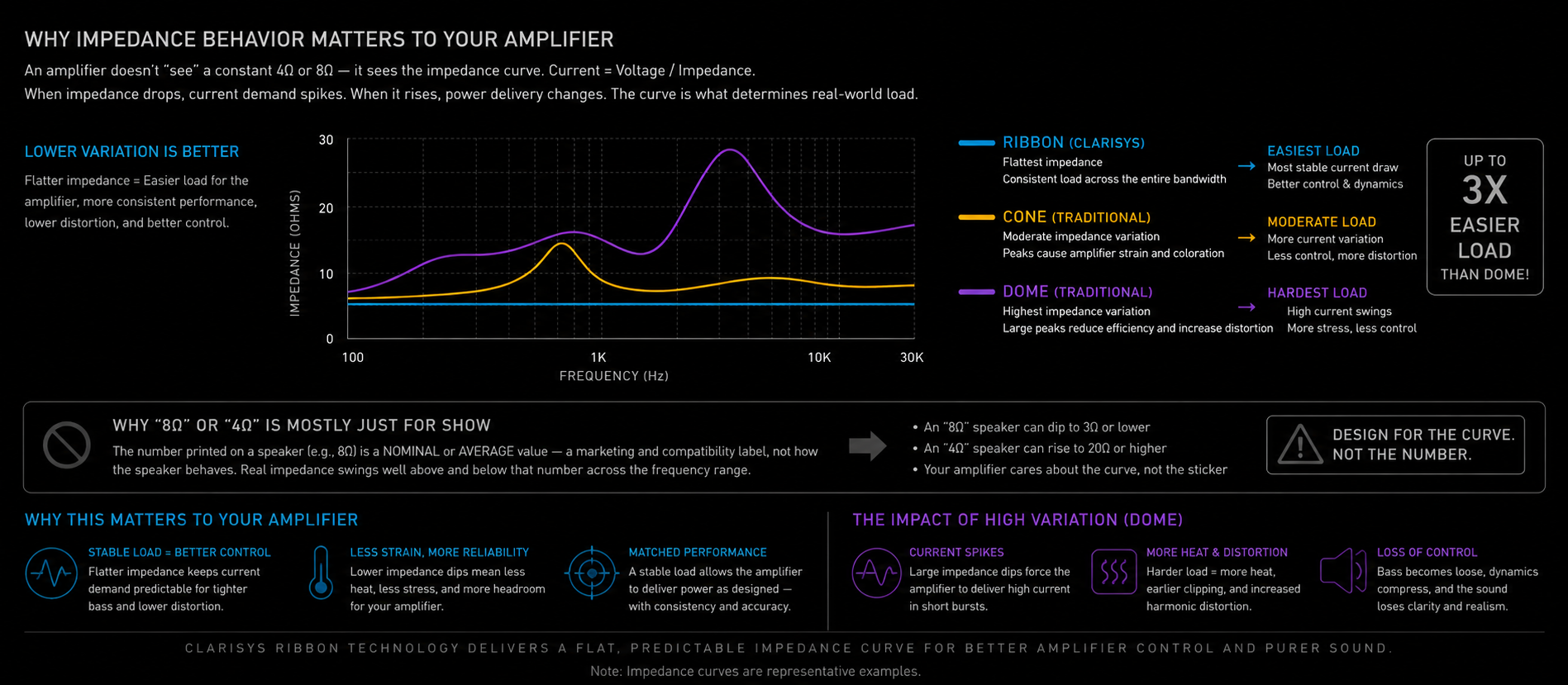
| IMPEDANCE | Varies 3Ω–30Ω+ across freq. | Flat & predictable across full band |
| MOTOR SYSTEM | Voice coil in radial gap — inductance rises with frequency | Ribbon in uniform magnetic field — no inductive rise |
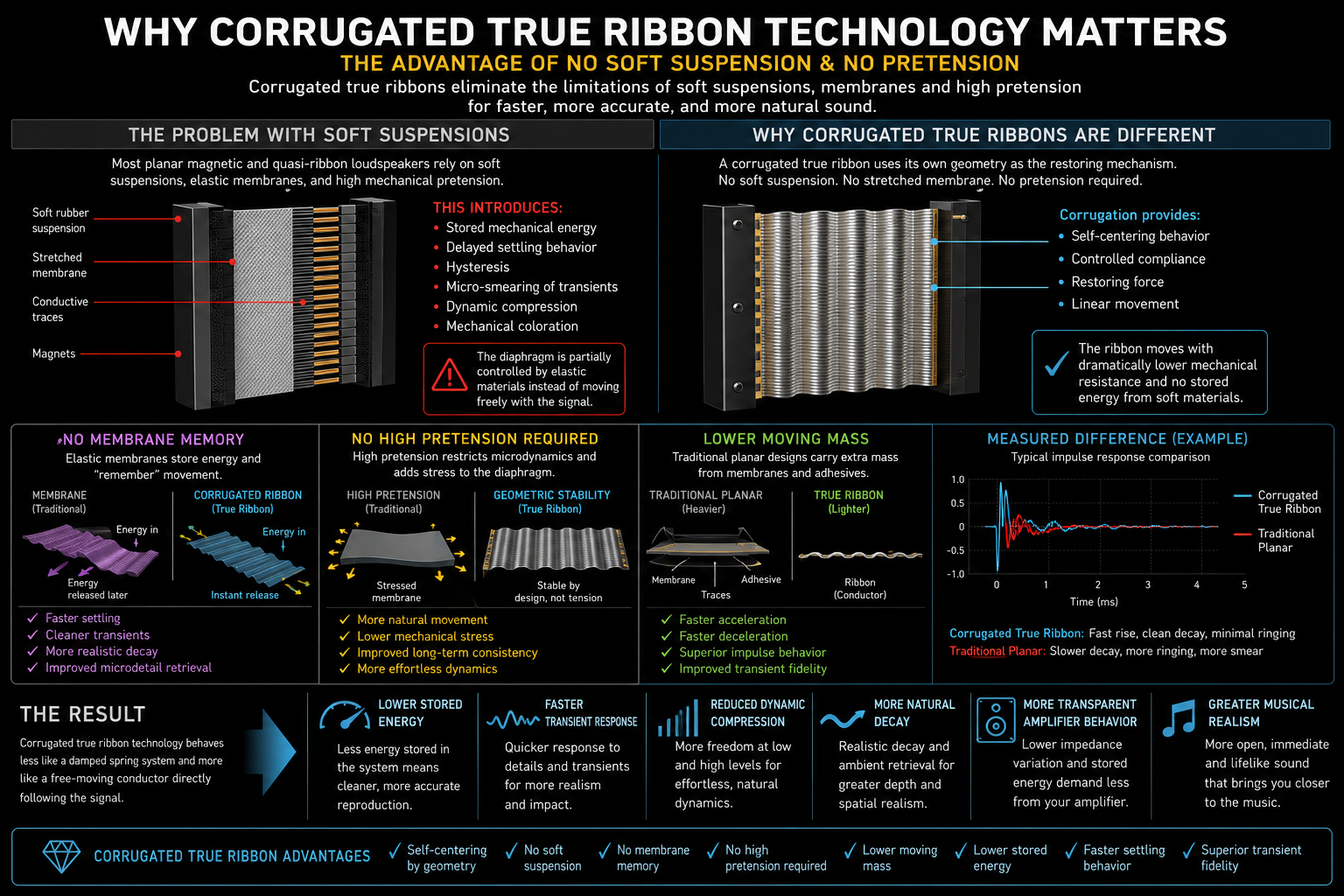
| RESTORATION FORCE | Mechanical: spider + surround — non-linear at excursion | Corrugated ribbon acts as its own spring — no surround, no spider |
| DIAPHRAGM MASS | Cone + coil + former ~5–30g typical (5,000–30,000mg) | Aluminium foil ~0.5–2mg typical (that's 0.002g) |
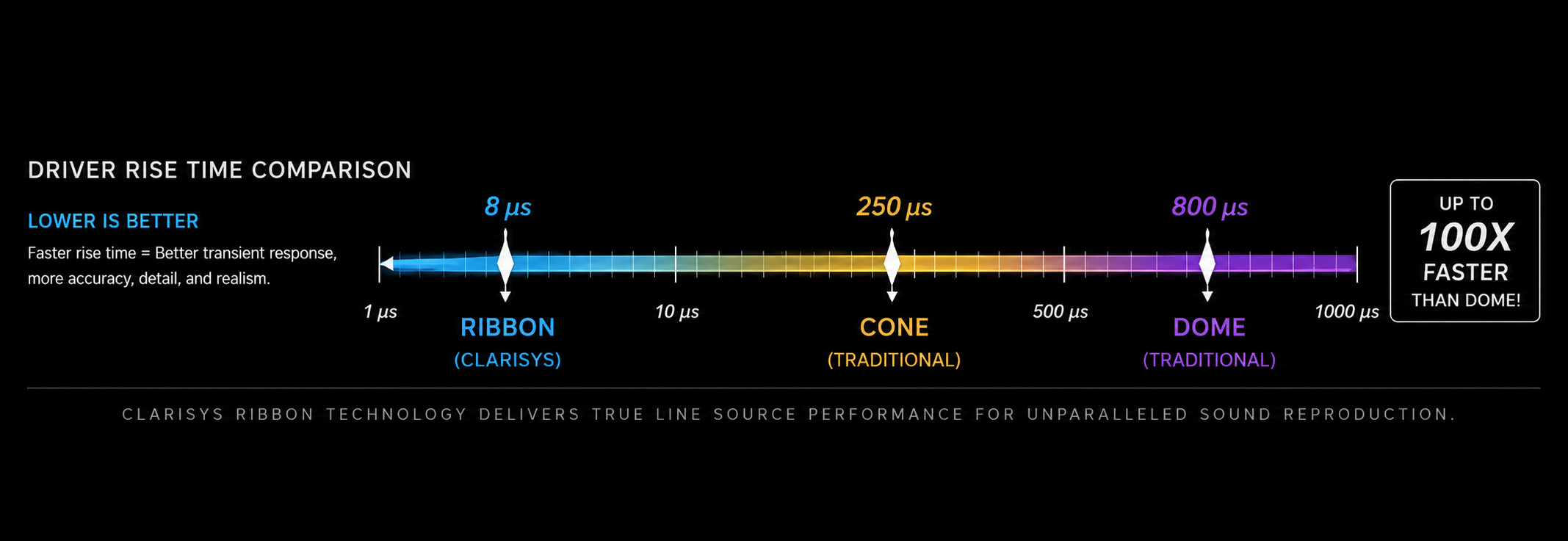
| RISE TIME | Limited by inertia — micro-transients smeared | 100–500× lower mass = near-instantaneous acceleration |
| AMPLIFIER STRESS | High — wildly varying load impedance | Low — stable, predictable load |
Flat Impedance
A dynamic voice coil is an inductor — impedance climbs steeply with frequency. Ribbon drivers carry no coil; the ribbon itself is the conductor, presenting a stable, near-resistive load to your amplifier across the entire audible band.
CLICK TO ENLARGE
Corrugated Restoration
Cone drivers depend on a spider and surround for mechanical restoration — both inherently non-linear under excursion. Clarisys ribbons are corrugated, so the ribbon itself acts as its own spring. With no spider or surround in the signal path, a major source of mechanical distortion found in cone drivers is removed entirely.
CLICK TO ENLARGE
Rise Time
Rise time is the speed at which a driver can go from silence to full output. F = ma. A Clarisys ribbon weighs ~1mg versus 5,000–30,000mg for a typical cone-and-coil assembly. For the same motor force, the ribbon accelerates up to 500× faster. The result: leading edges, micro-dynamics, and the ambient cues that define a real acoustic space are resolved with a precision no cone driver can match.
CLICK TO ENLARGE
INDUSTRY FIRST
MODULAR BASS
PANELS
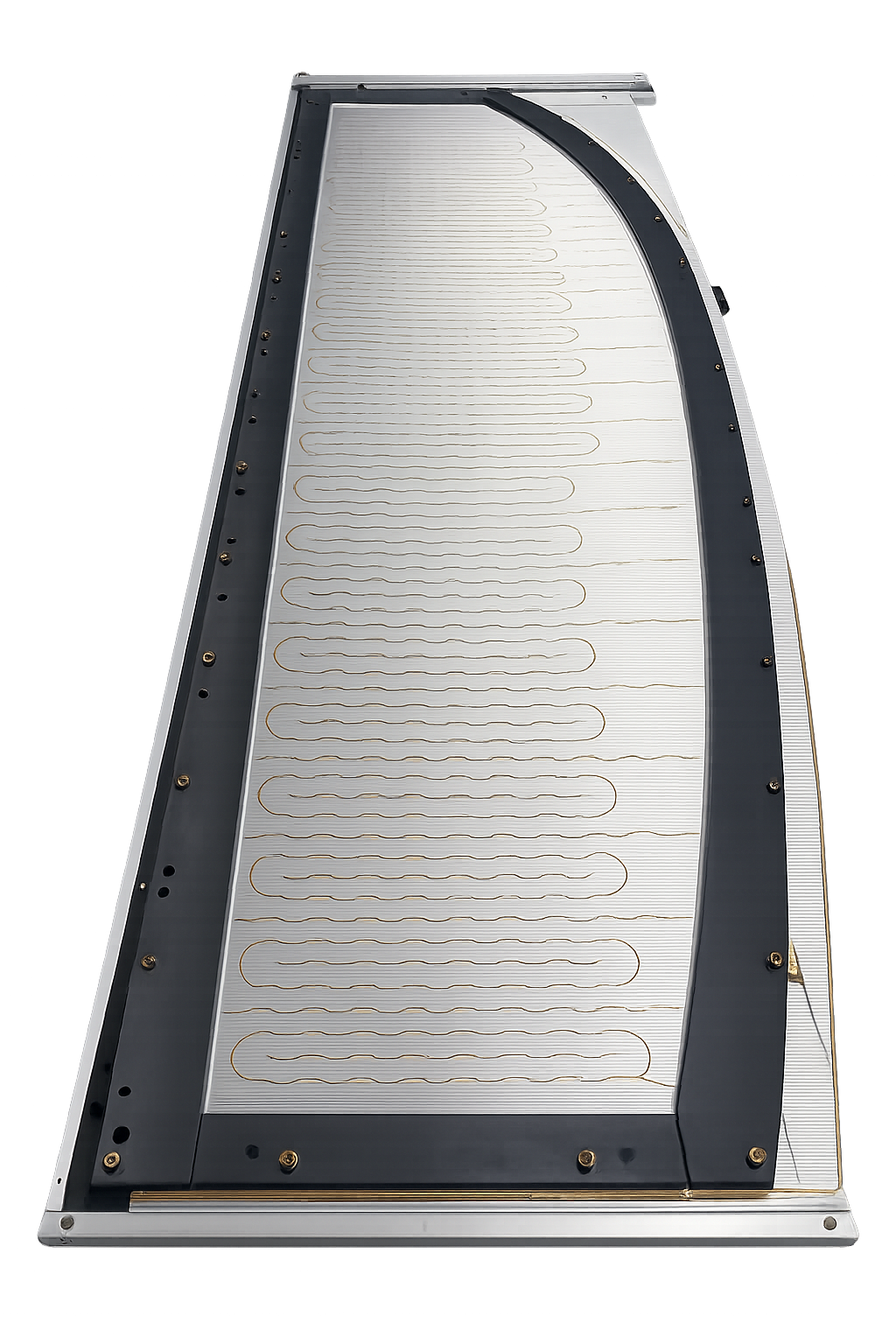
Clarisys Audio is the only loudspeaker manufacturer in the world to offer fully modular, user-replaceable bass panels across its entire range — from the Piccolo to the Atrium System.
In the event of damage, any bass panel can be swapped on-site by the installing dealer. No crating. No factory return. No downtime measured in weeks. The speaker is back playing the same day.
Each panel also features adjustable pretension — allowing the ribbon's mechanical tension to be dialled in by the dealer during installation or system setup. This is not a service procedure: it is a genuine acoustic tuning parameter, unique to Clarisys, that lets dealers optimise bass character and extension to the specific room and system.
HERITAGE
WHERE IT
ALL BEGAN
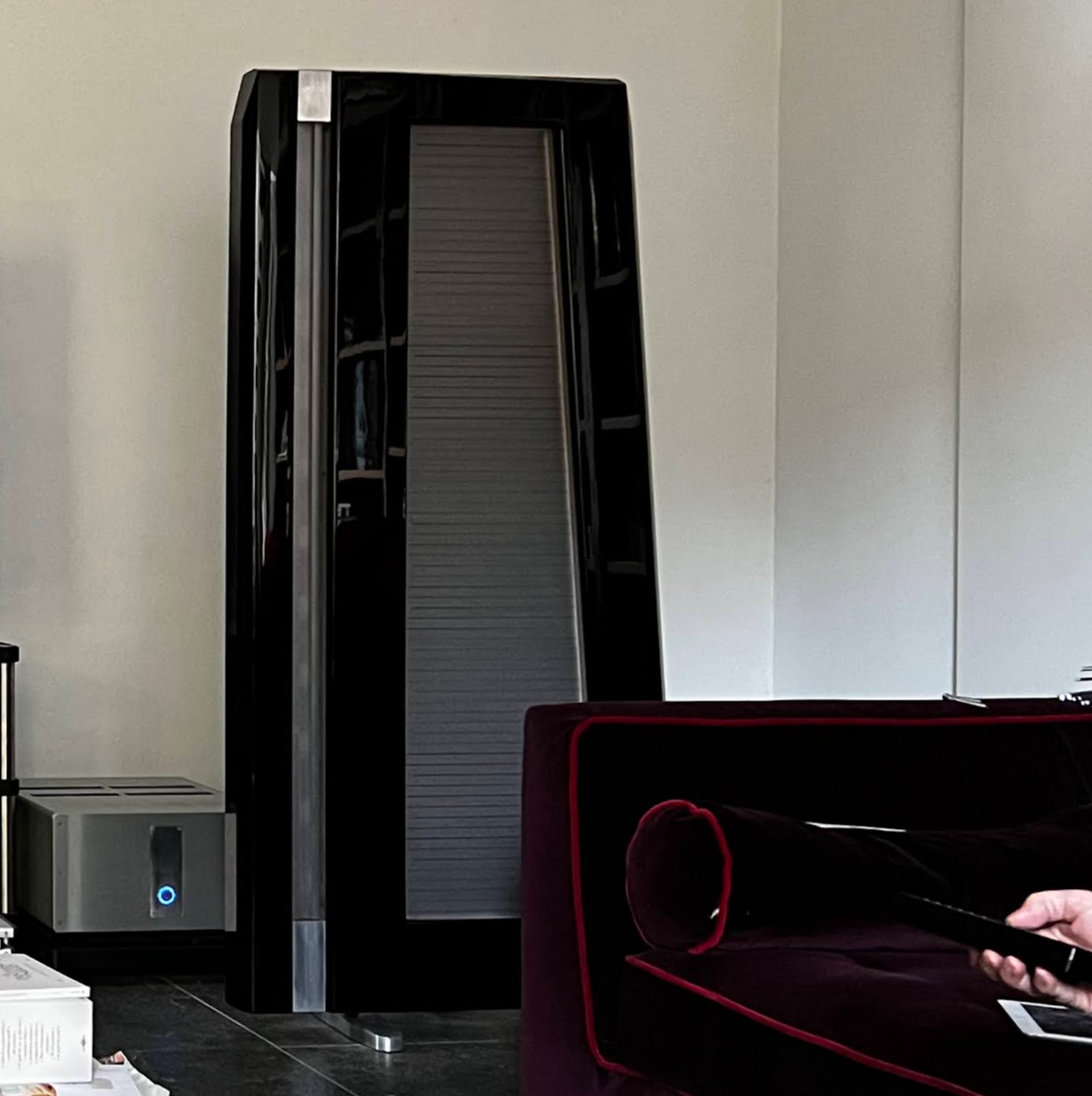
FIRST CUSTOMER INSTALLATION
This was the very first Clarisys speaker delivered to a customer — photographed at Olivier's home in Belgium. The model was called the Opera, a modern reimagining of the legendary Apogee Scintilla, rebuilt with contemporary materials and engineering.
A pure full-range ribbon design, the Opera carried the same founding principles that define every Clarisys speaker made today: zero-mass diaphragm, no crossover in the critical midrange, and a near-perfect dipole radiation pattern.
That first Opera still plays today — in a customer's home in Belgium. A testament to the durability and timeless relevance of ribbon technology done right.
IMPEDANCE vs FREQUENCY
MEASURED WITH CLIO POCKET