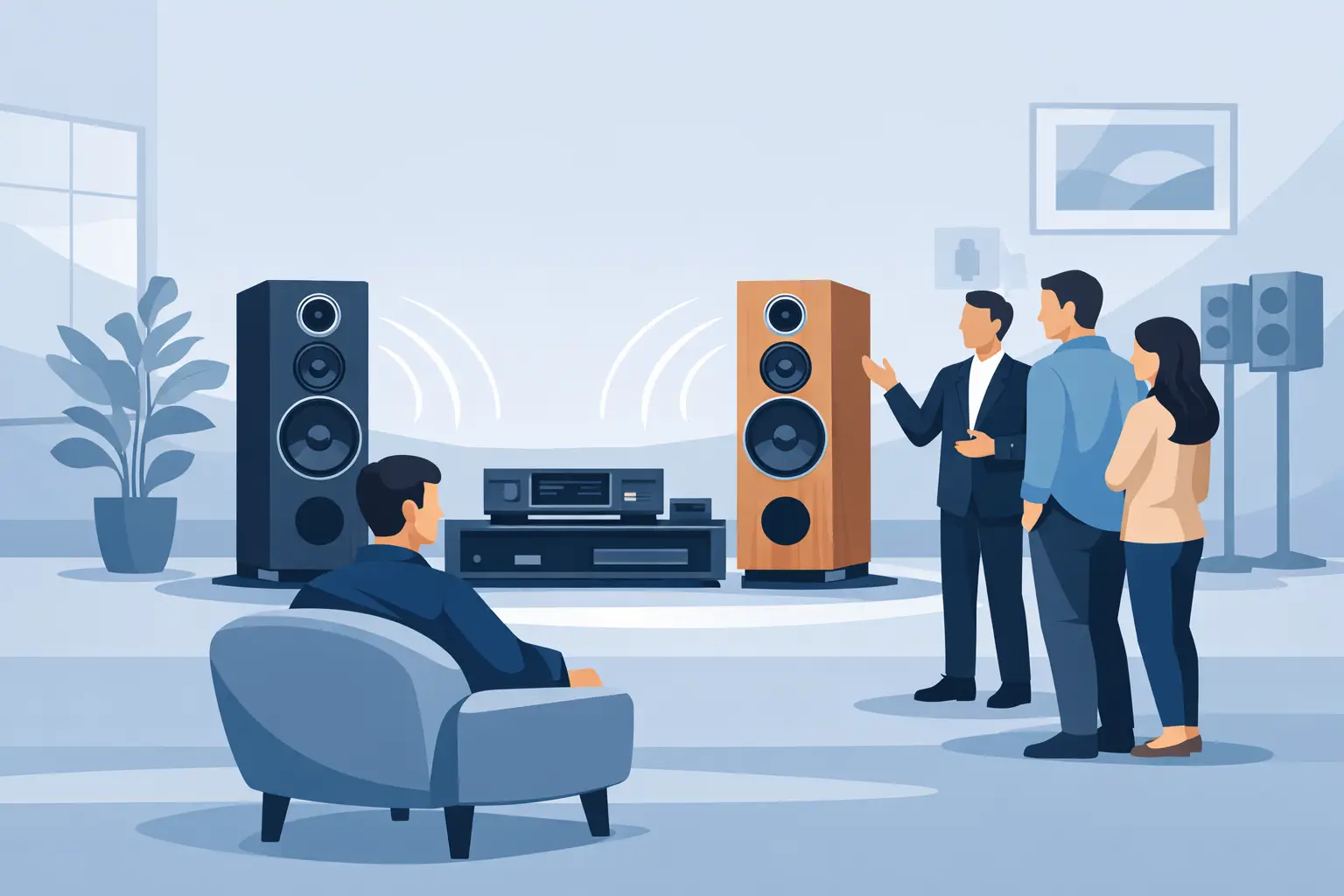
If you are asking where to audition high end speakers, you are already past the casual stage of buying audio. At this level, specifications narrow the field, but they do not make the decision. The room, upstream electronics, setup discipline, and your own listening priorities will change what you hear far more than most product pages suggest.
That is why the best audition is not simply the closest showroom with expensive gear on display. It is the location that lets you hear a speaker under controlled conditions, with competent setup, appropriate electronics, and enough time to move beyond first-impression effects. High-end loudspeakers reward careful listening. They also expose weak links instantly.
Where to audition high end speakers first
For most serious buyers, the right starting point is a specialist dealer rather than a general electronics retailer. A dedicated high-end dealer is more likely to have treated rooms, proper speaker placement, and staff who understand amplifier matching, source quality, room interaction, and voicing differences across brands. That matters whether you are considering dynamic, electrostatic, planar, or ribbon speaker designs.
A strong dealer audition gives you something online research cannot. You get context. You can hear how a speaker handles tonal density, transient speed, low-level resolution, image specificity, and dynamic scale in a real system. You can also ask better questions. Why was that amplifier selected? How far are the speakers from the front wall? Is that bass alignment natural in this room, or is room gain flattering it?
Manufacturer-supported listening locations can be equally valuable, especially when the brand works closely with certified partners and publishes a clear listening-location network. Those spaces often represent the intended setup philosophy more accurately than a random floor display. If a brand is serious about performance, it will care where and how the product is demonstrated.
Audio shows have a role, but they are rarely the final answer. They are efficient for exposure, not certainty. You can hear many products quickly, compare design philosophies, and identify what deserves a second audition later. But hotel rooms are compromises, setup time is limited, and crowd noise changes everything. A show can tell you what to investigate. It usually cannot tell you what to buy.
Private auditions in a client home or dedicated listening studio can be excellent, though availability varies. When offered through a qualified dealer or manufacturer network, this is often the most revealing path because it reduces the gap between the demo and your real ownership experience.
What makes a good speaker audition location
A useful room is not always a large room. It is a predictable room. You want to see that the system has been intentionally set up, not dropped into a sales floor. Speaker symmetry, seat location, acoustic treatment, and cable management all tell you whether the demonstration is serious.
Ask whether the setup can be adjusted. High-end loudspeakers are sensitive to placement, toe-in, and listening distance. If a dealer is unwilling to move a speaker even slightly, you may not be hearing what it can actually do. On the other hand, a room that has been over-tuned for one spectacular track can also mislead. You want repeatable performance across a range of music.
System matching is just as important as room quality. Some speakers need high current. Some need stable power into demanding impedance swings. Others reveal source noise or preamp character so clearly that the electronics become the story. If the associated equipment is poorly chosen, you are not evaluating the speaker. You are evaluating a mismatch.
This is especially relevant with highly resolving transducer technologies. Ribbon-based systems, for example, can deliver exceptional speed, texture, and openness, but they are honest enough to reveal mediocre ancillaries immediately. A proper audition space recognizes that and builds a system accordingly.
Dealers, showrooms, and listening studios
The best dealers behave more like system consultants than sales counters. They ask about your room dimensions, listening distance, amplifier power, musical priorities, and current reference points. If they move directly to price or prestige, the audition may be more theater than evaluation.
Listening studios can be even better if they are set up for long-form listening. A serious buyer needs more than a five-minute demo. Fatigue, tonal balance, bass integration, and treble behavior become clearer over time. A speaker that sounds dramatic at first can become tiring. Another that seems restrained may prove more natural and musically convincing over an hour.
Audio shows and events
Shows are efficient for comparison but poor for final judgment. Use them to identify signatures, not to rank winners. If a speaker holds tonal integrity, soundstage organization, and dynamic composure in a difficult show environment, that is useful information. Still, reserve judgment until you hear it in a proper room.
How to prepare before you audition
Arrive with a plan. Not a playlist designed to impress the room, but music that exposes differences in timing, tonal accuracy, texture, and scale. Bring familiar recordings with strong vocal content, real acoustic instruments, and at least one track with complex layering. Add one piece with low-frequency information you know well. If every demo track is spectacularly recorded, you learn less about real-world listening.
Volume discipline matters. Louder often sounds better for a few minutes because it exaggerates bass, detail, and excitement. Ask to level-match comparisons as closely as possible. If one speaker is playing even slightly louder, the result can be misleading.
It also helps to define what you value before you walk in. Some listeners prioritize image precision and low-level detail. Others care more about macro-dynamics, tonal saturation, or bass authority. There is no universal best speaker, only better alignment between the design and your priorities.
What to listen for during the audition
Start with tonal balance. Does the speaker sound coherent from bass through treble, or does one region call attention to itself? A premium loudspeaker should not make you mentally isolate drivers or frequency bands. It should present a unified event.
Then assess imaging and spatial information. Good imaging is not just a wide stage. It is stable localization, dimensional layering, and believable scale. If the center image collapses when you shift slightly, room setup may be the issue, but it is still worth noting.
Pay close attention to transient behavior. On percussion, piano, plucked strings, and brass attacks, does the speaker start and stop cleanly? Is there speed without etch? Is there detail without glare? Many high-end systems can sound impressive on first impact. Fewer can preserve harmonic body while remaining agile.
Bass deserves more skepticism than excitement. Deep bass in a showroom can be room gain, not extension. Tight bass can be undernourished bass. Listen for pitch definition, integration, and decay. Ask yourself whether the low frequencies support the music naturally or dominate it.
Finally, listen for involvement over time. The best systems invite longer sessions. They do not merely spotlight detail. They organize information in a way that feels musically complete.
Where to audition high end speakers if your room is the priority
If your room is unusual, your best audition may be one that leads to an in-home trial or at least a highly customized dealer consultation. Open floor plans, heavy glass, asymmetrical walls, and nearfield seating all change the result. A speaker that excels in a large treated room may overload a smaller domestic space. Another may come alive precisely because your room supports it.
This is why serious dealers ask for floor plans, photos, and current component lists. They are not being procedural. They are trying to reduce the risk of a false audition result. A speaker purchase at this level should reflect the system and room as much as the product itself.
If the brand offers a certified listening-location network, technical resources, manuals, setup guidance, and a knowledgeable dealer channel, use all of it. Clarisys Audio, for example, positions the listening experience as part of a broader ownership ecosystem rather than a single showroom event. That is the right approach for products that demand careful setup and informed system matching.
Questions worth asking before you leave
Ask whether you heard the speaker in its optimal configuration. Ask what amplifier range the dealer considers realistic. Ask how much the room is helping or hurting bass performance. Ask whether home setup support is available. These are not minor details. They shape the result as much as the transducer itself.
You should also ask to hear one step above and one step below your target model if possible. That comparison often reveals whether the model you want is the right value in the range or simply the one you arrived expecting to buy.
The best place to audition is not the room with the most expensive equipment. It is the room that tells the truth clearly enough for you to hear what will still matter after the novelty fades.