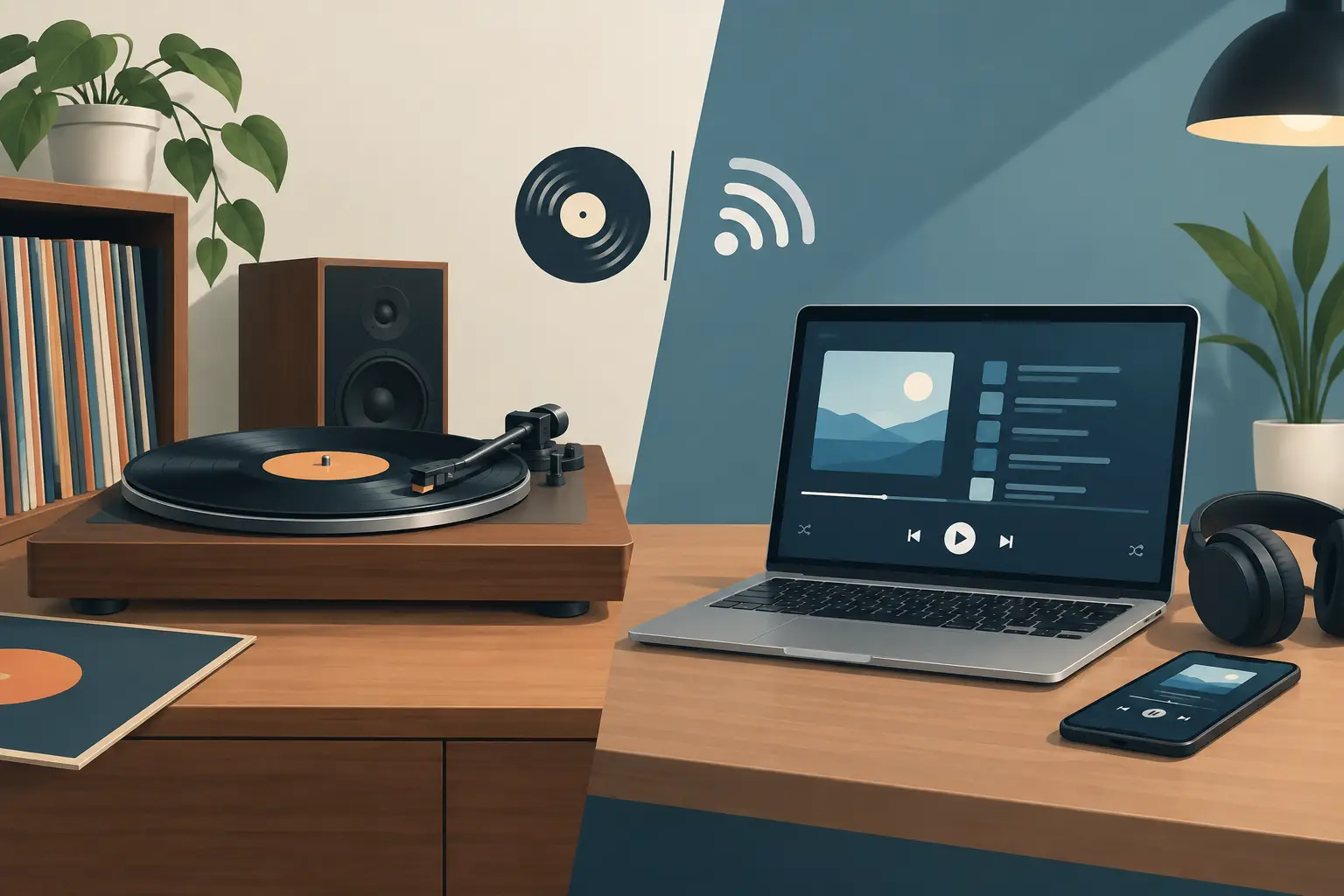
The vinyl vs streaming playback question is often reduced to a simple verdict: analog is warm, digital is precise. Serious listening is less convenient than that. What reaches the listener is the result of recording and mastering decisions, source hardware, gain structure, loudspeaker behavior, room acoustics, and attention. Either format can provide an exceptional musical experience. Either can also expose a weak link without mercy.
For a high-resolution system, the useful question is not which format wins in the abstract. It is which version of a recording, played through which chain, delivers the most convincing performance in your listening room.
Vinyl vs Streaming Playback Begins With the Master
The master matters more than the delivery format. A carefully cut LP from a dynamic, thoughtfully equalized master can be more involving than a compressed or aggressively limited streaming release. The reverse is equally true: a lossless stream from a superior modern master can exceed a vinyl edition created from a compromised source or pressed without adequate quality control.
This is why direct format comparisons can mislead. The same album may have different masters across original LP pressings, reissues, deluxe editions, downloads, and streaming catalogs. Equalization, compression, limiting, stereo balance, and even track spacing may differ. If one source sounds more open, weighty, or relaxed, the difference may begin in the mastering room rather than at the stylus or DAC.
When comparing formats, seek matching releases where possible. Level-match them carefully. A source that plays slightly louder will often appear more detailed and exciting, even when it is not more accurate. For critical evaluation, a difference of less than one decibel can influence the result.
What Vinyl Does Exceptionally Well
Vinyl is a mechanical medium, and its limitations are part of its character. A stylus traces a physical groove whose modulations represent the musical signal. The chain includes turntable speed stability, tonearm geometry, cartridge alignment, phono stage loading, and the RIAA equalization curve. Each decision affects the presentation.
At its best, vinyl can produce an unusually coherent sense of body, scale, and continuous musical flow. Many listeners value the way strong pressings render instrumental texture and spatial depth, particularly through a system with low noise and wide dynamic capability. The appeal is not simply added warmth. It can be a persuasive combination of mastering choices, harmonic behavior, and a carefully optimized analog chain.
Vinyl also encourages deliberate listening. Selecting a record, cleaning it, lowering the cue lever, and listening through an entire side creates a different relationship with an album. That ritual does not alter the frequency response, but it can alter attention. Attention is not a minor variable in music reproduction.
The costs are real. Surface noise, off-center pressings, groove wear, inner-groove distortion, channel crosstalk, and speed variation are inherent risks. Record care and setup are not optional at a high level. A misaligned cartridge or poorly matched phono stage can make a fine record sound congested, edgy, or unstable. Vinyl rewards precision, but it demands it too.
The Turntable Is a System, Not a Single Component
A premium turntable alone does not guarantee premium playback. Cartridge compliance must suit tonearm effective mass. Vertical tracking angle, azimuth, tracking force, and anti-skate require disciplined adjustment. The phono preamplifier must provide appropriate gain and loading while preserving low-level information without noise or overload.
A revealing loudspeaker will make these relationships clear. Ribbon speaker technology, with its fast transient response and low moving mass, can reveal both the atmosphere of a well-cut record and the grain of mistracking or a noisy groove. That is not a reason to avoid resolution. It is a reason to build the analog front end as carefully as the rest of the system.
Where Streaming Has the Technical Advantage
Streaming offers extraordinary access without the mechanical constraints of record playback. With a lossless service, a competent network player, and a well-engineered digital-to-analog converter, playback can be quiet, stable, and highly transparent. There is no stylus wear, no inner groove, no pressing defect, and no need to change sides every 18 to 25 minutes.
A standard lossless CD-quality stream can reproduce frequencies and dynamic range beyond what many recording and playback chains preserve in practice. High-resolution files may offer benefits when the original production supports them, but their value should not be assumed from the sample-rate label. The quality of the master remains decisive.
Streaming also makes musical exploration vastly easier. A listener can compare releases, discover unfamiliar performers, build reference playlists, and access music that may be unavailable or prohibitively expensive on vinyl. For collectors with broad interests, this is not a trivial convenience. It is a route to a deeper and more varied listening life.
Digital playback has its own variables. Network stability, software settings, digital volume control, DAC implementation, and downstream analog circuitry all influence results. Still, many supposed digital problems are now avoidable with properly configured equipment. A bit-perfect lossless signal into a capable DAC is an exceptionally strong baseline for high-fidelity playback.
The Listening Room Decides More Than Most Debates Admit
Neither vinyl nor streaming can compensate for poor loudspeaker placement or a room with severe bass peaks, early reflections, and uncontrolled reverberation. A room mode can alter low-frequency balance more dramatically than the difference between two editions of the same album. A reflective sidewall can blur imaging long before a source component reaches its performance limit.
Start with loudspeaker placement, symmetry, listening position, and basic acoustic control. Then assess source components at matched levels. This order is not glamorous, but it is effective. The superior source cannot show its full capability if the room masks tonal balance and spatial information.
Amplification deserves the same attention. Speakers with demanding impedance behavior or exceptional transient speed require an amplifier that remains composed under load. If the system loses grip during orchestral crescendos or electric bass transients, the discussion about analog versus digital becomes secondary. Control, noise floor, and dynamic headroom shape both experiences.
The Case for Owning Both
For many serious listeners, vinyl and streaming are complementary rather than competitive. Vinyl may be the preferred route for treasured albums, first pressings, and reissues selected for mastering quality. Streaming may be the practical reference source for discovery, casual sessions, and access to a vast library of lossless music.
The key is to avoid treating one format as a badge of seriousness. A record collection does not make a system refined, and a network player does not make it impersonal. What matters is whether the system preserves musical timing, tonal color, dynamic contrast, image stability, and the emotional scale of a performance.
There are also practical ownership considerations. Vinyl requires storage, cleaning, setup knowledge, and a realistic budget for pressings and cartridge replacement. Streaming requires an ongoing subscription, dependable network infrastructure, and acceptance that catalogs and versions can change. Neither path is free of compromise.
How to Make a Fair Comparison at Home
Choose music you know deeply, preferably recordings with acoustic instruments, natural vocals, substantial dynamic range, and dense passages that test separation. Compare the same mastering when possible, and avoid switching after only a few seconds. Give each source enough time for its strengths and weaknesses to become apparent.
Listen for more than treble extension or bass weight. Does the vocal maintain a stable position as the arrangement builds? Are cymbals distinct from room ambience, or do they merge into a bright wash? Does a piano retain harmonic complexity at low levels? Does the system remain relaxed when the music becomes dense? These are more useful observations than a quick judgment of warm versus detailed.
Do not be surprised if the preference changes by album. A favorite 1970s pressing may offer the most satisfying version of one record, while a modern lossless release reveals more of another. That is not inconsistency. It is evidence that recordings, masters, and playback chains are individual.
The best source is the one that makes you return to the music with greater curiosity and concentration. Build the system carefully enough that both formats can show what they do well, then let the recording decide which seat it deserves in your listening room.