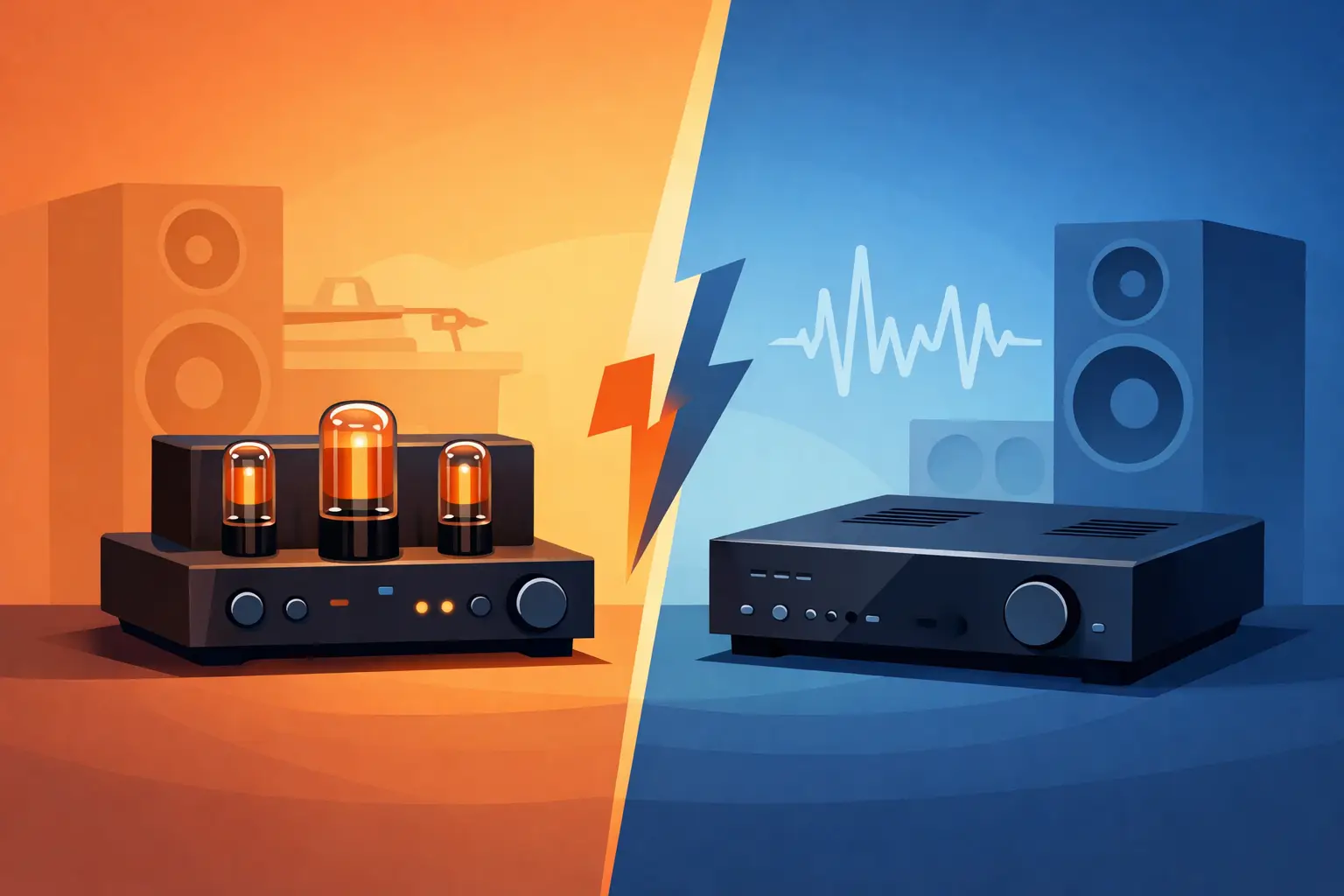
A fine amplifier does not simply make a loudspeaker louder. It establishes the electrical conditions under which the speaker’s crossover, drivers, and enclosure can do their work. That is why tube amps vs solid state remains a serious system-building question, particularly with revealing loudspeakers. The meaningful difference is not whether one technology is romantic and the other is analytical. It is how each design handles voltage, current, impedance, distortion, and dynamic demand - and how those behaviors translate through a real listening room.
For a high-end system, the correct choice begins with the loudspeaker. Its sensitivity, impedance curve, phase angle, driver behavior, and crossover architecture are more consequential than amplifier mythology. A superb tube amplifier can be transformative with an appropriate load. A superb solid-state amplifier can deliver remarkable control and transparency where current delivery is essential. Neither category deserves a blanket verdict.
Tube Amps vs Solid State: The Electrical Difference
Vacuum tubes and transistors amplify signals differently, and the circuit choices surrounding them matter as much as the active device itself. A tube amplifier commonly uses output transformers to match the high-voltage, low-current behavior of its output tubes to the low-impedance demands of a loudspeaker. Transformer quality, winding design, core material, and bandwidth are therefore central to the final result.
Most solid-state amplifiers use transistors that can deliver substantial current directly into low-impedance loads. Their output impedance is often lower than that of tube designs, producing a higher damping factor. In practical terms, this gives many solid-state amplifiers a firmer electrical grip on a woofer, especially when the speaker impedance drops or becomes electrically reactive.
These are tendencies, not guarantees. A poorly executed high-power transistor amplifier may sound constrained or grainy, while a carefully designed tube amplifier with excellent transformers can sound exceptionally extended, stable, and dynamic. Likewise, there are solid-state designs voiced for tonal density and tube amplifiers built for speed and neutrality. Topology, power supply design, bias arrangement, feedback strategy, and component selection all shape the result.
What Listeners Often Hear
The usual shorthand is familiar: tubes are described as dimensional, harmonically rich, and natural; solid state as controlled, quiet, and authoritative. Those descriptions can be useful, but they become misleading when treated as fixed rules.
Tube amplifiers often generate distortion spectra that are dominated by lower-order harmonics as they approach their limits. Some listeners find this behavior graceful, particularly with voices, strings, brass, and small acoustic ensembles. A well-matched tube amplifier can create a sense of tonal continuity and spatial ease that makes recorded instruments feel less mechanical and more physically present.
Solid-state amplifiers commonly offer lower measured distortion, lower noise, wider channel separation, and greater power reserves for a given size and cost. With demanding orchestral material, electronic music, large-scale rock, or recordings with powerful low-frequency information, those reserves can preserve transient contrast and bass definition at realistic listening levels. The amplifier does not sound impressive because it is loud. It sounds composed because it is not nearing distress.
The distinction becomes especially apparent during complex passages. When a system is asked to reproduce a full orchestra at scale, a dense jazz ensemble, or a kick drum beneath sustained electric bass, insufficient current delivery can soften leading edges and blur pitch definition. Conversely, an amplifier with ample control but an unsuitable tonal balance can make a highly resolving system feel overly explicit or fatiguing. Resolution without coherence is not fidelity.
Harmonic Character Is Only Part of the Story
The appeal of a tube amplifier is sometimes reduced to euphonic coloration. That misses the point of serious tube design. The best examples are not valuable because they obscure recordings. They are valued because they can preserve microdynamic shading, harmonic decay, and image density in a convincing way.
Similarly, solid state should not be equated with sterile sound. A high-quality transistor amplifier can reveal the body of a cello, the complex texture of a piano’s lower register, and the pressurized impact of a bass drum without flattening the space around them. When properly implemented, its neutrality can be deeply musical rather than merely clinical.
Speaker Matching Matters More Than the Label
Before selecting an amplifier, study the loudspeaker’s actual electrical behavior rather than its nominal impedance alone. An 8-ohm rating does not reveal whether the impedance falls significantly in the bass, whether the phase angle becomes difficult, or whether the crossover presents a demanding load at critical frequencies.
Sensitivity also deserves careful interpretation. A speaker rated at 90 dB may appear easy to drive, but its real-world demand depends on impedance, room size, listening distance, and preferred volume. Every 3 dB increase in output requires roughly twice the amplifier power. Large rooms and wide dynamic swings quickly expose the difference between an amplifier that is adequate and one that remains effortless.
Ribbon speaker technology adds another dimension to this discussion. A ribbon’s low moving mass can reveal transient texture, ambient information, and changes in amplifier character with unusual clarity. That does not automatically dictate tubes or solid state. It does mean that amplifier noise, stability, current capability, and tonal balance should be evaluated with care. A system built around a highly resolving ribbon loudspeaker benefits from an amplifier that is quiet, controlled, and musically complete.
For speakers with significant low-frequency demand, a powerful solid-state amplifier often provides a logical foundation. For efficient loudspeakers with a benign impedance curve, a lower-powered tube amplifier may offer a compelling and highly satisfying partnership. Some advanced systems combine both approaches through bi-amplification, using solid-state control where bass current is most needed and tubes for the frequencies where their particular strengths are desired. This requires thoughtful crossover integration and gain matching, not casual experimentation.
Power Ratings Are Not the Whole Answer
Comparing a 40-watt tube amplifier to a 40-watt solid-state amplifier by specification alone is rarely useful. Their overload behavior, power supply reserves, transformer limitations, and clipping characteristics differ. A tube amplifier may remain subjectively enjoyable as it approaches its limits, while a solid-state amplifier operating beyond its safe range can sound abruptly hard or compressed. Neither amplifier should be chosen with the intention of clipping, but the contrast affects how listeners perceive available headroom.
Current capability is particularly relevant with low-impedance speakers. Many solid-state amplifiers increase output substantially as impedance halves, indicating a power supply and output stage capable of delivering more current. This is not a universal requirement, but it is a valuable indicator when a speaker’s impedance drops below its nominal rating.
The most useful audition is not a brief comparison at low volume. Listen to familiar recordings at the levels you actually use. Include a sparsely recorded vocal, piano with natural decay, rhythm section material, and a large dynamic recording. Pay attention to bass pitch, center-image solidity, the stability of the soundstage when the arrangement becomes dense, and whether the system remains relaxed as volume rises.
Ownership, Maintenance, and System Priorities
Tube ownership asks more of the listener. Output tubes age, require eventual replacement, generate heat, and may need bias adjustment depending on the design. Tube selection can also influence sound, which appeals to enthusiasts who value careful system tuning but may be unwelcome to those seeking a fixed reference. A well-designed tube amplifier can be reliable for many years, yet it should be placed with proper ventilation and operated with the attention its heat output deserves.
Solid-state amplifiers are generally lower maintenance, cooler in many designs, and better suited to installations where high output and day-to-day consistency are priorities. They are often the practical choice for difficult loudspeaker loads, very large rooms, and listeners who want a system ready at any hour without concern for tube life.
There is also a matter of system architecture. A low-noise solid-state amplifier may be preferable in a nearfield or high-sensitivity setup where residual hiss is readily audible. A tube amplifier may be the more persuasive choice in a dedicated room built around efficient speakers and long, unhurried listening sessions. The better option depends on the complete chain: source component, preamplifier, cables, speaker placement, room acoustics, and listening habits.
Choose the Amplifier That Preserves the Music
Tube amps vs solid state is best treated as a matching exercise, not a contest between eras. Begin with a loudspeaker’s true demands, then consider the room, desired playback level, and the musical qualities that matter most to you. Specifications can narrow the field, but they cannot replace informed listening.
The right amplifier should make you less aware of amplifier technology, not more. When the partnership is correct, the bass has shape, images hold their place, dynamics arrive without strain, and the emotional logic of a performance remains intact long after the equipment itself has left your attention.