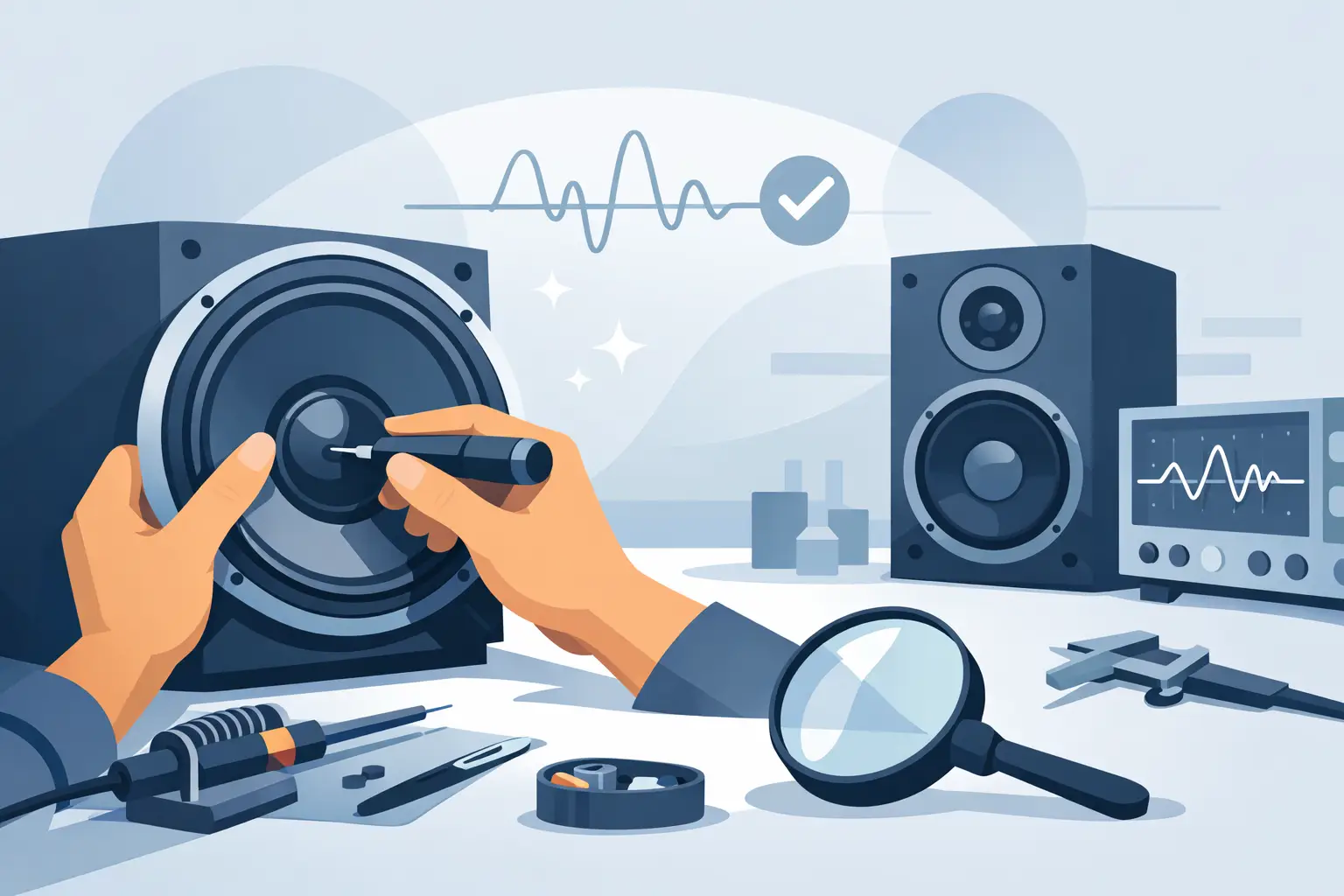
A loudspeaker rarely fails without leaving clues. A faint buzz at a particular piano note, a collapsed image, reduced output from one channel, or a metallic scrape during low-frequency passages can all point to a problem. For serious systems, speaker repair is not simply a matter of restoring sound. It is the work of preserving the timing, dispersion, tonal balance, and dynamic integrity that made the speaker worth owning.
The correct response depends on the fault, the design, and the speaker’s value. A loose grille or oxidized connection may be a straightforward correction. A damaged ribbon element, crossover failure, or compromised cabinet structure calls for a more disciplined assessment. The goal is not to make a loudspeaker merely operational. It is to return it to intended performance without introducing a new limitation.
Start With Diagnosis, Not Disassembly
The most expensive repair mistakes begin with an assumption. A distorted treble range may appear to be a failed driver, while the actual cause is a damaged amplifier channel, a loose jumper, an aging capacitor, or a connection that has oxidized over time. Before opening a cabinet or ordering parts, isolate the fault.
Begin by swapping left and right channels at the amplifier output. If the problem follows the speaker, the loudspeaker or its cable is implicated. If it remains in the same channel, investigate the source, preamplifier, power amplifier, or associated wiring. Then inspect speaker cables, binding posts, jumpers, and terminals for loose hardware, frayed conductors, or corrosion.
Use familiar recordings with stable, well-recorded vocal and acoustic content. They reveal changes in image focus and tonal continuity more reliably than heavily compressed material. A slow sine-wave sweep played at restrained volume can help identify buzzing, rattling, or a frequency-specific breakup, but it should never be used aggressively. A compromised driver can be damaged further by high-level test tones.
If a fault is present only at higher playback levels, consider the entire system. Amplifier clipping can sound remarkably similar to a distressed tweeter or ribbon, yet its cause is insufficient amplifier headroom, an unstable load, or an attempt to fill a room beyond the system’s practical limits.
What Speaker Repair Can Actually Address
Conventional dynamic loudspeakers often develop predictable age-related problems. Foam surrounds can deteriorate, adhesives can fail, voice coils can rub after physical impact, and crossover components can drift from their original values. Cabinets may develop air leaks or resonances when fasteners loosen, internal damping shifts, or a seam separates.
These issues are frequently repairable, but the quality of the work matters. Re-foaming a woofer with the wrong surround profile can alter compliance and change bass alignment. A replacement capacitor chosen only for matching capacitance may have unsuitable resistance, voltage behavior, or physical characteristics for the circuit. Replacing a driver with a unit that fits the cutout but differs in sensitivity or impedance can disturb crossover integration.
Ribbon loudspeakers require even more care. Their radiating elements are exceptionally light and capable of revealing minute changes in upstream electronics, placement, and component condition. That same precision means a ribbon assembly is not an appropriate candidate for casual handling, improvised materials, or generalized repair methods.
A ribbon can be vulnerable to excessive power, clipped amplifier signals, contamination, physical contact, and damage caused during shipping or improper service. The element’s tension, conductor geometry, magnetic-gap relationship, and protective structure all contribute to its behavior. A repair that restores output but changes these relationships may leave the listener with altered treble extension, reduced transient speed, or an imbalance between channels.
When a Professional Assessment Is the Better Choice
There is a reasonable place for owner-level maintenance. Tightening accessible hardware to the manufacturer’s specification, cleaning external contacts with appropriate materials, replacing a known-good fuse with the exact specified type, or securing a loose grille frame can be sensible. Anything that involves driver removal, ribbon elements, crossover networks, cabinet sealing, or internal wiring deserves a qualified technician or manufacturer-directed service path.
This is particularly true for premium loudspeakers, where replacement parts may be matched, revised by production generation, or unavailable outside authorized channels. A technician who understands the original design can verify more than whether sound is produced. They can assess channel matching, polarity, crossover behavior, fastener torque, enclosure integrity, and evidence of the failure that caused the symptom.
Professional evaluation is also prudent after a serious amplifier event. If a protection circuit failed, an amplifier oscillated, or a component was operated into clipping, the visible fault may not be the only fault. A driver can survive an incident while a crossover resistor, fuse holder, or connection has been stressed. Treating only the obvious symptom can leave a latent issue in the system.
For owners of ribbon loudspeakers, factory-level service has an additional advantage: it protects the original acoustic intent. The speaker is a system, not a collection of independent parts. A properly executed repair respects that system-level relationship.
Repair, Restore, or Replace?
The decision is not always financial, although cost matters. A simple repair may be clearly justified when the loudspeaker remains current, parts are available, and the work can return it to specification. Restoration becomes more compelling when the speaker has historical or personal value, a distinctive design, or cabinet craftsmanship that would be difficult to replace.
Replacement can be the wiser path when structural damage is extensive, critical proprietary parts are unavailable, or previous modifications have made accurate restoration uncertain. A water-damaged cabinet, for example, can retain hidden swelling, delamination, and altered resonance even after its exterior has been refinished.
Consider the full ownership equation: repair cost, shipping risk, expected service life, resale implications, and the performance of the speaker within the present system. A less expensive repair is not automatically the better repair if it compromises matching, reliability, or long-term value. Conversely, an elaborate restoration is not always rational if the speaker no longer suits the room, amplification, or listening priorities.
Certified pre-owned channels can be useful in this decision. They may provide a clearer baseline for market value and condition than an unverified private sale, especially when evaluating whether a major repair investment is proportionate.
Protect the System After Service
A successful repair should be followed by a measured return to listening. Confirm correct polarity and secure connections. Begin at low volume with a broad range of music, then gradually evaluate bass control, tonal continuity, center-image stability, and the absence of mechanical noise. Avoid making immediate conclusions from one familiar recording or a brief listening session.
It is equally worthwhile to identify the original cause. If a woofer failed after a party at high volume, reassess amplifier capacity and gain structure. If a ribbon was damaged following a power event, inspect the amplifier and source chain before reconnecting a repaired speaker. If intermittent output was traced to a corroded terminal, examine all exposed connections in the system rather than treating one contact in isolation.
Placement and room conditions deserve attention as well. Excessive sunlight, high humidity, airborne dust, unstable stands, and curious hands all create avoidable risks. Loudspeakers should be protected from physical contact, especially around delicate high-frequency elements, but they should not be sealed into an environment that traps heat around associated electronics.
Questions Worth Asking a Service Provider
Before authorizing work, ask whether the technician has experience with the specific driver technology and model family. Request clarity on the diagnosis, the parts to be used, whether channel matching will be checked, and how the repair will be tested. For high-value speakers, ask about packing requirements and shipping insurance before they leave your listening room.
A credible service process will distinguish between an estimate and a confirmed diagnosis. It will also acknowledge uncertainty where it exists. Intermittent noises, thermal faults, and damage that appears only under load can require extended testing. That is not a sign of weak expertise. It is often the reality of careful fault finding.
Clarisys Audio owners should use the available ownership support resources and follow model-specific guidance before arranging service. Manuals and approved support channels provide the safest path when a speaker’s construction, handling requirements, or transport procedure is specialized.
The best speaker repair is nearly invisible. Not because it hides evidence of work, but because the loudspeaker again disappears from the listening experience: instruments occupy stable space, transients arrive without strain, and music retains the scale and subtlety the system was built to reveal.