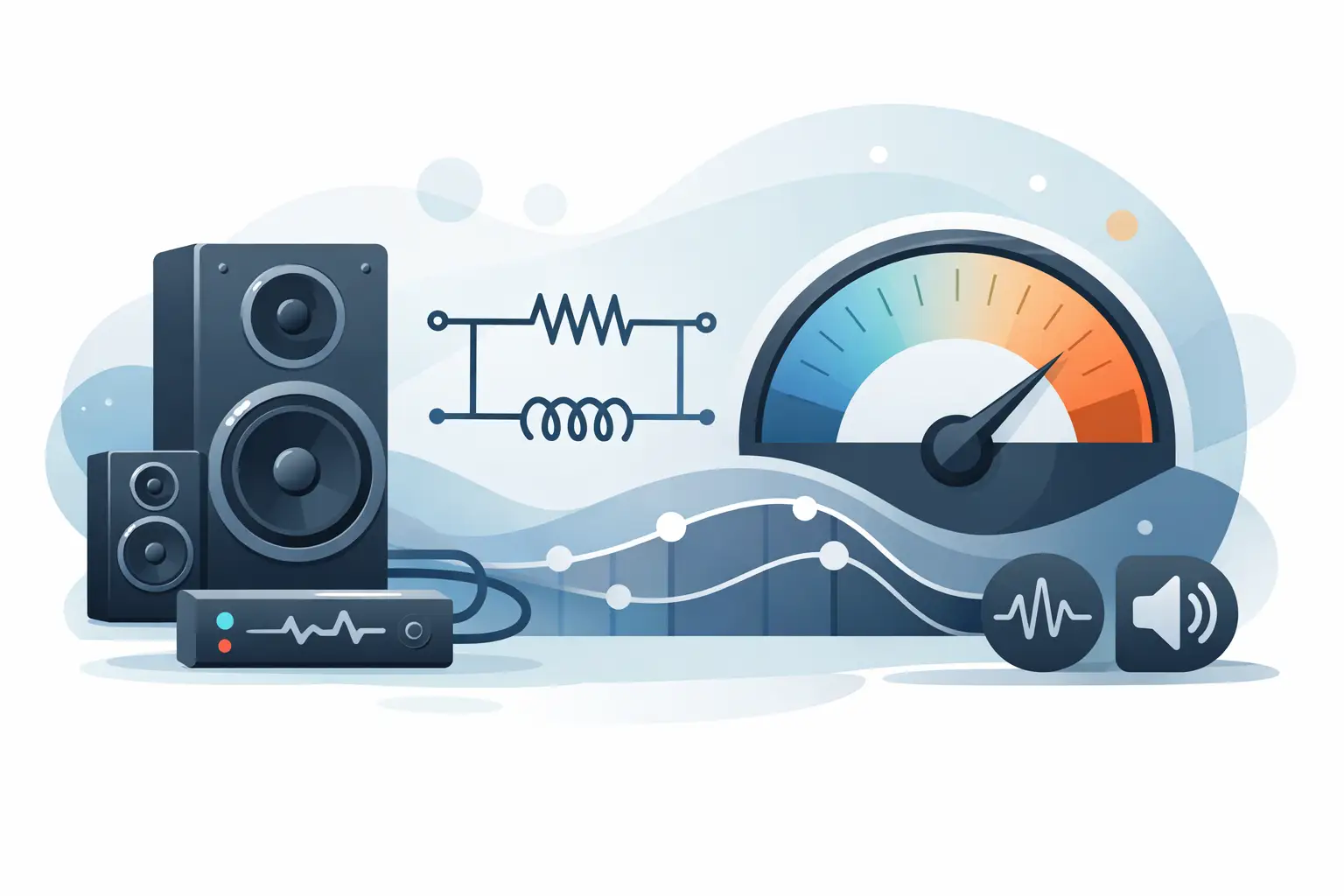
A system can sound composed at one volume and strained at the next, even when the amplifier appears to have ample power on paper. Very often, speaker impedance explained in plain terms is the missing piece. Impedance affects how demanding a loudspeaker is, how an amplifier delivers current, and why two speakers with the same sensitivity rating can behave very differently in a real listening room.
For serious hi-fi listeners, impedance is not a trivia-spec tucked into a brochure. It is part of the electrical relationship between amplifier and loudspeaker, and that relationship shapes control, dynamics, tonal balance, and long-term reliability. If you are building a system around high-resolution transducers, especially designs that reveal amplifier behavior with little mercy, understanding impedance is simply part of doing the job properly.
What speaker impedance actually means
Impedance is the opposition a speaker presents to alternating current from the amplifier. It is measured in ohms, but unlike a fixed resistor, a loudspeaker is not electrically constant. Its impedance changes with frequency because the driver motors, voice coils, crossover components, cabinet loading, and mechanical behavior all interact.
That is why a speaker sold as 4 ohms or 8 ohms does not stay at 4 or 8 ohms across the entire audible band. The nominal rating is a shorthand, not a full description. In practice, a speaker may rise sharply around resonance, dip through parts of the bass or midrange, and shift again in the treble depending on the crossover topology and driver characteristics.
This matters because amplifiers do not see the nominal number on a spec sheet. They see the actual impedance curve at each frequency and respond accordingly.
Speaker impedance explained in real system terms
The simplest way to think about impedance is this: lower impedance generally asks the amplifier for more current. If voltage remains the same and impedance falls, current demand rises. A speaker that dips to 3 ohms in the bass is asking more from the amplifier than an easier 8-ohm load at the same playback level.
That does not automatically make the lower-impedance speaker better, worse, louder, or harder to enjoy. It means amplifier matching becomes more critical. Some amplifiers are engineered to remain stable and controlled into low impedances, with strong power supplies and generous current delivery. Others sound superb within a narrower operating envelope and are better paired with speakers that present a more benign load.
For the listener, the consequences are audible. When an amplifier is comfortable with the speaker load, bass tends to sound more controlled, transients cleaner, and dynamic swings less compressed. When the pairing is poor, the presentation may flatten, harden, or lose composure as levels rise.
Nominal impedance vs minimum impedance
One of the most common mistakes in system matching is focusing only on nominal impedance. An 8-ohm speaker can still be challenging if its impedance drops steeply at critical frequencies or if its electrical phase angle compounds the load. By contrast, some 4-ohm speakers are relatively amplifier-friendly because their impedance curve is smoother and their phase behavior is less severe.
Minimum impedance is often more revealing than nominal impedance, but even that is only part of the story. The complete load includes both magnitude and phase. If a speaker has a low impedance dip where musical energy is substantial, and if the phase angle is also demanding in that region, the amplifier has real work to do.
Why impedance curves matter more than the headline number
A single ohm rating is useful for broad categorization, but serious evaluation requires looking at the impedance curve. That curve tells you where the electrical load becomes difficult and whether the challenge happens in a musically significant band.
For example, a brief dip in the upper treble may be less consequential than a sustained low-impedance region in the bass, where current demands rise and room gain often encourages listeners to push playback higher. Similarly, crossover design plays a major role. Multi-way loudspeakers with complex networks can produce more reactive loads than simpler implementations, even when the nominal rating looks conventional.
This is one reason high-end loudspeaker design is always a balancing act. Extending bandwidth, shaping dispersion, integrating multiple drive units, and controlling phase behavior can all affect impedance behavior. There is no free lunch. Engineering decisions that improve one aspect of performance may increase demands elsewhere.
How amplifiers respond to low speaker impedance
A well-designed amplifier should maintain stability as impedance falls, but not all designs approach that task the same way. Solid-state amplifiers with robust power supplies often double or nearly double their power output as impedance halves, at least within reasonable limits. That usually indicates strong current capability, though published numbers alone do not tell the whole story.
Tube amplifiers introduce another layer because output transformers and tap selection matter. Matching the speaker to the correct output tap helps optimize transfer and maintain better control, but it does not erase the reality of the speaker's impedance curve. Some speakers pair beautifully with tube amplification despite modest nominal impedance, while others expose the limits of a given tube design very quickly.
In premium systems, this is where listening and engineering data need to meet. A combination may be technically acceptable yet sonically underwhelming. Another may look unconventional on paper but produce exceptional coherence because the amplifier remains composed where the speaker demands it most.
Damping factor and control
Impedance also connects to damping factor, which is a way of describing how effectively the amplifier controls driver motion, especially in the bass. The topic is often oversimplified, but the core idea is valid: amplifier output impedance and speaker load interact. A lower amplifier output impedance generally provides tighter electrical control.
Still, chasing the highest damping factor number is rarely the point. Loudspeaker alignment, crossover behavior, room interaction, and driver design all shape perceived bass quality. Electrical control matters, but so does the broader system context.
What speaker impedance explained means for ribbon speakers
Ribbon-based loudspeaker systems deserve special attention because their design priorities often center on speed, transparency, low stored energy, and exceptional detail retrieval. Those strengths make amplifier behavior easier to hear, not less relevant. A revealing speaker will not hide an amplifier that runs short on current or loses grip when impedance falls.
Depending on implementation, ribbon systems may use transformers, hybrid architectures, or crossover strategies that influence the load the amplifier sees. The lesson is not that ribbon speakers are inherently difficult. It is that highly resolving loudspeakers reward thoughtful matching. When the amplifier is electrically and sonically aligned with the speaker, the result is not just volume or impact. It is composure, texture, and believable dynamic contrast.
At Clarisys Audio, that kind of system thinking is part of the listening experience. The finest transducer cannot separate itself from the amplifier behind it.
Common misconceptions about speaker impedance
One persistent myth is that lower impedance always means a better speaker. It does not. Impedance is not a quality ranking. It is a load characteristic.
Another is that an amplifier rated for 4 ohms will automatically work with any 4-ohm speaker. Not necessarily. Stability margins, phase angle tolerance, thermal behavior, and protection circuitry all matter. Some amplifiers remain effortless into demanding loads, while others meet the specification but sound constrained under real musical conditions.
A third misconception is that louder playback is the only time impedance matters. In reality, demanding impedance behavior can affect tonal balance and control at moderate levels too, especially with music that has strong low-frequency content or wide dynamic range.
How to match speakers and amplifiers more intelligently
Start by reading beyond the nominal impedance rating. If impedance curves or minimum impedance figures are available, use them. Then look at the amplifier's behavior into different loads, not just its single power rating into 8 ohms.
From there, consider the room and your listening habits. A speaker that is manageable in a small room at moderate levels may become a very different proposition in a larger space where realistic dynamics require more current delivery. Musical taste matters too. Solo piano and chamber music make different demands than large-scale orchestral works, electronic music, or rock played at live-like levels.
If you already own the amplifier, choose a speaker whose electrical behavior falls within the amplifier's comfort zone. If you are building from scratch, treat amplifier and loudspeaker as a pair. That approach nearly always yields a more convincing result than picking components in isolation.
The best systems are rarely assembled by chasing single numbers. They are built by respecting how specifications translate into behavior, and how behavior translates into sound. Speaker impedance is one of those specs that rewards careful attention. Learn to read it properly, and your system choices become more confident, more stable, and far more musically satisfying.