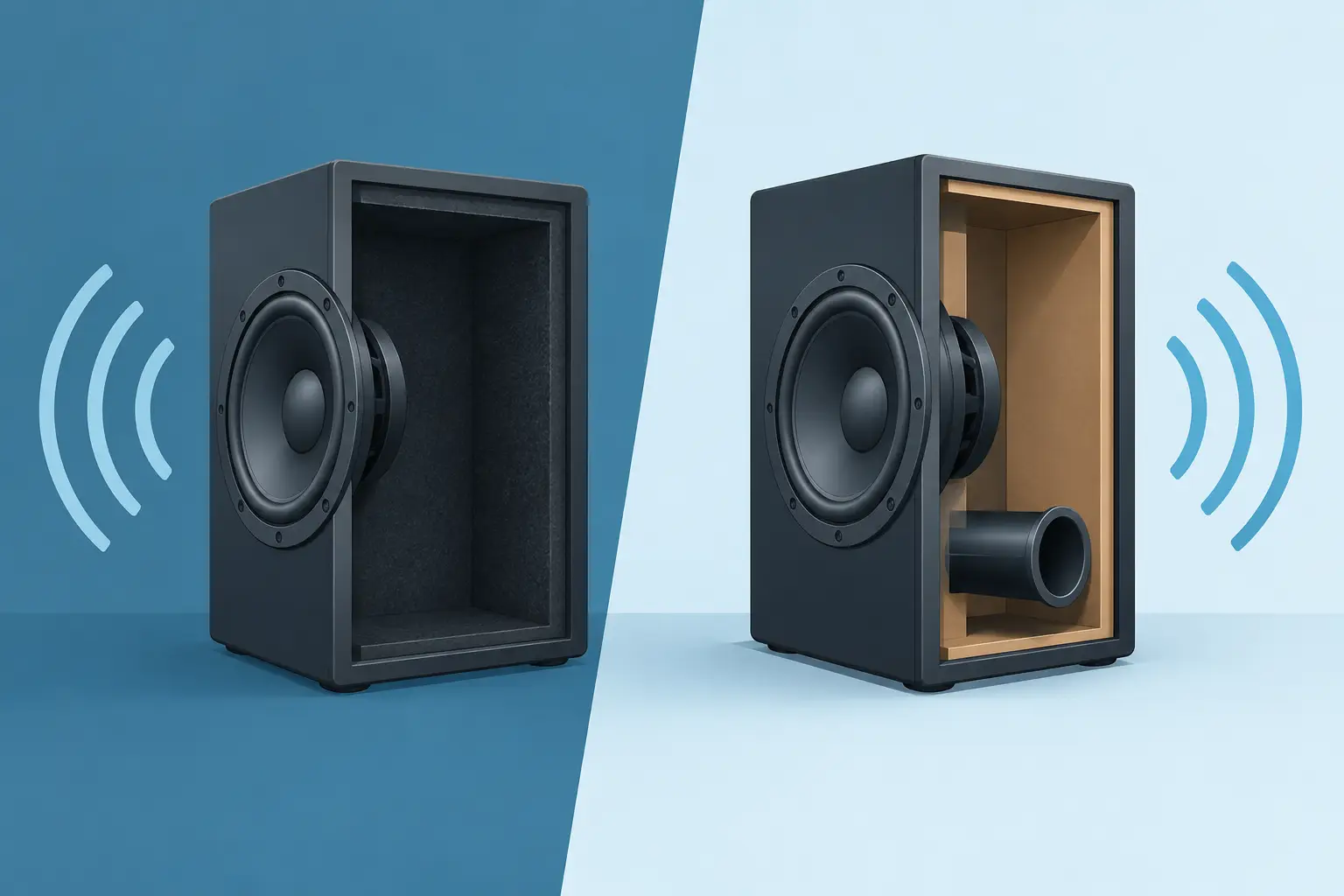
A loudspeaker cabinet is not furniture built around a driver. It is part of the acoustic system that determines how the driver moves, how low it plays, and how convincingly it stops. In the sealed vs ported speaker cabinets discussion, the useful question is not which alignment is universally superior. It is which one serves the driver, the room, and the listener’s musical priorities.
For serious listening, bass quality is not measured by extension alone. Pitch definition, dynamic control, integration with the midrange, and consistency across real rooms matter just as much. The enclosure alignment establishes the conditions under which those qualities can emerge.
Sealed vs Ported Speaker Cabinets: The Core Difference
A sealed cabinet, also called an acoustic suspension enclosure, contains a fixed volume of air behind the woofer. That trapped air acts as a spring. As the cone moves inward, air pressure rises and resists the motion; as it moves outward, the pressure falls and helps return the cone toward its resting position. The system is mechanically simple, but its behavior depends heavily on driver parameters, internal volume, damping material, and crossover design.
A ported cabinet uses a vent or duct tuned to a particular frequency. Near that tuning point, energy from the rear of the woofer is routed through the port and contributes to the forward output. The port becomes an active acoustic element, increasing efficiency and extending usable bass from a given driver and enclosure volume.
Neither approach is inherently more sophisticated. Both can be executed brilliantly or compromised by poor engineering. The meaningful distinction is in their acoustic trade-offs.
Why Sealed Enclosures Earn Their Reputation
A well-designed sealed enclosure is often prized for bass that feels taut, articulate, and proportionate. Because the enclosed air continuously controls the woofer, cone motion remains more predictable below the system resonance than it does in a conventional ported design. The low-frequency roll-off is gradual, typically around 12 dB per octave, which can combine gracefully with a room’s natural bass reinforcement.
This behavior is valuable in domestic listening spaces, where dimensions, boundaries, and furnishings often shape the lowest octaves more strongly than the loudspeaker itself. A sealed system may give up some apparent output in the deep bass, yet produce a more even and convincing in-room balance. Its response can be easier to integrate with one or more subwoofers as well.
Transient behavior is another reason enthusiasts favor sealed designs. The familiar description of "fast bass" can be imprecise, since a woofer is not literally speeding up because its cabinet is sealed. What listeners are often hearing is reduced overhang, controlled decay, and cleaner differentiation between successive bass notes. On an acoustic bass recording, that can mean hearing the body of each note and its pitch rather than a generalized low-frequency bloom.
There is a cost. Sealed systems are generally less efficient in the lowest octaves. To achieve substantial deep-bass output, they may require a larger driver, more cone excursion, higher amplifier power, or all three. The amplifier should offer genuine current delivery and stable behavior into the speaker’s impedance load. A sealed alignment also cannot compensate for a poorly chosen woofer or an undersized cabinet.
What a Ported Cabinet Can Do Exceptionally Well
A properly engineered ported cabinet can produce deeper bass and greater output for a given enclosure size and driver complement. Around the port tuning frequency, the port carries much of the acoustic work while woofer excursion decreases. This is a practical advantage for designs intended to reproduce orchestral scale, electronic music, large drums, and cinematic material without requiring an unusually large cabinet.
The additional efficiency is not merely a specification-sheet benefit. It can preserve dynamic ease at realistic listening levels. A speaker that does not need to force its woofer through excessive excursion may sound less strained when a recording moves from a quiet passage to a full orchestral peak.
Ported alignments demand precision, however. Port diameter, length, placement, flare geometry, cabinet volume, internal damping, and tuning frequency all matter. An undersized or poorly flared port can create audible turbulence. A tuning frequency selected solely to maximize a low-frequency number can yield bass that is impressive in isolation but less persuasive with music.
Below port tuning, the woofer loses much of the air-spring control provided by the ported system. Excursion can rise rapidly, making a high-pass filter or careful system protection valuable when very low-frequency content is present. This is not a defect. It is a known engineering condition that must be considered in the complete loudspeaker design.
Group delay is frequently raised in discussions of ported speakers. In simplified terms, a reflex alignment stores and releases more energy around its tuning region than a sealed alignment. Whether that becomes audible depends on the alignment, frequency range, music, room, and listener. A carefully tuned ported loudspeaker can sound rhythmically convincing and exceptionally natural. Still, in smaller rooms or systems already energized by strong room modes, its extra low-frequency output can be harder to manage.
The Room Decides More Than Most Specifications Suggest
A speaker’s published bass response is measured under controlled conditions. Your room is not controlled. It has dimensions, boundaries, seating positions, resonant modes, and often a strong preference for exaggerating a narrow band somewhere between roughly 30 and 100 Hz.
A ported speaker placed close to a front wall may gain useful weight, but it may also excite a room mode with more authority than desired. Rear port placement does not automatically make wall placement impossible, nor does front port placement guarantee easy positioning. The cabinet’s total low-frequency radiation and tuning matter more than a simple front-versus-rear-port rule.
Sealed speakers often offer more latitude because their bass falls away gradually and their output below resonance is more controlled. That does not make them immune to room effects. A sealed speaker can still sound heavy, thin, or uneven when positioned poorly. It simply tends to present a different starting point for placement and equalization.
Before changing components, experiment with speaker distance from the front wall, side-wall symmetry, and listening position. Moving either the speakers or the chair by a modest distance can change bass balance more dramatically than a cable change or a minor amplifier substitution. Measurement can accelerate the process, but attentive listening with familiar recordings remains essential.
Cabinet Alignment and Ribbon Speaker Systems
For ribbon and planar-magnetic loudspeakers, the question has an additional layer. Many such designs radiate as dipoles, with significant front and rear wave interaction rather than operating as a conventional boxed midrange or full-range driver. Their open, fast, and low-distortion character is inseparable from that radiation pattern.
Yet bass reproduction still requires deliberate acoustic engineering. A ribbon or planar system may employ dedicated woofers in sealed or ported modules, use dipole bass panels, or combine approaches across different frequency ranges. The chosen bass alignment must not only reach low frequencies. It must preserve the speed, transparency, and spatial coherence that make ribbon technology compelling.
This is where integration becomes more important than ideology. A ported bass section with poorly managed upper-bass energy can obscure the clarity of a ribbon midrange. Conversely, a sealed bass section that lacks the required displacement or amplifier support can make an otherwise refined system sound dynamically restrained. The crossover, driver sensitivity, phase behavior, and room response must be developed as one system.
Choosing for Music, System, and Listening Habits
Choose a sealed design when you prioritize pitch accuracy, controlled decay, flexible room integration, and the option to build a carefully managed subwoofer system. It is often an excellent match for smaller to medium rooms, acoustic music, and listeners who value coherence over maximum low-frequency impact.
Choose a ported design when you want meaningful bass extension and dynamic scale from a practical cabinet size, especially in a larger room or with music that contains sustained low-frequency energy. The strongest examples do not announce their ports. They simply make the recording feel complete, energized, and unforced.
Amplification should influence the decision. A sealed speaker may reward an amplifier with substantial current reserve, while an efficient ported speaker may deliver greater apparent scale from more moderate power. But nominal sensitivity alone is not enough. Examine impedance behavior, listen at realistic levels, and consider how the amplifier controls the woofer under load.
Audition with recordings you know intimately. Use an upright bass for pitch and decay, kick drum for impact, piano for lower-register weight, and dense orchestral passages for control under pressure. Listen not only for how far the speaker reaches, but for whether low frequencies remain distinct when the arrangement becomes complex.
The right cabinet alignment disappears into the performance. When bass has weight without blur, power without exaggeration, and scale without sacrificing the midrange, the loudspeaker has begun to serve the music rather than call attention to its own design.