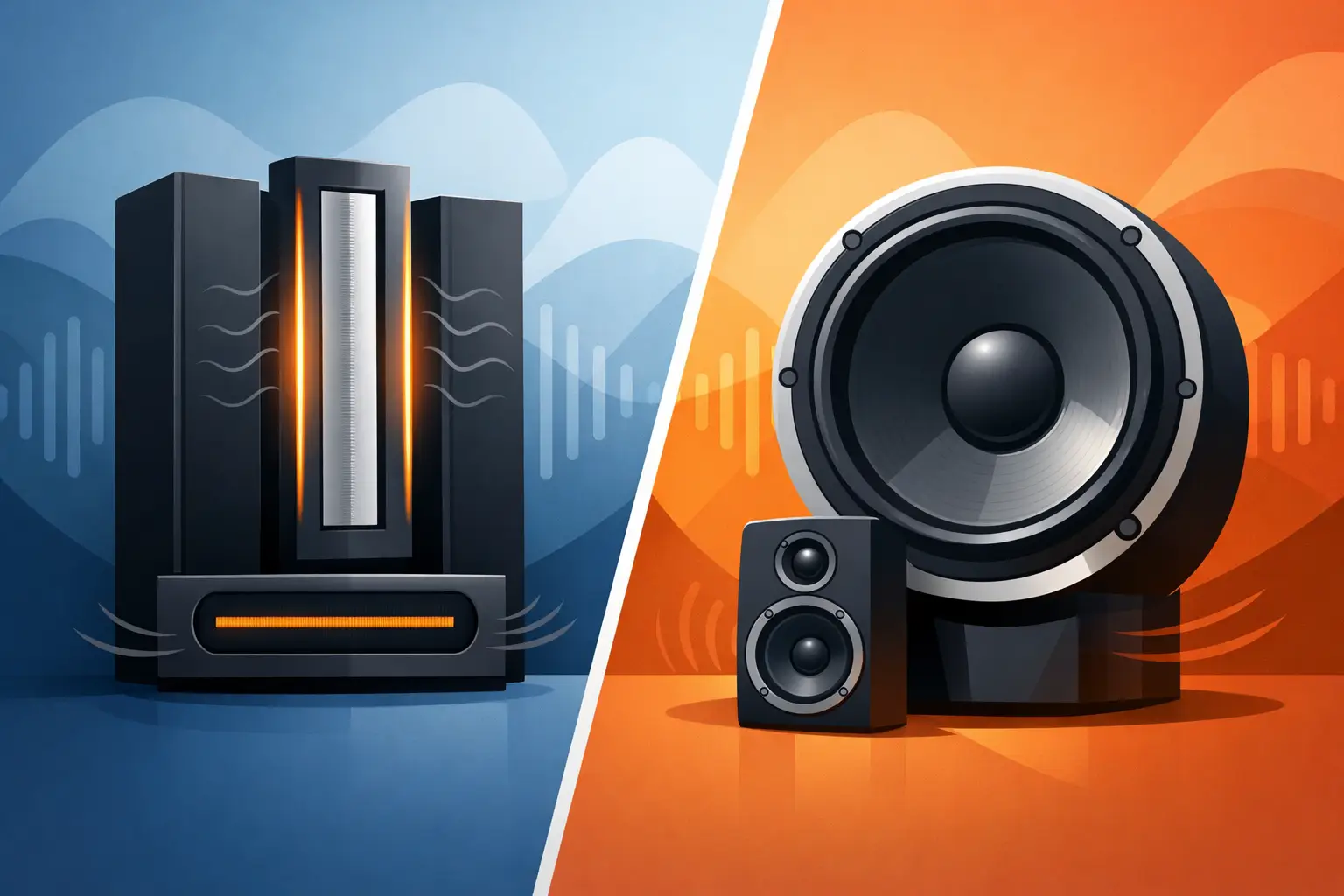
If you have ever sat in front of a well-set-up ribbon system and felt a cymbal hang in space with almost tactile delicacy, you already know why ribbon speakers vs cone speakers is not a trivial debate. This is not just a matter of taste or brand loyalty. It is a question of transducer physics, dispersion behavior, system matching, and what kind of listening experience you want your loudspeakers to prioritize.
For serious listeners, the comparison matters because the driver technology shapes the character of the presentation before amplification, room treatment, and source quality even enter the picture. Cone drivers remain the dominant architecture in loudspeaker design for good reasons. Ribbon drivers, especially in advanced implementations, pursue a different set of strengths. Neither is automatically better in every application. The real issue is where each technology excels, where it asks for compromise, and how those choices align with your room and priorities.
What changes when you compare ribbon speakers vs cone speakers
A cone driver works by attaching a voice coil to a diaphragm, typically paper, plastic, metal, or composite, and moving that assembly within a magnetic field. It is a mature and highly versatile technology. Designers can tune cone materials, suspensions, motor structures, and enclosure loading to achieve very different results, from compact monitors to large full-range floorstanders.
A ribbon driver approaches the problem differently. In a true ribbon design, a very light conductive ribbon is suspended in a magnetic field and acts as both diaphragm and conductor. That low moving mass is central to the ribbon proposition. With less mass to start and stop, the driver can respond with exceptional speed and precision, particularly through the frequencies where timing, texture, and microdynamic detail are most perceptible.
This distinction has audible consequences. Cone speakers often deliver greater versatility across bandwidth and output demands, while ribbon-based systems are prized for immediacy, transient fidelity, and a sense of openness that many experienced listeners find difficult to forget once heard under the right conditions.
Speed, detail, and transient behavior
The most common reason audiophiles gravitate toward ribbons is transient performance. A snare hit, a brushed cymbal, a violin bow change, or the leading edge of a piano note asks a driver to accelerate and stop quickly without adding blur. Ribbon designs are inherently advantaged here because the moving element is extremely light.
That does not mean every ribbon speaker sounds analytical or lean. It means that, when properly engineered, the driver can reveal low-level information with less mechanical inertia masking the event. The impression is often one of ease rather than exaggeration. Detail emerges naturally instead of being pushed forward.
Cone drivers can also be highly resolving, especially at the top end when paired with excellent tweeter design and careful crossover work. But they typically achieve that result through a more complex balance of diaphragm stiffness, damping, breakup control, and motor linearity. The best cone-based systems can be superb. They simply take a different route to clarity.
Dispersion and how the room hears the speaker
One of the less discussed but more consequential differences between ribbon speakers and cone speakers is dispersion. A speaker does not only send energy toward the listener. It also energizes the room, and the pattern of that radiation influences tonal balance, image stability, and listening comfort.
Many ribbon implementations exhibit broad horizontal dispersion with more controlled vertical dispersion. In practice, that can support expansive stereo imaging and strong lateral soundstage cues while reducing some of the floor and ceiling interaction that can smear fine detail. In a properly arranged room, this can create a presentation with striking image specificity and a convincing sense of air around instruments.
Cone drivers generally radiate in a more symmetrical pattern, though dispersion narrows as frequency rises and varies by driver diameter and waveguide strategy. This can make integration across drivers and room interactions more dependent on the specific design. Well-executed cone speakers can image beautifully, but their room behavior is often more variable from one model to another.
There is a trade-off. Controlled vertical dispersion can reward careful listener height and setup precision. Ribbon systems tend to appreciate more disciplined placement than casual, anywhere-in-the-room solutions.
Bass authority and full-range practicality
This is where cone technology keeps its broad appeal. Cones are highly effective at moving air, particularly in the bass and lower midrange where excursion demands are substantial. If your priorities center on visceral low-frequency weight, large-scale dynamics, and easier packaging of full-range output, cone woofers remain the practical standard.
Ribbon drivers are rarely asked to do deep bass duty on their own. In many advanced loudspeaker systems, ribbons handle the frequencies where their speed and low mass provide the greatest benefit, while woofers or other bass drivers take over lower in the spectrum. That hybrid approach can be extremely effective, but it also means the crossover and integration quality become critical. If the handoff is not seamless, the speaker can sound disjointed.
This is why simplistic claims that ribbons are better than cones miss the point. A ribbon may outperform a cone in preserving subtle harmonic structure and transient finesse, yet a cone woofer may still be the best solution for realistic bass foundation. In high-end design, the real objective is not ideology. It is coherent bandwidth reproduction.
Dynamics, scale, and listening levels
When people discuss dynamics, they often lump together very different phenomena. Microdynamics refer to subtle gradations in intensity, such as the fine expressive shifts in a vocalist's phrasing. Macrodynamics refer to large swings, such as orchestral crescendos or a kick drum hitting with force.
Ribbon technology is often exceptional at microdynamic expression. Because the diaphragm starts and stops so readily, it can preserve the tiny changes that make recordings feel alive rather than merely accurate. This contributes to the sensation of realism at moderate listening levels, where many systems flatten nuance.
Cone systems often have an easier path to raw output and large-scale impact, particularly in designs intended for high SPL and broad room coverage. That does not mean ribbons cannot sound dynamic. It means the type of dynamic excellence may differ. Listeners who prioritize low-level resolution, articulation, and spatial delicacy may prefer ribbons. Those who want sheer punch with fewer setup sensitivities may lean toward cones or hybrid architectures.
Tonal character and listener expectations
A common stereotype paints ribbon speakers as airy but lightweight, and cone speakers as warm but less refined. Neither stereotype survives exposure to serious engineering. Tonal balance is a system-level result shaped by crossover topology, cabinet design, driver integration, impedance behavior, and voicing choices.
Still, there are tendencies. Ribbon-based speakers often sound more open through the upper midrange and treble, with less apparent stored energy. Cone-based systems can deliver excellent tonal density and body, especially through the midbass and lower mids. Depending on implementation, that can read as natural richness or as a slight thickening.
Your library matters here. Chamber music, jazz ensembles, acoustic recordings, and vocal material often reveal the strengths of ribbons quickly. Rock, large-scale electronic music, and bass-heavy productions may showcase the advantages of cone-driven weight and impact unless the ribbon system is paired with very capable low-frequency drivers.
Amplifier matching and system demands
Advanced loudspeakers are never just about the driver. Ribbon designs can place meaningful demands on amplifier quality and current delivery, depending on impedance characteristics and transformer implementation. They reward electronics that are stable, quiet, and tonally composed. Feed them mediocre upstream gear and they tend to expose it without mercy.
Cone speakers vary widely, but many offer a broader range of amplifier compatibility. That can simplify system building, especially if you value flexibility or already own electronics you intend to keep.
For the experienced buyer, this is not a drawback so much as a design reality. A revealing loudspeaker deserves a carefully considered chain. In the premium category, that level of matching is part of the process, not an inconvenience.
Which one is right for your room
Room size, listening distance, and placement freedom all influence the answer. If you have a dedicated listening space, can position the speakers with care, and value image depth, transparency, and transient realism, a ribbon-based design may offer the more compelling path. This is particularly true when the rest of the system is chosen with equal discipline.
If your room is multi-use, placement is constrained, or your listening priorities favor broad genre versatility, heavier bass output, and fewer sensitivity concerns, a cone-based speaker may be the more forgiving and practical choice.
Many sophisticated loudspeakers blend both technologies because the strengths are complementary. That is often where the most convincing results emerge - ribbon speed and openness combined with cone-driven bass authority and scale. Brands focused on ribbon speaker technology, including Clarisys Audio, build around the idea that a refined listening experience starts with minimizing diaphragm mass where it matters most.
The useful question is not which topology wins in the abstract. It is which one serves your listening goals with the fewest meaningful compromises. If you chase timing precision, spatial integrity, and the feeling that recorded music has shed a layer of mechanical haze, ribbons deserve your full attention. If you want maximum flexibility and full-range ease in a wider range of rooms, cones remain deeply relevant.
The best systems are the ones that make you forget the hardware and stay with the performance a little longer than you planned.