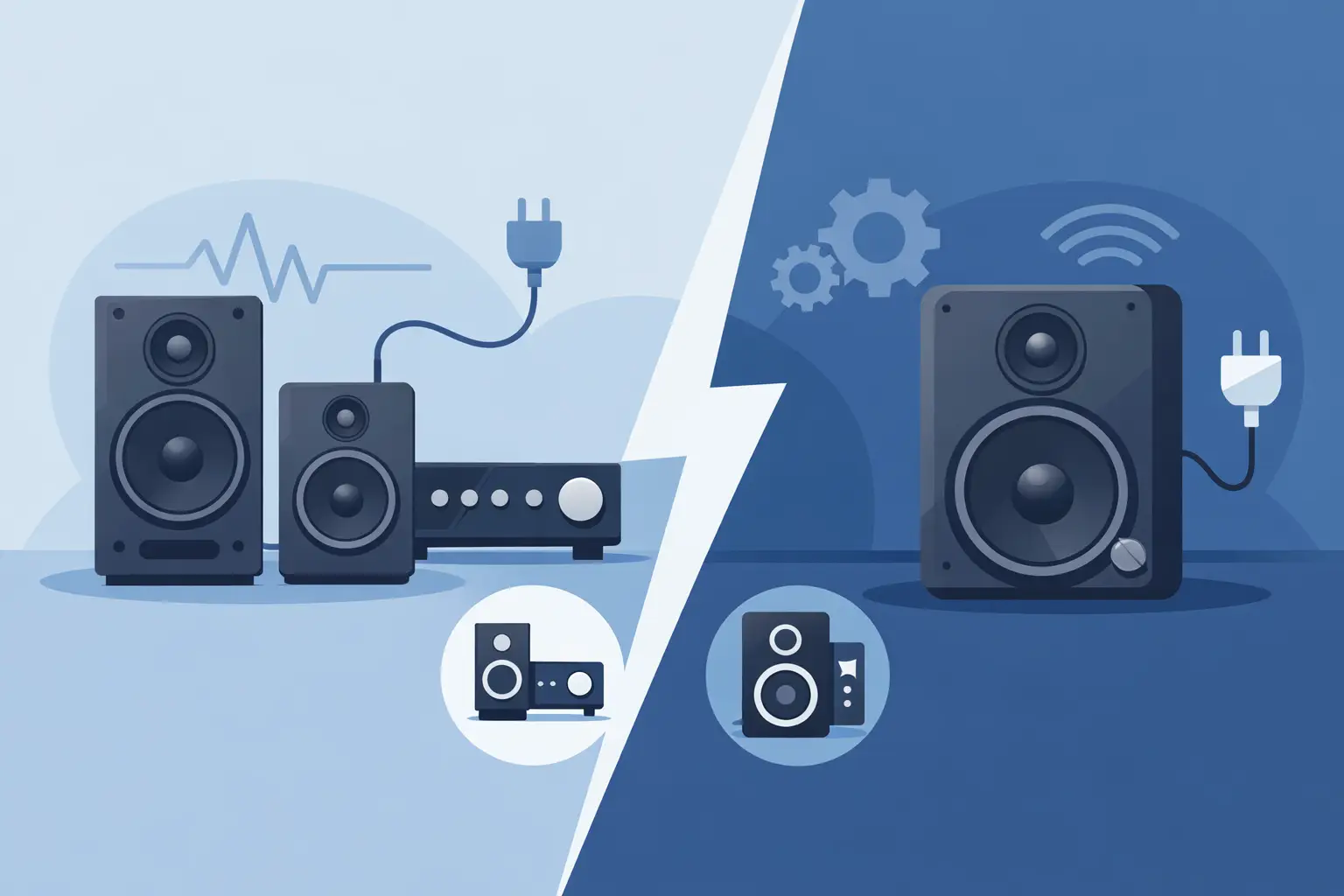
A loudspeaker can be exceptional on paper and still underperform because the amplifier, crossover, room, or setup was treated as an afterthought. Passive vs active loudspeakers is therefore not a simple contest between traditional separates and modern convenience. It is a decision about where critical engineering happens, who controls it, and how much latitude you want to retain as a system owner.
For serious listeners, the right answer begins with the listening objective. A carefully matched passive loudspeaker and amplifier can produce extraordinary scale, tonal color, and long-term ownership flexibility. An active loudspeaker can place amplification and crossover optimization under a single engineering authority, often with remarkable precision. Neither architecture is inherently more high fidelity.
Passive vs Active Loudspeakers: The Core Difference
A passive loudspeaker requires an external power amplifier. The amplifier sends a full-range, high-level music signal through speaker cables to a passive crossover inside the loudspeaker cabinet. That crossover divides the signal among the woofer, midrange, ribbon, tweeter, or other drive units.
An active loudspeaker contains its own amplification. In a properly active design, the incoming line-level signal is divided before amplification, usually by an electronic crossover or digital signal processor. Each drive unit, or each driver section, receives power from a dedicated amplifier channel. A three-way active loudspeaker may therefore contain three or more amplifier channels per speaker.
The distinction matters because passive crossovers operate after the amplifier and must handle substantial current and voltage. Active crossovers work at low signal level, before the power amplifiers. This gives the designer more direct control over crossover slopes, driver equalization, level matching, protection, and time alignment.
There is also a term worth using carefully: powered speaker does not always mean active speaker. A powered speaker may include one internal amplifier, often for a bass driver, while retaining a passive crossover for the rest of the system. That can be an effective hybrid solution, but it is not the same as a fully active, multi-amplified architecture.
Why Passive Loudspeakers Remain the Reference for Many Systems
Passive loudspeakers remain central to high-end two-channel audio because they preserve component choice. The loudspeaker, power amplifier, preamplifier, cables, and source can each be selected and refined independently. For an enthusiast who values system voicing, this is not a complication. It is part of the craft.
A passive design also permits the use of amplifiers chosen for a particular electrical and musical relationship with the loudspeaker. An amplifier with substantial current delivery, stable behavior into low impedances, and generous power reserves may bring greater authority and ease to a demanding ribbon loudspeaker. Another listener may prefer the spatial delicacy and harmonic character of a different amplification topology. The passive architecture leaves that decision in the owner’s hands.
This flexibility has practical value over decades of ownership. Amplification can be upgraded without replacing the loudspeakers. A preamplifier can be changed as sources evolve. If a component needs service, the system is not necessarily out of operation. For collectors of fine electronics and listeners building a reference system over time, that modularity is compelling.
The trade-off is responsibility. A passive loudspeaker is only as convincing as the system around it. Sensitivity, impedance behavior, room size, desired playback level, cable runs, and amplifier stability all require attention. Buying on wattage alone is a common mistake. A nominally powerful amplifier that struggles when impedance falls can sound constrained compared with a lower-rated design with superior current capability and control.
Passive crossover design is still serious engineering
A passive crossover should never be dismissed as old technology. At its best, it is a highly refined network of carefully selected components, developed through measurement and extensive listening. Its behavior is inseparable from driver impedance, enclosure loading, and acoustic output.
The challenge is that passive components introduce their own losses, tolerances, and interactions. Designing a crossover that maintains tonal coherence, preserves transient response, and presents a reasonable load to the amplifier is an exacting discipline. The result can be superb, but it asks more of both the loudspeaker designer and the partnering amplifier.
What Active Loudspeakers Can Do Differently
The greatest advantage of active loudspeakers is integration. The manufacturer knows the drivers, cabinet, crossover parameters, amplifier channels, and intended operating limits as one system. Rather than hoping an external amplifier is a suitable match, the active designer specifies the match directly.
Because each driver section has dedicated amplification, active systems can optimize power delivery with unusual precision. A low-frequency driver can receive an amplifier designed for excursion and control, while a high-frequency ribbon or tweeter can receive a quieter, lower-power channel optimized for speed and low distortion. The amplifiers do not compete through a passive network for the same full-range signal.
Electronic crossover design can also make complex acoustic targets more achievable. Filters can be steeper, driver levels can be adjusted precisely, and protective limits can be applied without the blunt compromises associated with some passive protection circuits. In DSP-based designs, room-boundary settings, bass contour, and placement compensation may be available as well.
These advantages are especially relevant when a system must deliver consistent performance across many installations. An active loudspeaker reduces the number of unknowns between factory voicing and final playback. For a listener seeking a compact, highly controlled system, that is a meaningful benefit.
Yet active does not eliminate the need for judgment. The quality of the internal amplifiers, power supply, analog stages, digital processing, and implementation matters enormously. A mediocre active loudspeaker does not become refined merely because it has multiple amplifiers inside. Likewise, DSP can correct selected response issues, but it cannot fully overcome poor room acoustics, unsuitable placement, or a driver operating beyond its ideal range.
The Questions That Actually Decide the Choice
Start with your intended system architecture. If you already own a reference preamplifier and power amplifier, or want to explore different amplification approaches, passive loudspeakers provide the natural path. If you want fewer boxes, shorter signal paths, and a manufacturer-defined amplifier-to-driver relationship, active loudspeakers deserve close consideration.
Room size changes the equation. In a large listening room at realistic orchestral or live-music levels, a passive loudspeaker paired with substantial external amplification can offer exceptional headroom and upgrade capacity. An active system can do the same if its internal amplification and driver complement are engineered for that scale. Do not assume active automatically means limited output, or passive automatically means greater authority.
Consider your source chain as well. Many active loudspeakers accept analog line-level inputs, digital inputs, or both. That can simplify a system, but it may also place digital conversion, volume control, and software behavior within the speaker ecosystem. Some listeners welcome that integration; others prefer a dedicated DAC and analog preamplifier whose performance and character they know intimately.
Serviceability deserves equal weight in a premium purchase. With passive loudspeakers, electronics are external and often easier to update or service independently. With active loudspeakers, the electronics are part of the loudspeaker and should be supported accordingly. Ask clear questions about warranty coverage, firmware policy where applicable, long-term parts availability, and authorized service procedures.
Ribbon Loudspeakers and Amplifier Control
Ribbon technology makes the amplifier question particularly consequential. A ribbon’s low moving mass can reveal fine transient detail, dynamic shading, and spatial information with exceptional immediacy. It can also expose grain, compression, or instability elsewhere in the chain.
In a passive ribbon loudspeaker, the external amplifier must remain composed into the loudspeaker’s real electrical load, not merely its published nominal impedance. Control at low frequencies, freedom from hardness at higher levels, and low noise through the midrange and treble are all audible priorities. High quality power is not about brute force alone. It is about stability, current delivery, and musical composure.
In an active ribbon design, the designer can tailor the amplification and filtering specifically to the ribbon’s operating range and protection needs. This can produce excellent integration and repeatability. But the listener is accepting the designer’s choices as a complete package, rather than selecting alternatives later.
That is why a well-executed passive ribbon speaker remains attractive to enthusiasts who view the amplifier as a vital musical component. Brands such as Clarisys Audio build for listeners who recognize that the loudspeaker does not exist in isolation from the chain driving it.
Audition for More Than Detail
When comparing passive and active loudspeakers, avoid making a decision from a brief first impression of detail or bass weight. Use familiar recordings with natural voices, acoustic instruments, dense orchestration, and quiet passages. Listen for continuity through crossover regions, stability of image height, low-level resolution, and whether dynamics remain relaxed as volume rises.
With passive loudspeakers, ask for an audition using amplification appropriate to their demands. With active loudspeakers, evaluate the complete input path and controls you would use at home. In both cases, listen at realistic levels in a room that is not working against the speaker.
The finest choice is the one that gives you confidence in both the engineering and the ownership experience. Choose passive when you want a loudspeaker to anchor an evolving system. Choose active when you value an integrated design whose amplifier, crossover, and drivers were conceived as one instrument. Then give the loudspeakers the room, setup, and attentive listening they deserve.