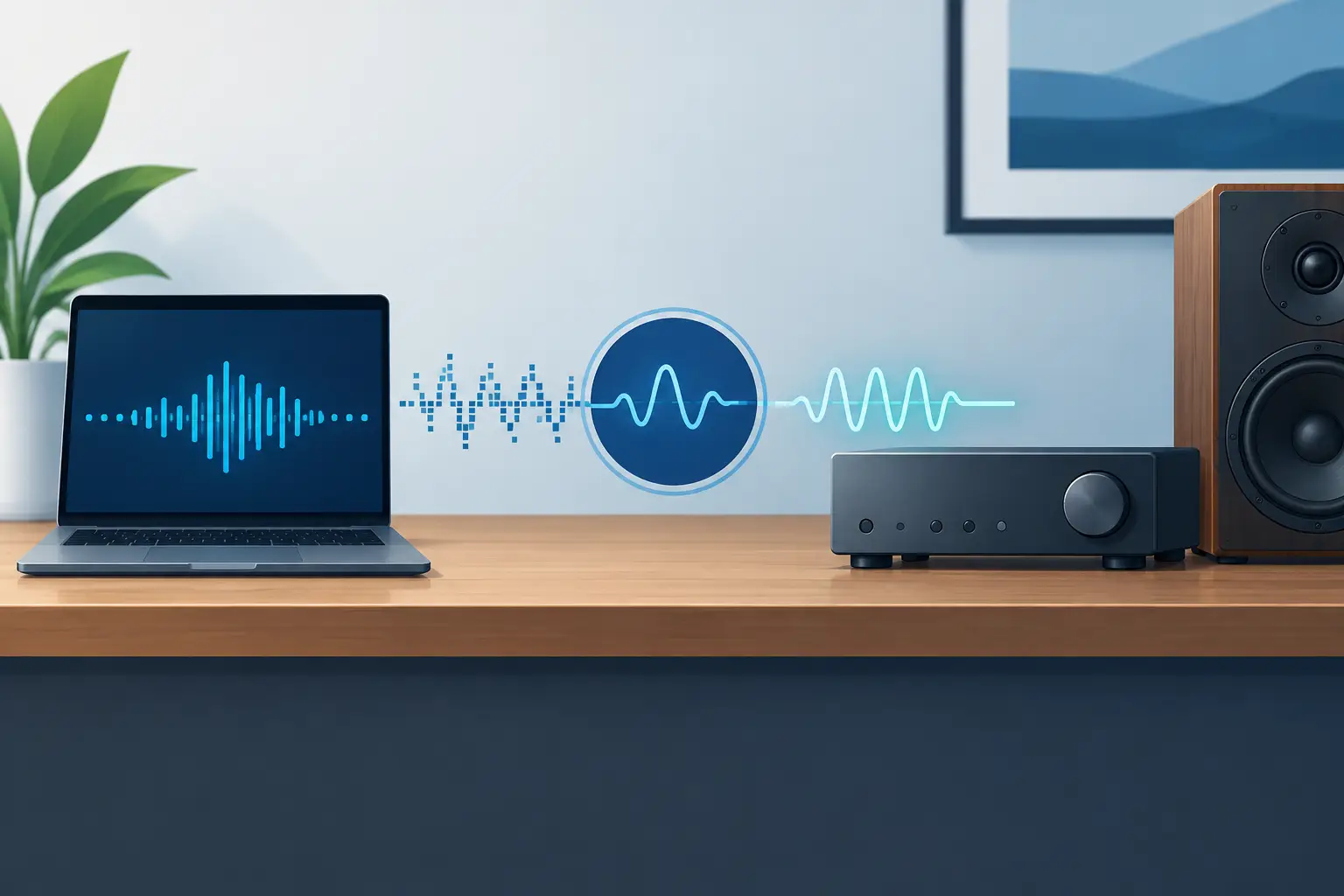
A revealing ribbon loudspeaker does not flatter uncertainty upstream. When image placement becomes less stable, leading edges lose their natural ease, or a recording seems to flatten as volume rises, it is reasonable to examine the digital chain. To optimize digital source jitter, however, requires more than buying a clock-shaped box or replacing every cable in sight. It requires identifying where timing errors enter the system, how the DAC handles them, and whether the change is audible in your particular installation.
Jitter is often discussed with more certainty than the evidence allows. It can matter, especially in a highly resolving system, but its significance depends on interface design, clock recovery, DAC architecture, electrical noise, and the quality of the recording itself. A disciplined approach delivers better results than treating jitter as a universal explanation for every digital weakness.
What Digital Source Jitter Actually Is
Digital audio represents a continuous musical signal as samples taken at precise intervals. Jitter is variation in the timing of those intervals. If the conversion process reconstructs audio samples at slightly inconsistent moments, it can create low-level distortion or modulation products. In severe cases, the result may be measurable and audible as a loss of focus, reduced depth, grain around sustained tones, or a less convincing sense of instrumental separation.
The critical distinction is between jitter carried by an incoming interface and jitter at the DAC's actual conversion clock. A transport can send a signal with imperfect timing, yet a well-designed DAC may buffer, reclock, or asynchronously isolate that signal before conversion. Conversely, a poorly implemented clock or noisy power environment within the DAC can compromise performance even when the incoming digital stream appears exemplary.
That is why the source, cable, and DAC must be considered as a system. The digital connection does not exist in isolation from grounding, power supplies, network hardware, or analog output stages.
Where Timing Errors Enter a Hi-Fi System
A conventional disc transport using S/PDIF, AES/EBU, or coaxial BNC must transmit both audio data and timing information. The receiving DAC recovers the clock from that signal, making interface quality and receiver design relevant. Reflections caused by incorrect cable impedance, marginal transmitter circuits, or poor termination can make clock recovery more difficult.
USB audio works differently. In an asynchronous USB implementation, the DAC's local clock governs conversion and requests data from the computer or streamer as needed. This usually makes the timing quality of the host computer less central than it was with older adaptive USB designs. Yet USB can still conduct high-frequency electrical noise and ground contamination into the DAC, so an apparently jitter-related improvement may actually be a noise-related improvement.
Network streaming separates packet delivery from audio conversion timing. Ethernet packets may arrive with variable timing without directly creating conversion jitter, provided the streamer buffers data correctly and uses a competent local clock. Network switches, cables, and routers can still influence noise behavior in some systems, but they should not be assumed to alter the timing of the audio samples merely because packet arrival is variable.
Optimize Digital Source Jitter by Starting at the DAC
The DAC is the proper first point of investigation because it determines how much incoming timing variation survives to the conversion stage. Consult its technical documentation and establish whether it uses asynchronous USB, phase-locked loop clock recovery, FIFO buffering, sample-rate conversion, galvanic isolation, or a dedicated master-clock input. These are not interchangeable solutions, and each entails trade-offs.
A very narrow phase-locked loop may reject less noise close to the clock but can struggle with a poor transport. A wider loop is more tolerant of incoming instability but may pass more source-related timing variation. Buffering and asynchronous reclocking can offer substantial isolation, but their performance depends on the quality of the local oscillators, power regulation, and implementation.
Do not assume that an external master clock improves every DAC. Some products are designed around excellent internal clocks and may perform best as delivered. Others provide a properly engineered clock input for studio synchronization or for a compatible companion transport. An external clock adds its own cable, connector, termination requirements, and power supply. It is a system decision, not an automatic upgrade.
Use the Best Available Interface
Choose the interface that best suits the specific source and DAC, not the one surrounded by the strongest folklore. For a modern streamer and DAC, asynchronous USB, AES/EBU, or a dedicated I2S connection may each be excellent if both components implement it correctly. For a legacy transport, AES/EBU or true 75-ohm coaxial S/PDIF may provide more dependable clock recovery than an improvised connection.
Use cables built for the required standard. Digital coaxial cable should maintain 75-ohm characteristic impedance; AES/EBU calls for 110-ohm balanced cable. A cable does not need extravagant construction to meet its electrical specification, but it should be correctly terminated, mechanically sound, and appropriate in length. Avoid adapters when possible, particularly in clock-sensitive S/PDIF paths.
Address Noise Without Confusing It With Jitter
Clean power can improve digital playback, but not because every power accessory corrects clock timing. Switching noise, ground currents, and RF interference can affect clock circuits, data receivers, and analog stages. The audible effect may resemble what listeners describe as lower jitter: quieter space around instruments, cleaner decay, and a more stable image.
Begin with practical fundamentals. Keep the DAC and analog components on a thoughtfully organized power arrangement. Separate noisy computing devices from low-level analog cabling. Use well-designed, shielded interconnects where the system environment demands it. If a computer is the source, reduce unnecessary processing and wireless activity during listening, then assess whether an isolated USB connection or dedicated network streamer changes the result.
The goal is not to remove every trace of electrical activity. It is to prevent noise from reaching circuits where it can become audible.
A Sensible Evaluation Process
Change one variable at a time. A new streamer, USB isolator, clock, power supply, and cable introduced together cannot tell you what improved or whether the improvement persists. Allow components to return to normal operating temperature, level-match comparisons where possible, and use familiar recordings with exposed spatial and transient information.
Piano is useful because its attacks and decays reveal timing and noise artifacts. Small acoustic ensembles can show whether image boundaries remain stable. Well-recorded vocal material exposes whether sibilants become etched or retain their natural texture. Dense orchestral passages are valuable for evaluating whether the system preserves scale without turning individual sections into a generalized mass.
Listen over several sessions. Immediate contrast can favor a brighter or more forward presentation, while long-term listening reveals whether the system has gained ease, tonal credibility, and low-level resolution. If the perceived change disappears when you return to the original configuration, that is useful information rather than a failure.
Where measurements are available, use them as a filter for implausible claims. DAC jitter spectra, noise floor behavior, and interface performance can indicate whether a proposed upgrade addresses a measurable limitation. Measurements do not replace listening, particularly when evaluating an entire system, but they can keep the investigation anchored in engineering.
Common Mistakes in Jitter Optimization
The most expensive mistake is treating the transport as the sole clock authority in a system whose DAC reclocks everything effectively. The next is assuming that a network accessory changes sample timing simply because it changes the sound. If a network component affects playback, investigate noise coupling, grounding, or power behavior before attributing the result to packet timing.
Another mistake is pursuing clock upgrades before establishing speaker position, room behavior, analog gain structure, and component matching. Ribbon loudspeakers are exceptionally informative about transient behavior and recorded ambience, but they will also reveal an over-bright room, unsuitable amplification, or an unstable setup. Those larger variables usually deserve attention first.
Finally, do not confuse higher sample rates with lower jitter. They are separate concerns. A 24/192 stream can be converted with poor timing, and a 16/44.1 recording can sound remarkably coherent through a properly engineered digital front end.
When an Upgrade Is Worth Considering
A source upgrade is most justified when there is a known technical weakness: an aging adaptive USB input, a transport with unreliable clock recovery, audible noise from a computer connection, or a DAC whose interface behavior does not suit the system. It can also be justified when your existing DAC offers a superior input that your current source cannot use.
For many serious systems, the most meaningful route is a quality streamer or transport feeding a DAC with strong input isolation and a stable internal clock. This reduces dependence on external add-ons and keeps the signal path understandable. A more elaborate clocking architecture may be appropriate in a carefully matched high-end system, but only when its benefits can be verified in the listening room.
The finest digital front end does not announce itself with exaggerated detail. It makes timing feel less like a technical subject and more like music: a piano attack arrives with weight and precision, a hall decay remains intact, and the space between performers becomes easier to believe.