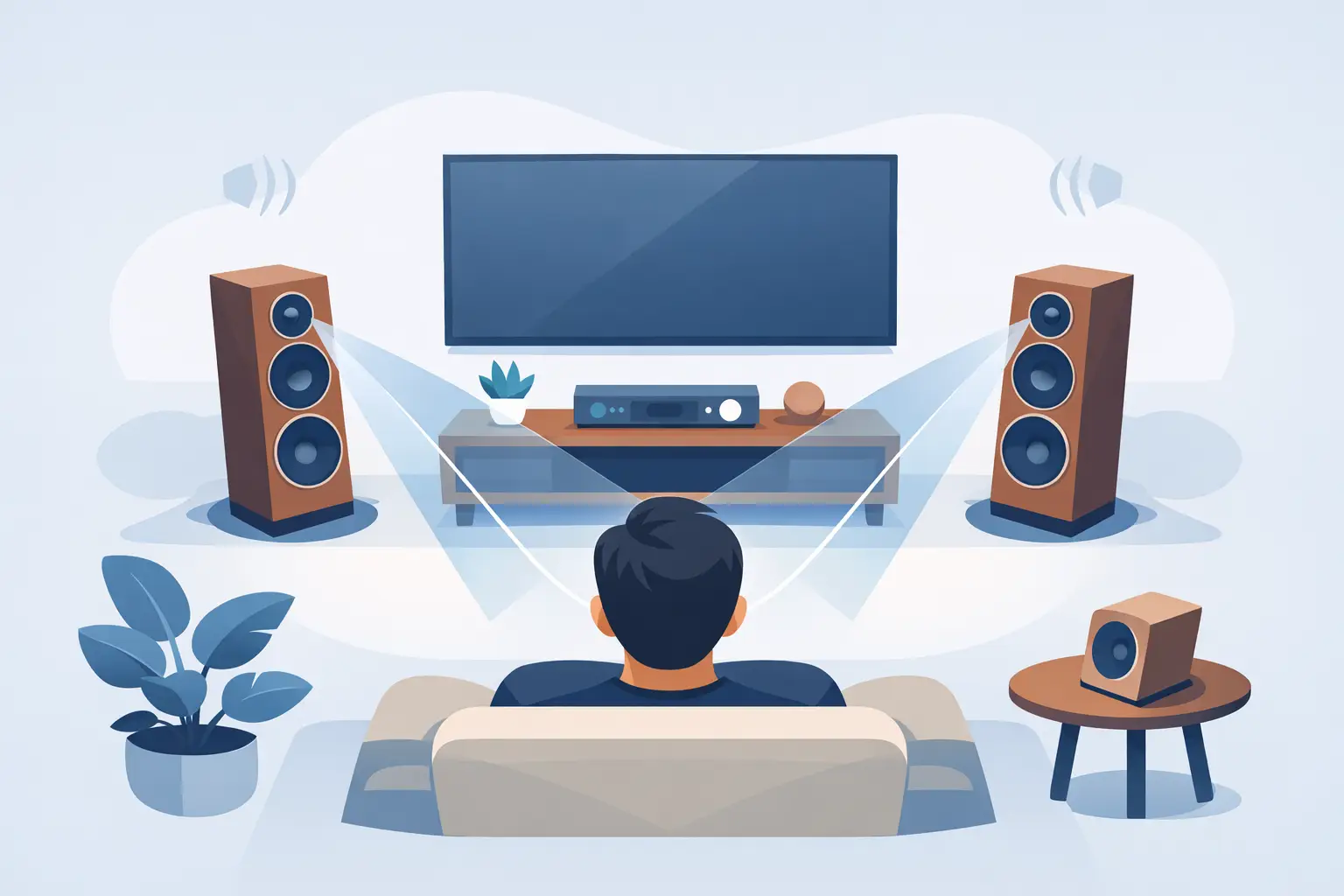
A system can measure flat, use excellent electronics, and still sound strangely unsettled if the speakers are aimed a few degrees off. That is why many experienced listeners spend real time to tune speaker toe in rather than treating it as a final cosmetic adjustment. Toe-in affects image focus, tonal balance, stage width, center fill, and how consistently a system performs across the listening seat.
For high-resolution loudspeakers, especially fast and revealing designs, toe-in is not a minor variable. It is part of the acoustic setup itself. When it is right, vocal placement locks in, instrumental outlines become more convincing, and the room contributes less confusion. When it is wrong, listeners often blame the amplifier, source, cable loom, or even the recording.
What speaker toe-in actually changes
Toe-in is simply the angle at which each loudspeaker is aimed toward the listening position. Small changes matter because most speakers do not radiate energy uniformly at every frequency. The on-axis response is often different from the off-axis response, and the room hears that difference too.
If you increase toe-in, you usually hear more direct energy from the tweeter or ribbon and less early side-wall contribution. That often improves image specificity and center focus. It can also make the presentation feel more intense or narrower if you go too far.
If you reduce toe-in, the stage may appear wider and more relaxed. In some rooms that can sound more natural. In others, image outlines soften, vocal placement becomes vague, and tonal balance shifts because you are listening farther off axis than the designer intended.
This is where serious setup moves beyond rules of thumb. The correct angle depends on the speaker's dispersion pattern, the room's reflectivity, the distance between speakers, and the listening distance. Ribbon-based systems can be especially sensitive because their horizontal and vertical radiation behavior is often more controlled and more revealing of small setup errors.
Before you tune speaker toe in
Set the basics first. Toe-in should not be used to compensate for poor speaker spacing, uneven distance to the listening seat, or major room asymmetry. Start by confirming that both speakers are the same distance from the primary listening position, that they are level, and that the front wall distance is intentional rather than arbitrary.
Also decide which seat matters most. If the system is optimized for one dedicated listening chair, you can pursue sharper focus and more exact symmetry. If the goal is a wider shared listening area, you may accept slightly less precise imaging in exchange for broader coverage.
A tape measure helps, but so does discipline. Mark initial positions on the floor with low-tack tape. Without a repeatable starting point, it becomes difficult to know whether the latest change actually improved anything.
A reliable starting point for toe-in
Begin with the speakers aimed so their axes cross just behind your head. This is a useful baseline because it tends to preserve center image stability without forcing an aggressively narrow stage. It also avoids the common mistake of pointing both speakers straight ahead in a room that clearly benefits from some directivity control.
From there, listen before making further adjustments. Use recordings you know intimately, not just spectacular audiophile material. A close-miked vocal, a small acoustic ensemble, and a dense orchestral or amplified track will tell you different things.
Listen for the center image first. A properly tuned pair should place a solo vocal in a stable, believable position without drifting left or right as pitch changes. Then evaluate width. The stage should extend beyond the speakers when the recording contains that information, but it should not become stretched or hollow in the middle.
The listening cues that matter most
The fastest way to tune speaker toe in is to stop chasing abstract terms and listen for specific outcomes.
Center fill is the first cue. If a singer sounds split between the speakers, you likely need more toe-in, better symmetry, or both. If the singer is tightly centered but unnaturally small and spotlit, toe-in may be excessive.
High-frequency balance is the next clue. Too little toe-in can make the top end seem muted, diffuse, or detached from the rest of the spectrum, particularly if you are far off axis. Too much can make transients sound etched and reduce ease, even when detail initially seems impressive.
Then consider stage geometry. Better toe-in does not always mean a wider image. It means a more believable one. Depth should emerge in layers, not as a flat curtain between the cabinets. Instruments should occupy space with stable boundaries rather than appearing and disappearing as arrangements become complex.
Finally, pay attention to the room. If strong side-wall reflections are pulling the image outward or adding glare, a touch more toe-in can reduce the room's influence. If the room is already controlled and the presentation feels hemmed in, backing off the angle may allow the system to breathe.
Small adjustments win
Make changes in very small increments. A half inch at the front inside edge of the cabinet can be enough to shift the entire presentation. Large swings usually cause overshooting, where listeners bounce between too much and too little toe-in without recognizing the best middle position.
After each adjustment, sit down and replay the same musical passage. Do not rely on memory across multiple tracks and long intervals. Toe-in work is comparative listening, not casual listening.
It also helps to adjust one variable at a time. If you change toe-in, speaker spacing, and listening distance in a single session, the result may improve, but you will not know why. For advanced users and dealers, that lack of process makes future optimization harder.
Toe-in and ribbon speaker behavior
Ribbon loudspeakers often reward precision because they can expose phase relationships, image boundaries, and tonal shifts with very little ambiguity. That does not mean every ribbon design wants aggressive toe-in. It means the audible result of each degree tends to be clearer.
In some ribbon systems, aiming directly at the listener produces exceptional focus and transient clarity. In others, crossing slightly in front of or behind the listener yields a more integrated tonal balance and a less mechanical soundstage. The right answer depends on the radiation pattern, crossover integration, and room behavior.
This is one reason setup should always be guided by listening rather than borrowed formulas. A premium loudspeaker can only perform to its standard when geometry and acoustics are working with the design, not against it.
Common mistakes when you tune speaker toe in
One common mistake is mistaking brightness for resolution. More toe-in can increase direct high-frequency energy and create an illusion of added detail. Real resolution, however, includes body, dimensionality, and low-level coherence, not just sharper edges.
Another mistake is optimizing only for a mono vocal. A dead-center voice is useful, but it is not the whole test. A system can produce a locked center image and still mishandle width, depth, or tonal evenness across a full arrangement.
The third mistake is ignoring seat height and ear position. With highly resolving speakers, especially those with controlled vertical behavior, a setup that works beautifully at one ear height can become less convincing if the chair is too low or too high. Toe-in cannot fix that by itself.
There is also the issue of asymmetrical rooms. If one side wall is closer, more reflective, or partly open, identical angles may not produce the most symmetrical sound. Purists sometimes resist this, but real rooms are not always cooperative. Occasionally the best acoustic result comes from slightly unequal toe-in side to side.
When more toe-in is usually the right move
If imaging is vague, center vocals do not lock, and the room feels overly dominant, try increasing toe-in. The same applies if the system sounds polite but not immediate, or if transient articulation seems weaker than the speaker's design suggests it should be.
More toe-in can also help in lively rooms with minimal side-wall treatment, where reducing early lateral reflections improves clarity. Dealers often use this approach to stabilize imaging in unfamiliar spaces.
When less toe-in is usually better
If the stage feels too narrow, the tonal balance is overly forward, or long sessions become fatiguing, reduce toe-in slightly. This can be especially effective when the listening seat is relatively close to the speakers and already receiving strong direct energy.
Less toe-in may also suit listeners who prioritize scale and openness over razor-sharp image outlines. That is not a compromise if the result remains tonally correct and spatially coherent. It is simply a different setup target.
Knowing when you are done
You are done when the system stops calling attention to speaker placement. The cabinets recede, the center image holds naturally, and the tonal balance remains convincing across a wide range of recordings. At that point, further adjustment usually trades one virtue for another rather than delivering a clear gain.
For a revealing system, careful setup is part of ownership, not an afterthought. Brands such as Clarisys Audio build loudspeakers capable of exposing exactly these differences, which is why patient positioning matters as much as premium electronics. If you give toe-in the same seriousness you give component matching, the reward is not a hi-fi trick. It is a more believable musical event in your room.
The last few degrees are rarely dramatic, but they are often where a system becomes truly convincing.