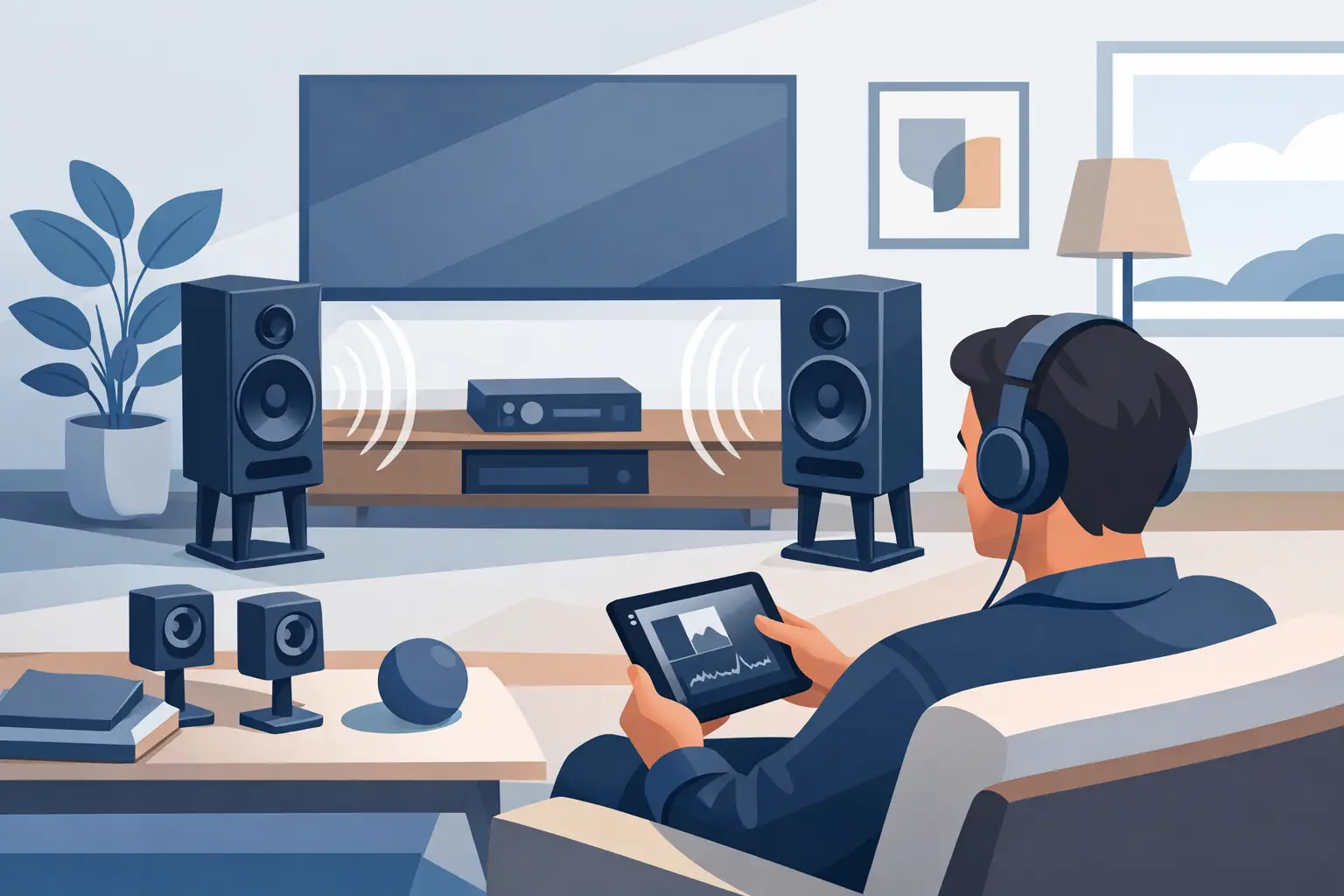
A loudspeaker can sound spectacular for five minutes and still be the wrong loudspeaker for your system. The purpose of a home speaker audition guide is not to identify the most immediately impressive presentation. It is to determine whether a speaker preserves the musical qualities that matter to you across familiar recordings, realistic levels, and the particular acoustic behavior of your room.
For a serious listener, an audition is less like a product demonstration and more like a controlled listening session. You are assessing a transducer, a room, associated electronics, setup decisions, and your own priorities at the same time. That complexity is precisely why disciplined listening pays off.
Begin With Your Room, Not the Specification Sheet
Before arranging an audition, establish the physical constraints that will shape the result. Measure the listening room, note ceiling height, identify large glass surfaces and open adjoining spaces, and consider where speakers can realistically live. A speaker that needs substantial distance from the front wall may be extraordinary in a dedicated room yet impractical in a living space where placement must be more discreet.
The listening position matters just as much. A chair pressed against the rear wall often encounters elevated bass energy and less convincing depth. If possible, allow room behind both the loudspeakers and the listener. Symmetry is helpful, though not always available. The goal is not visual perfection but a stable acoustic foundation.
This is particularly relevant with high-resolution ribbon speaker technology. A well-executed ribbon design can reveal very fine transient and spatial information, but that information benefits from careful toe-in, appropriate listening distance, and thoughtful control of early reflections. Do not dismiss a speaker because it performs poorly in an unsuitable position. Equally, do not purchase one based on a carefully prepared showroom setup you cannot approximate at home.
Establish the System Context
A loudspeaker is not an isolated component. Ask what amplification, source, cables, and digital front end will be used during the audition. The electronics do not need to match your system exactly, but they should be credible partners for the speaker's load and performance level.
Pay special attention to amplifier behavior. A speaker's nominal impedance is only part of the story; impedance variation, sensitivity, current demands, and the amplifier's ability to remain composed during dynamic peaks all affect what you hear. If a speaker sounds constrained, bright, or soft in the bass, do not assume the transducer is solely responsible. The pairing may be limiting it.
Level matching also deserves more respect than it usually receives. A difference of even a small amount in playback level can make one speaker appear fuller, more detailed, or more dynamic. When comparing models, ask the dealer to match levels as closely as possible and avoid rapid switching before you have listened to complete musical passages. Your ears need enough time to recognize a speaker's character rather than react to novelty.
Choose Music That Exposes, Not Flatters
Bring recordings you know deeply, preferably in the same format and resolution you use at home. The best audition tracks are not necessarily audiophile favorites. They are recordings whose vocal phrasing, bass line, cymbal texture, orchestral scale, or studio ambience you can recall with confidence.
Build a compact set that covers four useful tests:
- A naturally recorded voice to assess presence, sibilance, chest resonance, and intelligibility.
- Small acoustic ensemble music to hear timing, instrumental tone, and the space between performers.
- A dense rock, electronic, or large-scale orchestral passage to test composure when the mix becomes complex.
- Music with sustained low frequencies to assess pitch definition and room interaction, not simply bass quantity.
Listen for whether individual lines remain intelligible as a track builds. A capable system does not turn complexity into a wall of sound. It preserves the momentum of the performance while allowing you to follow bass, rhythm, harmony, and vocal expression without strain.
Avoid making a decision from a single pristine recording. Some speakers can cast a remarkable image on sparse material while becoming fatiguing or congested when fed less forgiving music. A long-term loudspeaker must respect the range of recordings you actually own.
What to Hear During a Home Speaker Audition
Tonal balance and timbre
Start with tonal credibility. Voices should have body without excess thickness, and instruments should sound like themselves rather than like a speaker's interpretation of themselves. Listen to piano in particular. Its range exposes discontinuities between drivers, exaggerated upper-midrange energy, and indistinct low-register weight.
Do not confuse elevated treble with resolution. Initial brightness can make detail seem more obvious, especially in a short audition. Genuine resolution reveals low-level information, harmonic structure, and recorded ambience without forcing your attention toward hi-hats, vocal consonants, or string sheen. If you find yourself lowering the volume on familiar music, investigate why.
Dynamics and composure
Dynamic ability has two dimensions. Macro-dynamics are the large swings from quiet to loud. Micro-dynamics are the smaller shifts in touch, breath, bow pressure, and rhythmic emphasis that make a performance feel alive.
Play music at a realistic level, then slightly below it. A refined speaker should remain engaging at moderate volume, where many people spend most of their listening time. At higher levels, listen for compression, hardening, bass blur, or a soundstage that collapses toward the cabinets. The appropriate limit depends on room size and listening habits, but composure matters more than sheer loudness.
Imaging, scale, and soundstage
A convincing image is not a collection of pinpoints floating in empty space. It is a believable relationship among performers, recording venue, and musical scale. With a strong recording, a center vocal should remain stable as you move slightly around the listening seat. Instruments should not appear to cling to the speaker enclosures.
Depth is especially revealing. Can you sense a front-to-back relationship between a soloist and the rear of the hall? Does a reverberant recording retain its decay, or does the room swallow it? Keep perspective in mind: an oversized image may be exciting, but it can also be less faithful to the recording.
Bass quality and integration
The question is not whether the speaker produces bass. It is whether bass has pitch, starts and stops cleanly, and joins the rest of the spectrum without calling attention to itself. Room modes can make a single note dominate, turning a double bass into a sequence of booms rather than distinct notes.
Move the speaker or listening seat in small increments before judging low-frequency performance. A change of several inches can materially alter bass balance. If a subwoofer is part of the plan, audition the integration process rather than assuming deeper extension alone will improve the system.
Take Time Between Sessions
Auditory memory is short, and novelty is powerful. If possible, return for a second session on another day. The first visit often reveals a speaker's strengths. The second tells you whether those strengths are accompanied by comfort, consistency, and emotional connection.
After each audition, write a few observations without consulting specifications or sales literature. Note which recordings drew you into the performance, which became difficult, and whether you felt encouraged to keep listening. This is more useful than attempting to rank speakers by isolated attributes.
A home trial is the most meaningful final step when it is available. In your own room, use your own music and components, and allow enough time for placement refinement. Clarisys Audio encourages the kind of careful, informed listening that recognizes a loudspeaker as part of a complete system rather than a showroom spectacle.
Ask Questions That Protect the Investment
A premium loudspeaker purchase includes ownership considerations beyond the audition. Ask about recommended room dimensions, amplifier matching, placement guidance, break-in expectations, service access, warranty terms, and the availability of manuals or technical support. For long-lived components, a strong dealer relationship and access to knowledgeable after-sale assistance can matter as much as the initial demonstration.
Also ask whether the model has meaningful setup flexibility. Adjustable toe-in, well-considered bass alignment, and clear positioning guidance can make the difference between a speaker that merely works and one that becomes fully convincing. There is no shame in choosing the model that integrates more gracefully with your room over the one that claims a marginal advantage under ideal conditions.
The right choice is the speaker that makes familiar music feel more complete, not the speaker that wins every isolated test. Give it a proper room, appropriate electronics, and enough unhurried listening time. The result should be a system you return to long after the excitement of the purchase has passed.