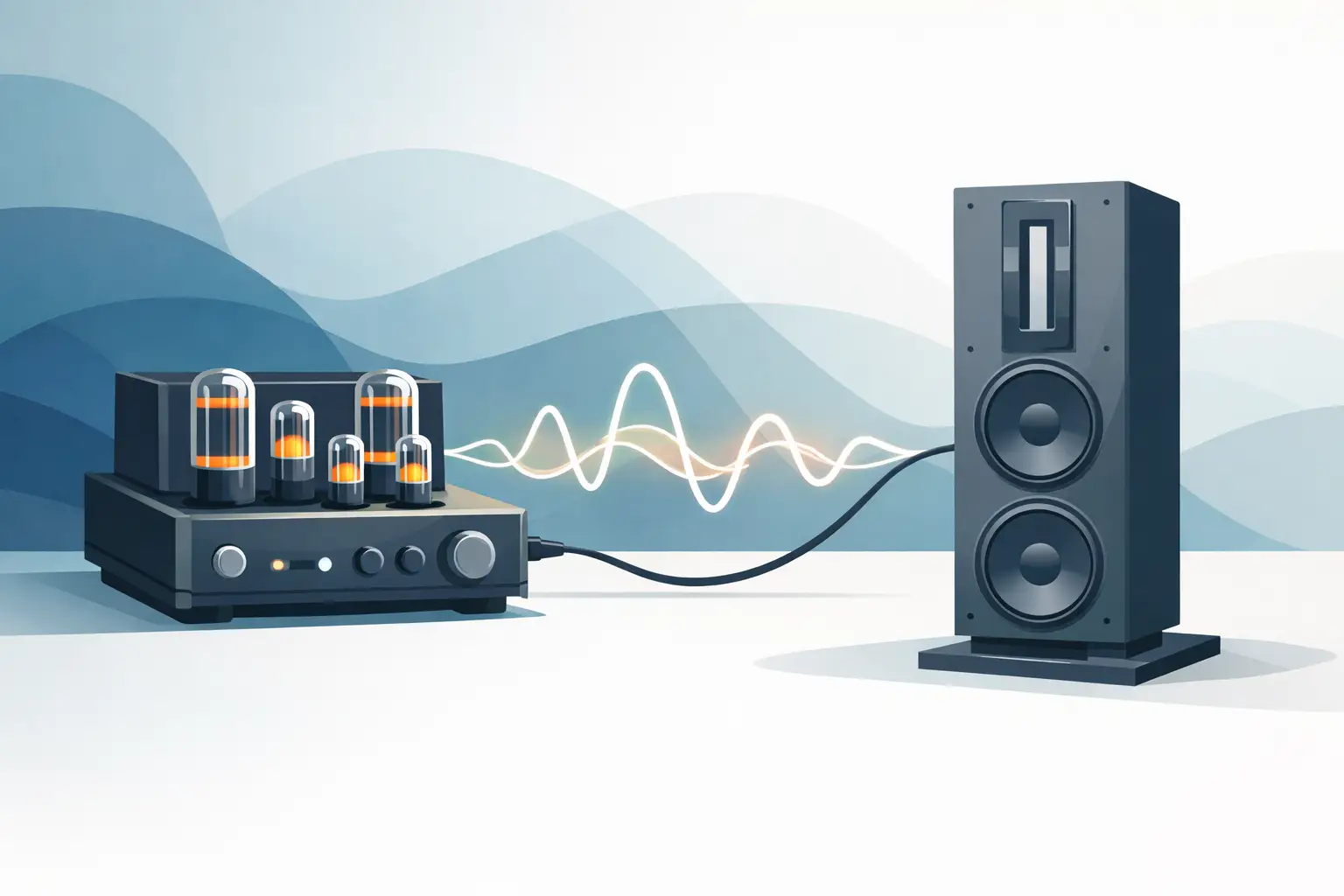
A well-chosen tube amplifier can make a ribbon loudspeaker sound remarkably immediate, dimensional, and tonally complete. But can tube amplifiers drive ribbons in every system? No. The answer rests less on whether an amplifier uses tubes and more on the speaker’s impedance behavior, the output transformer’s quality and taps, the listening distance, and the level at which you expect the system to play.
Ribbon speakers do not ask for a particular amplifier topology as a matter of principle. They ask for an amplifier that remains composed into their real electrical load while preserving the dynamic nuance and low-level resolution that make ribbon technology so compelling. A great tube amplifier can be an exceptional partner. The wrong one can sound soft, constrained, or unstable long before its rated power suggests it should.
Why Ribbon Speakers Challenge Amplifiers
A ribbon is an exceptionally light transducer. Its low moving mass allows it to respond quickly to musical transients, revealing texture in bow pressure, the leading edge of a piano note, the decay of cymbals, and the spatial cues that define a convincing recording. That speed does not automatically mean the speaker is difficult to drive, but many ribbon designs present demands that deserve careful attention.
The relevant specification is not sensitivity alone. A speaker may appear reasonably sensitive on paper yet require meaningful current when its impedance falls in the bass or lower midrange. The electrical phase angle matters as well. When impedance and phase combine unfavorably, the amplifier sees a load that is more demanding than a single nominal impedance number can convey.
This is where broad claims become unhelpful. “Tube amplifiers lack current” is not technically precise, just as “ribbons need solid state” is not universally true. A transformer-coupled tube amplifier delivers power through its output transformer, and the transformer reflects the speaker load back to the output tubes. Its design, core capacity, winding quality, feedback strategy, and available taps strongly influence how confidently it controls a real loudspeaker.
Can Tube Amplifiers Drive Ribbons? Yes, With the Right Match
The most successful tube-and-ribbon systems tend to share a few characteristics. The amplifier has an output transformer designed for wide bandwidth and stable load handling. It has enough clean power for the room and listening habits. Most importantly, the owner has selected the correct speaker tap by listening as well as measuring.
A 4-ohm speaker tap is not merely a lower-power connection. It changes the load relationship seen by the output stage. If a ribbon loudspeaker has a nominal 4-ohm rating, that tap is usually the logical starting point. Yet published nominal impedance is only the beginning. Some speakers may sound more open, balanced, or controlled from a different tap, depending on the amplifier’s transformer and the speaker’s impedance curve. This is a legitimate area for careful comparison, provided the amplifier manufacturer permits the connection and the system is evaluated at sensible levels.
Power requirements also depend on the room. In a smaller dedicated listening room, a high-quality 35- to 60-watt tube amplifier may provide ample headroom with an appropriately matched ribbon speaker. In a large, open-plan space, or for listeners seeking realistic orchestral peaks and concert-level rock dynamics, 100 watts or more may be the more relaxed choice. Headroom is not only about maximum loudness. It is about allowing crescendos to arrive without the amplifier hardening, flattening the soundstage, or losing bass definition.
Wattage Is Not the Whole Story
Two amplifiers with identical power ratings can behave very differently. One 50-watt design may have generous transformers, strong power supplies, and excellent stability into changing loads. Another may reach its limits earlier, particularly in the lower registers where music carries substantial energy.
Tube type alone does not settle the matter either. A carefully designed EL34, KT88, 6550, KT150, or 6L6 amplifier can all be successful in the right system. Push-pull amplifiers are often favored when substantial room-filling capability is required, while a refined single-ended design can be deeply persuasive with a compatible ribbon speaker at moderate levels. The decision should follow the speaker, room, and repertoire rather than a preference for tube families.
A useful listening test is not a brief vocal track at low volume. Use music with sustained bass, dense orchestration, and sudden dynamic shifts. Listen for the bass line losing pitch definition, the center image becoming vague as volume rises, or high frequencies turning strained during complex passages. These are signs that the system may be running out of amplifier control or headroom.
The Damping Factor Question
Ribbon owners often encounter the term damping factor, usually in discussions that favor high-power solid-state amplification. Damping factor describes, in simplified terms, the relationship between speaker impedance and amplifier output impedance. A lower amplifier output impedance can exert greater electrical control over the woofer or bass section, which may influence bass weight, transient shape, and tonal balance.
Many tube amplifiers have a lower damping factor than solid-state designs. That does not disqualify them. It means their interaction with the loudspeaker’s impedance curve may be more audible. If impedance rises through part of the frequency range, a tube amplifier with higher output impedance may produce a mild tonal lift there. Depending on the speaker and room, this can be musically welcome, neutral, or too warm.
The best approach is to treat damping factor as one part of a system decision, not a scorecard. A ribbon speaker with well-engineered bass loading, a benign impedance profile, and thoughtful crossover design may pair beautifully with tubes. A speaker with deep impedance dips and demanding bass requirements may benefit from a more powerful tube design, a solid-state amplifier, or a hybrid approach.
Do Not Confuse Warmth With Control
The attraction of tubes is often described as warmth, but that word can obscure more than it explains. A first-rate tube amplifier should not simply soften the sound. It can reveal harmonic structure, preserve image depth, and render instrumental color with unusual continuity. With a properly matched ribbon speaker, the result can be exceptionally transparent without becoming etched.
If bass becomes generous but indistinct, or if the soundstage shrinks as music becomes complex, that is not necessarily “tube character.” It may be a mismatch. The goal is not to impose a personality on the speaker. It is to let the system reproduce scale, tone, and dynamic contrast without obvious effort.
Choosing an Amplifier for a Ribbon System
Start with the loudspeaker manufacturer’s recommended amplification range, but read it as context rather than a guarantee. Ask for the impedance curve if it is available, and pay attention to minimum impedance, phase behavior, and the frequencies where those conditions occur. A low impedance in the upper treble may be less punishing than a demanding load through the bass and lower midrange, where far more musical power is required.
Then consider how you actually listen. A nearfield listener who values chamber music, vocal jazz, and acoustic recordings has different needs from a listener seated 14 feet away with large-scale symphonic works and electronic music. Room absorption, speaker placement, and bass reinforcement from boundaries also affect how hard the amplifier must work.
For a Clarisys Audio ribbon loudspeaker, auditioning remains essential. Bring familiar recordings that expose vocal placement, bass articulation, and dynamic compression. Compare amplifiers at matched levels, including passages that challenge the system. A component that initially seems more exciting can prove less convincing over a full evening if it sacrifices tonal balance or musical ease.
Also confirm practical compatibility. Use correctly terminated speaker cables, connect them with the amplifier powered down, and never operate a tube amplifier without a speaker load attached unless its manufacturer explicitly allows it. Tube amplifiers generate high voltages at their output transformers, and open-circuit operation can cause damage. Verify bias requirements, tube availability, service support, and heat management before making a long-term choice.
When Solid State May Be the Better Choice
There are circumstances in which solid state is the more straightforward solution. A large room, a speaker with difficult low-impedance behavior, or a preference for very high playback levels can favor an amplifier with substantial current delivery and high continuous power. Modern solid-state amplifiers can offer exceptional transparency, grip, and low-frequency authority with ribbon systems.
That choice does not diminish the case for tubes. It simply recognizes that a system is an electrical and acoustic partnership. Many experienced listeners also choose a tube preamplifier with a powerful solid-state power amplifier, preserving some of the dimensional and tonal qualities they value while providing greater control over demanding bass loads.
The right amplifier will not call attention to its topology. It will let the ribbon’s speed, resolution, and scale emerge naturally, leaving the listener focused on the performance rather than the equipment.