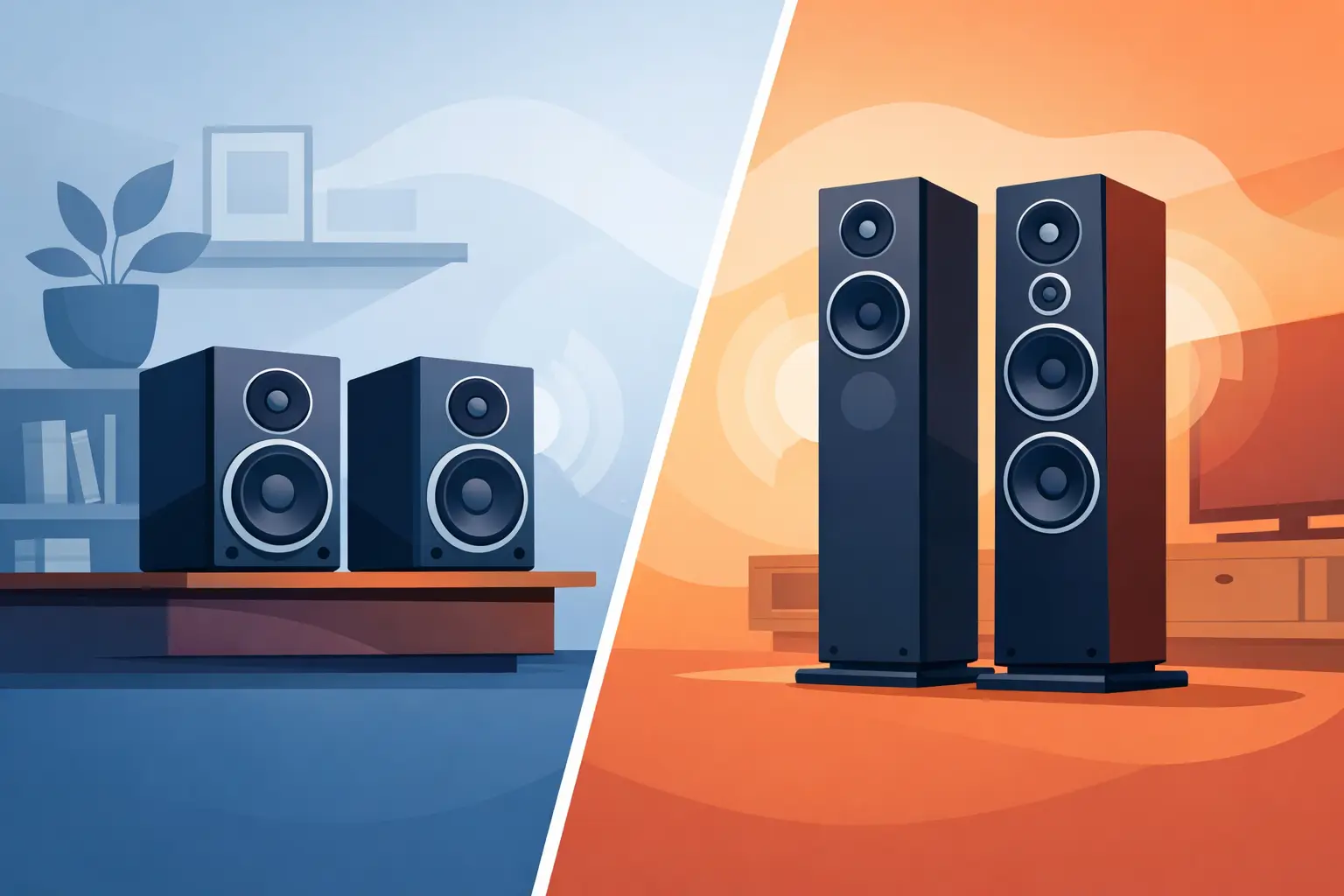
A speaker’s footprint is often treated as a styling decision. In a serious listening room, it is an acoustic decision first. The bookshelf vs floorstanding speakers question determines how deeply a system reaches into the bass, how it energizes the room, how much placement freedom remains, and whether the loudspeaker can reproduce large-scale music without strain.
Neither format is inherently superior. A well-designed stand-mount can produce more convincing imaging than a poorly placed tower, while a properly engineered floorstander can deliver scale and low-frequency authority that a compact enclosure cannot physically match. The correct choice begins with the room, the listening distance, the music, and the expectations placed on the system.
The real distinction is cabinet volume
The obvious difference between a bookshelf speaker and a floorstanding speaker is height. The more consequential difference is internal volume. A larger enclosure gives a designer more latitude to use larger bass drivers, lower tuning frequencies, additional driver sections, or more sophisticated internal loading. This is why floorstanding speakers typically offer greater bass extension and higher maximum output.
A bookshelf speaker, more accurately called a stand-mount speaker in a high-performance system, works within tighter physical limits. Its smaller cabinet can be advantageous: the enclosure may be easier to control for resonance, and its compact front baffle can support precise dispersion and stable stereo imaging. Yet there is no escaping the physics. Below a certain frequency, moving enough air requires cone area, excursion, cabinet volume, or some combination of all three.
For acoustic jazz, chamber music, vocals, and smaller ensembles, a refined stand-mount may feel complete in a modest room. For orchestral recordings, pipe organ, electronic music, or live rock, the additional low-frequency capacity of a floorstanding design can make the performance feel less reduced in scale.
Bookshelf vs floorstanding speakers in real rooms
Room volume matters more than many buyers expect. A speaker does not perform in isolation. Its bass output interacts with boundaries, room modes, floor construction, furnishings, and the distance from the listening position.
In a smaller dedicated room or an apartment living space, a floorstanding speaker may excite low-frequency room modes too strongly. The result is not necessarily more bass, but less articulate bass: a sustained note can become thick, slow, or disproportionately loud. A stand-mount speaker may offer a more balanced starting point, particularly when placed clear of sidewalls and supported on rigid, mass-appropriate stands.
That does not mean small rooms automatically require small speakers. A carefully designed floorstander with controlled bass alignment can work beautifully in a compact space, provided there is room to position it properly. Conversely, a stand-mount placed close to a rear wall can generate more bass weight than expected. Placement and room treatment can alter the outcome as much as the enclosure category.
Larger rooms introduce a different challenge. As the listening distance increases, a speaker must maintain dynamic contrast and tonal density across more air. Floorstanding speakers generally have an advantage here because they can distribute the workload across multiple drivers and carry more low-frequency energy into the room. They may also retain composure when the musical program shifts suddenly from a quiet passage to a full orchestral climax.
Bass extension is not the same as bass quality
A floorstander’s lower specified frequency response is useful, but it should not end the discussion. Deep bass is valuable only when it is integrated, controlled, and proportionate to the rest of the spectrum. A speaker that reaches lower but overdrives a room is less satisfying than one that stops higher yet reveals pitch, texture, and rhythmic precision.
Stand-mount speakers often benefit from their natural handoff to a subwoofer. A properly integrated subwoofer can extend bass response while allowing the main speakers to focus on the range where their cabinets and drivers are most comfortable. This approach can be exceptionally effective, though it requires care with crossover settings, phase, location, and level. A subwoofer is not merely a device for adding impact. It must arrive and stop with the main loudspeakers as one coherent system.
A floorstanding speaker can simplify the system by providing satisfying full-range response from two enclosures. For listeners who prefer minimal equipment and do not wish to pursue subwoofer integration, this is a compelling advantage. Still, even a large floorstander may benefit from one or more subwoofers in a difficult room, especially when the goal is smoother bass across multiple seating positions.
Imaging, height, and the listening perspective
The best stand-mount speakers are admired for their ability to disappear. With careful placement, they can create a focused soundstage in which instruments occupy stable, believable positions. Their narrower baffles and reduced cabinet presence can contribute to clean lateral imaging and sharply drawn phantom center images.
Floorstanding speakers can image with equal precision, but they tend to present music on a larger physical and dynamic canvas. Their driver layout places more of the radiating surface at a natural seated-ear height, while taller cabinets may create a greater sense of vertical scale. The effect is especially persuasive with recordings that capture hall ambience, large choirs, or the full body of a concert grand piano.
Ribbon speaker technology adds another consideration. A ribbon’s low moving mass can reveal transient detail and spatial information with remarkable speed, but its dispersion behavior and vertical geometry require thoughtful setup. The listening height, toe-in, and distance from room boundaries should be treated as part of the design, not as final adjustments made by eye. In either cabinet format, the speaker must be positioned to allow its ribbon transducer to develop a coherent wavefront at the listening seat.
Amplification and dynamic demands
Do not assume that a smaller speaker is always easier to drive. Sensitivity, impedance behavior, crossover complexity, and driver loading determine amplifier demands more reliably than cabinet size alone. Some compact high-end speakers present a challenging electrical load, while some floorstanding designs are relatively amplifier-friendly.
That said, floorstanders often encourage higher playback levels because they can sound more effortless at scale. The amplifier must provide adequate current and control, particularly in the bass where driver motion demands the most authority. A system that sounds polished at moderate volume can lose grip when a large floorstander is asked to reproduce sustained orchestral bass, kick drum, or synthesized low frequencies.
When evaluating amplification, look beyond headline wattage. A stable amplifier with substantial current delivery, low noise, and disciplined control of the loudspeaker can be more valuable than a higher-powered unit that becomes unsettled into difficult impedance swings. Auditioning with familiar, dynamically demanding music remains the most meaningful test.
Placement is part of the purchase
A compact speaker is not truly compact once it is installed correctly. Proper stands add height and footprint, and the speakers may need to sit several feet into the room. A pair of stand-mounts, rigid stands, and subwoofers can occupy as much visual and physical space as a pair of slim floorstanders.
Floorstanding speakers eliminate the need for separate stands and usually provide a more integrated mechanical foundation. Their larger cabinets, however, can be less forgiving of poor placement. Before choosing, measure the available distance from the front wall, sidewalls, and listening chair. Consider whether both speakers can be positioned symmetrically and whether the room allows incremental adjustment.
The listening triangle remains useful: begin with comparable distances between the two speakers and the listening seat, then refine from there. Small changes in toe-in and wall distance can substantially affect tonal balance, image focus, and bass behavior. A premium loudspeaker deserves this attention.
Choosing the format that serves the music
Choose stand-mount speakers when room size, placement flexibility, and imaging precision are central priorities. They are particularly compelling for focused listening in small to medium rooms, and they leave a clear upgrade path through carefully integrated subwoofers.
Choose floorstanding speakers when the room can accommodate them and the musical experience calls for greater bass reach, dynamic ease, and physical scale. They often make the strongest case for listeners who want a complete full-range presentation from a simple two-speaker system.
The most rewarding choice is rarely the largest speaker that will fit through the door. It is the speaker that can breathe in the room, match the amplifier, and make a familiar recording reveal another layer of musical intent. Arrange a proper audition, bring demanding music you know intimately, and give the setup enough time to speak for itself.