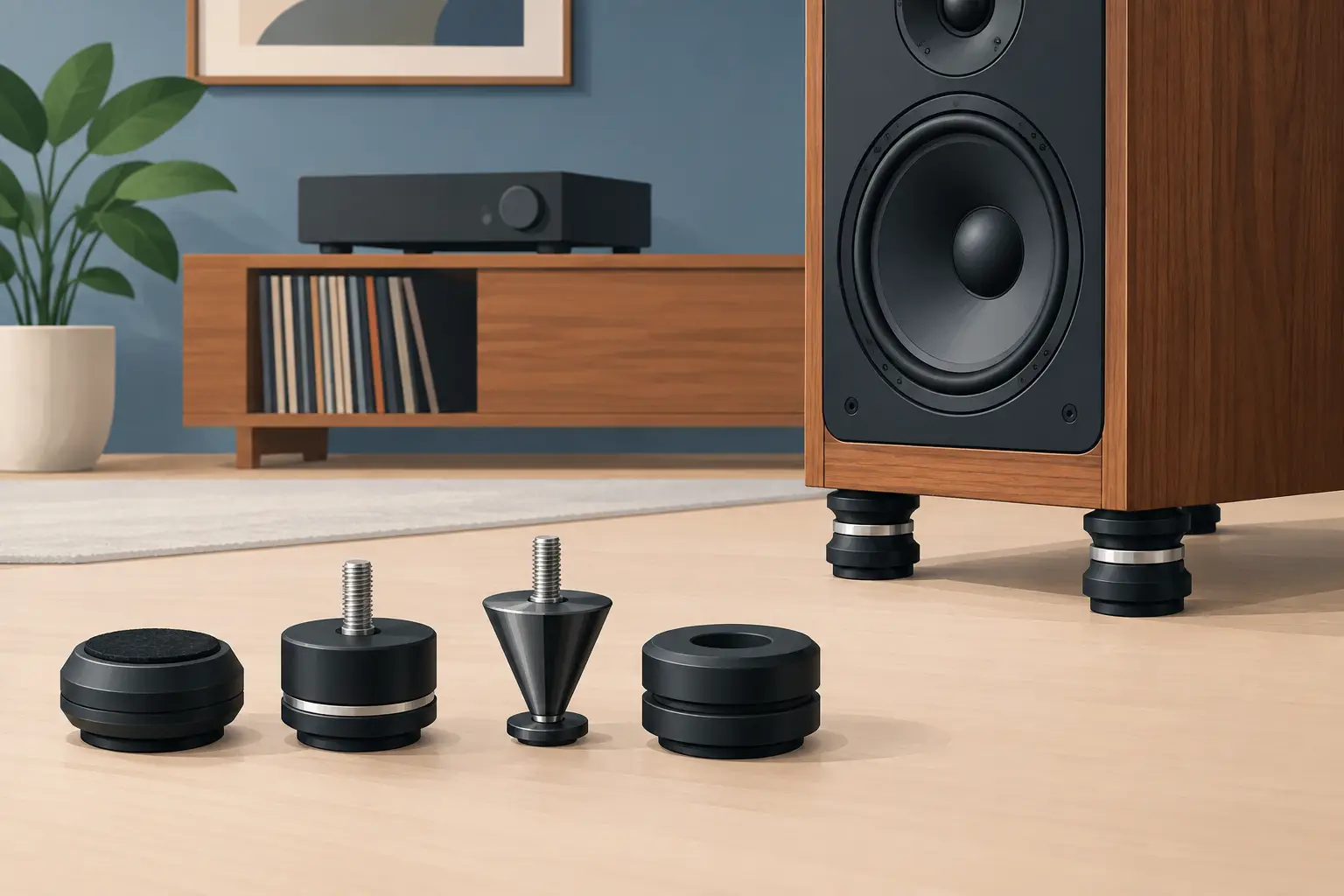
A loudspeaker does not end at its cabinet. Its mechanical behavior extends through the stand or plinth, into the contact points beneath it, and finally into the floor. That is why the best speaker isolation feet are not simply the softest, most expensive, or most aggressively marketed option. They are the ones that suit the speaker’s mass, cabinet geometry, floor construction, and the way energy is managed in the complete system.
For a serious hi-fi installation, this is not a cosmetic detail. An unsuitable interface can allow a speaker to rock microscopically, store energy in a compliant floor, or transmit vibration into furniture and nearby equipment. The audible effect may range from subtly softened bass articulation to less stable imaging. Just as often, however, a poorly chosen isolation product can make matters worse. The goal is controlled mechanical grounding or carefully tuned decoupling, not isolation as an abstract ideal.
What Speaker Isolation Feet Actually Do
The phrase “speaker isolation” covers two different strategies that are often confused. Coupling creates a firm, stable path between the speaker and a substantial supporting surface. Decoupling uses a compliant material or mechanical device to reduce vibration transfer between the speaker and its support.
Neither strategy is automatically superior. A heavy loudspeaker on a dense concrete slab may benefit from a rigid, adjustable interface that establishes stable contact and makes leveling precise. A speaker on a suspended wood floor may excite the floor structure itself, in which case a correctly rated compliant footer can reduce energy transfer and tighten the system’s low-frequency behavior.
The distinction matters because loudspeakers generate force. Woofer motion produces an equal and opposite reaction in the cabinet. Ribbon speakers, while often exceptionally fast and low in moving mass through the midrange and treble, still rely on a cabinet and bass system that must remain mechanically stable. A footer should support that stability, not introduce lateral movement, tilt, or an uncontrolled resonant frequency.
Best Speaker Isolation Feet Start With the Floor
Before comparing materials or brands, identify what is beneath the speaker. This single decision often determines whether coupling or decoupling is the more rational approach.
Concrete slabs and solid masonry floors
A concrete slab is comparatively massive and inert. Here, the priority is usually rigid support, accurate leveling, and protection for the finished surface. Adjustable metal feet, spikes used with proper floor protectors, or hard interface discs can work well when they prevent cabinet rocking and provide repeatable contact.
The trade-off is that a very rigid interface can transmit some cabinet vibration into the floor. On a genuine slab, that transfer is often less problematic than instability at the speaker base. Do not assume that adding soft elastomer pads will improve the sound. If the speaker can sway slightly or settle unevenly into the material, bass precision and image focus may suffer.
Suspended wood floors
Wood joists, raised subfloors, and engineered floors behave differently. They can flex, store energy, and act as broad resonant surfaces. In this environment, decoupling may be valuable, particularly with full-range loudspeakers that produce significant low-frequency output.
Choose feet designed for the actual load, not merely the total weight printed on the carton. Divide the speaker’s weight by the number of support points, then account for uneven distribution caused by the cabinet’s center of gravity. A footer that is too soft for its load can bottom out or become unstable. One that is too stiff may provide little meaningful isolation.
Carpet, rugs, and mixed surfaces
Carpet complicates the issue because it is already compliant, but not necessarily stable. A thick pad beneath carpet can allow a speaker to lean or shift. Spikes can reach through carpet to a solid subfloor, while broad, rigid feet may distribute weight and reduce indentation. The right choice depends on what lies below the carpet, not the carpet alone.
For hardwood, tile, and stone, protect the finish. A spike cup or purpose-built hard disc preserves a stable interface without sacrificing the ability to level the speaker. Improvised coins, loose furniture pads, and soft adhesive bumpers are poor substitutes in a system where placement and alignment matter.
How to Evaluate Isolation Feet for Your System
The best speaker isolation feet are specified by engineering constraints before they are chosen by listening preference. Start with load capacity, height, contact geometry, and the device’s behavior under lateral force.
A suitable footer has sufficient load capacity with room to spare. It should maintain its intended operating range under the speaker’s real weight. If a product uses elastomer, spring, air, or constrained-layer materials, its stated load range is not a suggestion. Operation outside that range changes the device’s resonant behavior and can compromise its effectiveness.
Height deserves more attention than it usually receives. Raising a speaker changes tweeter or ribbon height relative to the listener and may alter the relationship between the speaker and the floor. A few millimeters can be useful for leveling; several inches may require revisiting toe-in, rake angle, and listening position. For speakers designed around a specific acoustic center, maintain the intended geometry whenever possible.
Also examine the cabinet’s base. Four feet are intuitive, but three contact points are inherently stable on an uneven floor. Some high-end designs use three-point support for precisely this reason. If the speaker already has threaded inserts, use hardware that is compatible with the thread specification and does not extend so far into the cabinet that it risks internal damage.
Materials: What They Can and Cannot Tell You
Material names alone do not predict sonic results. Aluminum, stainless steel, brass, ceramic, sorbothane-type elastomers, rubber, and composite constrained-layer designs can all be appropriate in the right implementation.
Hard metals are commonly associated with coupling because they resist compression and provide a defined contact point. Their usefulness depends on the mass and rigidity of the support below them. Ceramic balls and cups can offer very low contact area, but they require careful installation and may be unforgiving on delicate floors.
Elastomers are used for decoupling and damping. Their performance depends on compound, shape, thickness, temperature, and load. A generic rubber puck may protect a floor yet offer no controlled isolation. A properly engineered elastomer footer can be effective, but only when its compliance matches the speaker and floor. Broad claims about one material sounding “faster” or “warmer” should be treated cautiously unless the comparison controls for placement, level, and stability.
A Listening Method That Produces Useful Answers
Mechanical accessories invite expectation bias because they are easy to install and often visually persuasive. Make the evaluation disciplined. Begin with speaker position marked on the floor, confirmed level, and a familiar recording with articulate bass, centered vocals, and complex spatial information.
Listen first for stability rather than spectacle. Does the bass start and stop cleanly? Does the center image remain locked as the music becomes dense? Are low notes more differentiated, or merely lighter? Does the soundstage gain depth without losing tonal weight? These questions reveal more than a generalized impression of added detail.
Then compare at least two conditions: the existing interface and the candidate footer. Keep toe-in, listening level, and placement unchanged. If installation changes speaker height, restore the acoustic alignment as closely as possible before judging. Repeat the comparison on another day. A meaningful improvement should remain apparent without requiring a dramatic shift in volume or a favorable first impression.
When Isolation Feet Are Not the Answer
Isolation feet cannot correct a speaker that is poorly positioned, improperly leveled, or operating in a room with severe modal problems. If bass is bloated because the speakers are too close to the front wall or listening seat, changing footers may only move the symptom. Likewise, a cabinet that rocks because of an uneven floor needs stable leveling before it needs sophisticated damping.
Treat footers as part of setup optimization, after speaker placement, room interaction, and support rigidity have been addressed. For Clarisys Audio owners, that means preserving the speaker’s designed orientation and the precise acoustic relationships that allow ribbon technology to reveal its speed, scale, and spatial resolution.
The most rewarding choice is often the least theatrical one: a properly rated interface that makes the speaker feel absolutely planted, protects the floor, and disappears from attention. Once the foundation is mechanically correct, the music has a clearer path to do the work.