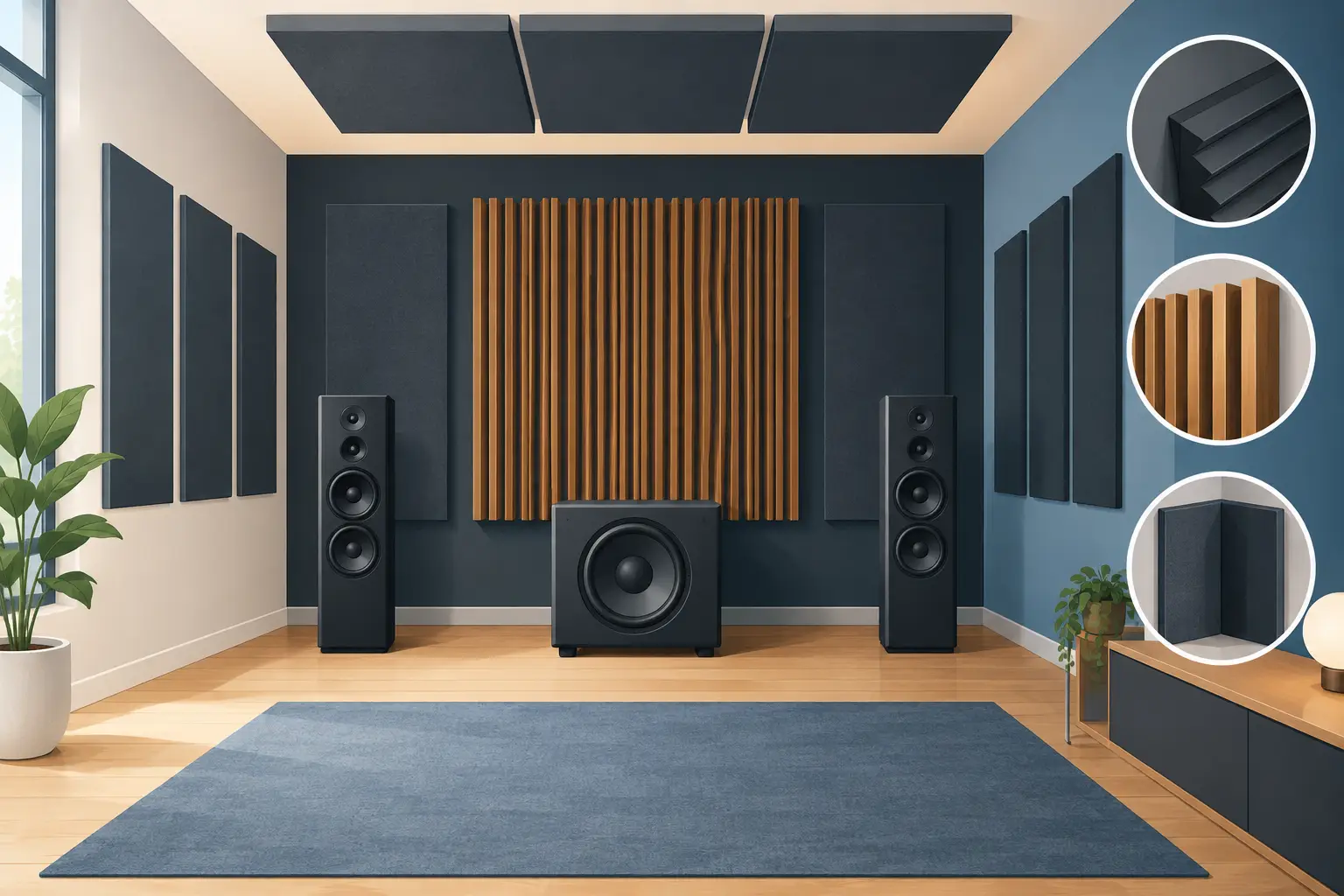
A well-designed loudspeaker can reveal the weight of a concert grand, the pitch of an upright bass, and the physical scale of a kick drum. Yet below roughly 200 Hz, the listening room becomes an equal partner in the performance. The best room treatments for bass do not simply make a system sound leaner or more controlled. They reduce the room's tendency to exaggerate some notes, erase others, and blur the timing that gives music its foundation.
This is why bass treatment deserves a more considered approach than placing a few foam panels around the room. Low-frequency problems are governed by room dimensions, boundary conditions, speaker placement, and listening position. A successful solution begins with diagnosis, then applies the right treatment in the locations where it can do meaningful work.
Why bass behaves differently in a listening room
At low frequencies, sound wavelengths are long enough to interact strongly with every major surface in the room. A 40 Hz wave is about 28 feet long. In a typical listening space, that wave does not disperse harmlessly. It reflects between opposing walls, floor, and ceiling, creating standing waves called room modes.
The audible result is familiar to many serious listeners. One bass note blooms while the adjacent note seems to disappear. A bass line changes character as you move a few feet across the room. Kick drums become thick and indistinct, even when the loudspeakers themselves are fast and articulate. These are not necessarily loudspeaker faults. They are often positional effects created by the room.
Room modes are most severe at the lowest frequencies, while reflections and boundary interference complicate the upper-bass region. The goal is not a mathematically flat response at every point in the room. That is neither realistic nor always desirable. The goal is a listening position where bass has convincing pitch, proportion, decay, and integration with the midrange.
The best room treatments for bass start with measurement
Before selecting traps or commissioning custom treatment, establish what the room is doing. Measurements save money because they distinguish a genuine modal issue from a placement issue that treatment alone will not solve.
A calibrated measurement microphone and room-analysis software can show frequency response, decay time, and waterfall behavior at the listening position. Response curves identify peaks and nulls, but decay plots are equally revealing. A narrow, persistent resonance may be far more distracting than a broader response variation because it continues after the musical note has stopped.
Measure both channels together and separately. Then repeat measurements in a small area around the primary seat rather than trusting one exact microphone location. Bass varies rapidly in space, and the objective is a usable listening zone, not an impressive-looking graph from a single point.
If measurement is not available, use familiar recordings with acoustic bass, low piano, and consistently recorded kick drum. Move the listening chair forward and backward in small increments. Large tonal changes over a short distance are a strong indication that modes and boundary effects are controlling the result.
Start with placement before adding treatment
Treatment is valuable, but it should not be used to compensate for avoidable geometry. Move the loudspeakers and chair first, within the practical limits of the room and system layout.
Avoid placing the listening position exactly halfway between the front and rear walls. That location frequently coincides with a major modal null. Likewise, speakers placed very close to the front wall may gain substantial bass energy, while moving them outward changes both boundary interaction and the timing of early reflections. There is no universal distance that suits every room, which is precisely why measurement and careful listening matter.
For dipole and ribbon loudspeakers, including designs in the Clarisys Audio tradition, the interaction with the front wall deserves particular attention. Their radiation behavior can produce an exceptionally open soundstage, but the room must support that openness without allowing low-frequency buildup to obscure it. Speaker placement, toe-in, and distance from boundaries should be established before finalizing treatment locations.
Choose treatment by the problem it can solve
Not all acoustic products absorb meaningful bass energy. Thin foam and lightweight decorative panels may reduce treble reflections, but they have limited influence on the modal region. Effective low-frequency treatment needs depth, mass, tuned resonance, or some combination of these qualities.
Deep porous bass traps
Porous absorbers made from dense mineral wool or fiberglass work by converting acoustic energy into heat through air movement within the material. They are broadband devices, which makes them valuable for the upper bass and lower midrange as well as portions of the modal range.
Their limitation is physical depth. A two-inch panel is not a bass trap, regardless of the marketing language around it. Thick corner treatment, often 6 to 12 inches deep or more, is far more effective because corners are pressure-rich areas where multiple room boundaries meet. Leaving an air gap behind a panel can extend its useful absorption lower in frequency.
For many domestic listening rooms, substantial floor-to-ceiling corner trapping is the most productive first treatment purchase. It will not eliminate a severe 30 Hz resonance, but it can reduce broad bass buildup and make subsequent tuning more predictable.
Membrane and panel absorbers
A membrane absorber uses a limp or rigid panel mounted over an enclosed air cavity. The panel moves in response to low-frequency pressure, dissipating energy around its operating range. These devices can be more space-efficient than very deep porous traps when designed for a specific problem frequency.
Their strength is targeted control. Their trade-off is that poorly designed or poorly placed units may address the wrong range, leaving the underlying issue intact. They should be specified from actual measurements, particularly when treating a persistent peak below about 80 Hz.
Helmholtz resonators
Helmholtz resonators use a cavity and opening to absorb energy within a narrow frequency range. They can be highly effective for a stubborn, well-defined room mode, especially when a large porous absorber would be impractical.
They are specialized tools rather than default solutions. A resonator tuned to one frequency will not correct broad bass imbalance, and its performance depends on precise construction, placement, and tuning. In a high-resolution system, this precision is worthwhile when measurements identify a single resonance with excessive decay.
Large rear-wall absorption
The rear wall is often overlooked in two-channel rooms, particularly when the listening seat is relatively close to it. A deep absorber across a meaningful portion of this boundary can reduce upper-bass congestion, lower-midrange coloration, and late reflections arriving at the listening position.
This treatment is most useful when it is genuinely deep. A thin decorative panel behind the chair may improve the room's visual finish, but it rarely changes bass behavior in a consequential way. A carefully integrated deep treatment can also preserve the sense of scale that enthusiasts rightly value.
Where bass treatment belongs
Placement matters as much as the type of treatment. Start with vertical corners, then consider wall-ceiling corners and the front-wall corners behind the loudspeakers. These locations capture broad pressure maxima and are usually the least disruptive to a room's appearance and use.
For targeted devices, placement should follow the measured pressure distribution of the offending mode. A resonance associated with the room's length may respond best at the front or rear wall. One associated with width may require side-wall placement. This is one reason a generic package of identical traps rarely delivers the same result as a room-specific plan.
Do not treat every surface indiscriminately. An overdamped room can sound small, dry, and dynamically constrained. Bass control should support the natural decay of instruments, not remove the room's contribution entirely. The best rooms retain air and scale while no longer imposing a repetitive low-frequency signature on every recording.
What treatment cannot fix alone
Deep nulls are especially resistant to correction with absorption. If a cancellation occurs at the listening position, adding more bass energy or applying equalization may not solve it. Moving the speakers, subwoofers, or chair is usually more productive.
Multiple subwoofers can be exceptionally effective when properly integrated because they excite room modes from different locations. Used with measurement, crossover control, delay, and modest equalization, they can smooth seat-to-seat variation in ways that passive treatment alone may not achieve. They are not a substitute for treatment, however. A long-decaying resonance still benefits from acoustic control.
Equalization also has a defined role. It can reduce peaks efficiently, but it cannot restore energy where the room cancels it, and it does not shorten modal decay by itself. Think of EQ as final calibration after placement and treatment, not the first response to every bass problem.
Build the room in stages
A measured, staged approach protects both the budget and the musical result. Begin with placement optimization and meaningful corner absorption. Re-measure, listen for several days, and identify what remains. Add targeted membrane or resonant treatment only when the data and the listening experience point to a specific unresolved issue.
A refined listening room should not announce its treatment. It should allow the lowest octave to arrive with authority, stop with conviction, and reveal the harmonic detail that makes bass instruments feel alive. When the room ceases to editorialize, the system can speak with its full voice.