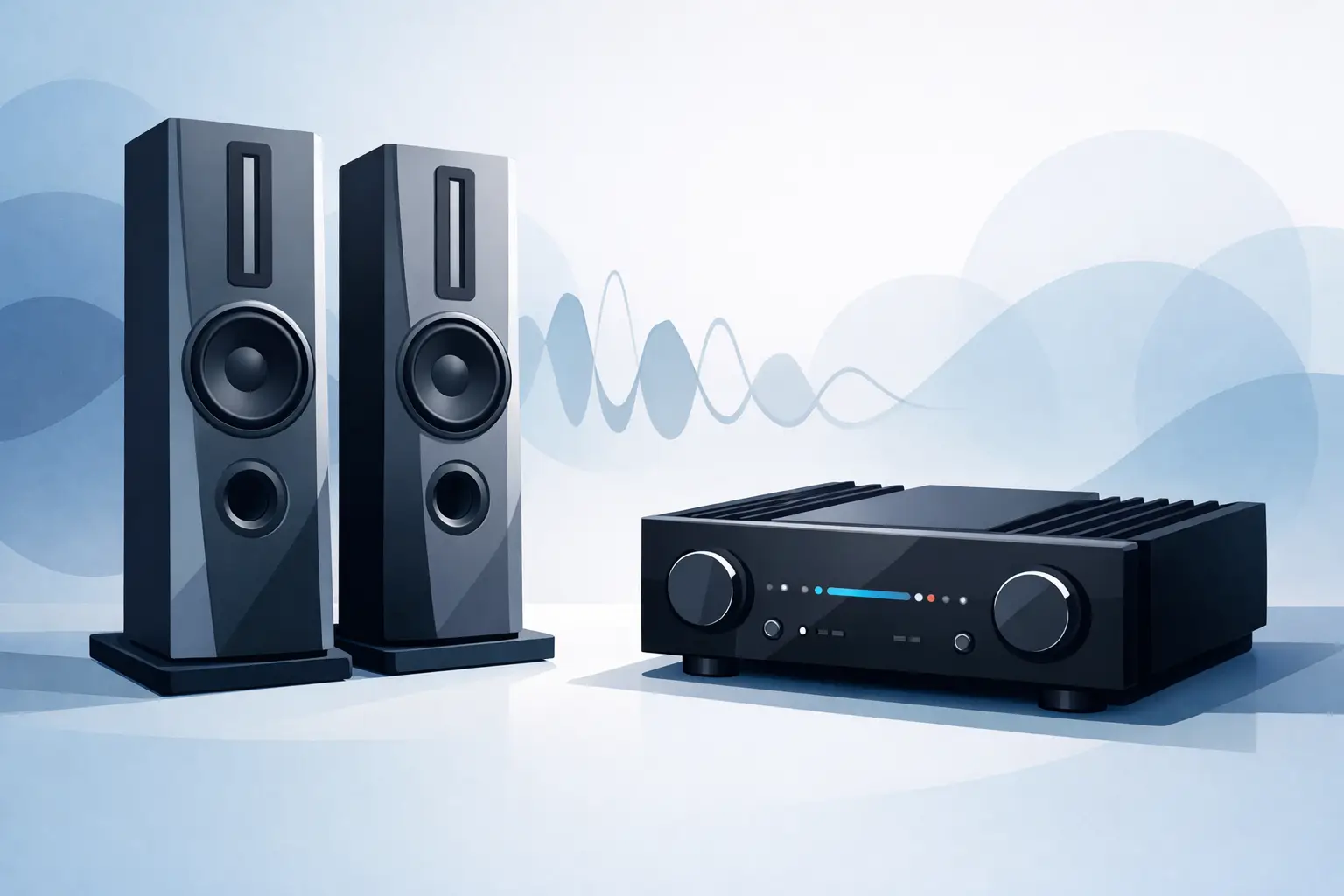
A ribbon speaker does not reward amplifier shopping by wattage alone. The best high current amplifiers combine meaningful power with the ability to remain composed when impedance falls, musical peaks arrive without warning, and the speaker asks for firm electrical control. That distinction is central to building a system that lets a finely resolved transducer sound open, effortless, and complete rather than merely loud.
For serious listeners, the goal is not an amplifier with the most imposing specification sheet. It is an amplifier whose output stage, power supply, protection behavior, and gain structure suit the loudspeaker, the room, and the listening habits of the owner.
What Makes an Amplifier High Current?
An amplifier delivers voltage and current. Voltage contributes to the potential loudness a system can achieve, while current becomes especially relevant when a loudspeaker's impedance presents a demanding load. As impedance drops, the amplifier must supply more current to maintain the same voltage. If it cannot, dynamics compress, bass loses definition, and the soundstage can flatten when the music becomes complex.
This is why a power rating into 8 ohms is only the beginning. A useful indication of amplifier capability is how power changes into 4 ohms and, where published responsibly, 2 ohms. In an idealized case, power doubles each time impedance halves. Real amplifiers have practical limits, but an amplifier that increases output substantially from 8 to 4 ohms often has the power supply reserve and output-stage capacity required for difficult speaker loads.
Current capability is not a single number that settles the matter. Manufacturers may quote peak current, but test conditions vary. More revealing are several specifications considered together: continuous power into multiple impedances, transformer or switching-supply capacity, filter capacitance, thermal design, weight where applicable, and evidence that the amplifier is rated for low-impedance operation. Listening remains the final test, but engineering details tell you which auditions deserve your time.
Why Ribbon Speakers Benefit From Current Reserve
Ribbon and planar magnetic designs can expose amplifier limitations with unusual clarity. Their low moving mass and broad radiating surfaces are capable of fast transient response, finely differentiated texture, and exceptional retrieval of low-level detail. When the partnering amplifier strains, those qualities do not disappear politely. The system may become thin, hard at high levels, dynamically constrained, or less convincing in its sense of scale.
Many ribbon loudspeakers present an impedance curve that asks for a stable, confident amplifier even if their nominal sensitivity appears reasonable. The exact requirement depends on the model, crossover topology, room size, and desired listening level. A large room and orchestral music at realistic levels create a different demand than a nearfield setup used mainly for vocal jazz.
The benefit of high current is not simply more volume. It is composure. A capable amplifier gives bass instruments their start-and-stop authority, preserves the separation of massed strings, and keeps a dense recording from turning into a bright, undifferentiated wall of sound. With ribbon speakers, that calm reserve often translates directly into a more natural presentation.
How to Evaluate the Best High Current Amplifiers
Start with the loudspeaker, not the amplifier's reputation. Read the speaker's recommended amplification range, nominal impedance, minimum impedance, and any guidance about stable operation. These figures are not an instruction to buy the largest amplifier available. They establish the electrical territory in which the amplifier must operate.
Look Beyond the Headline Wattage
A 200-watt amplifier is not automatically more capable than a 100-watt design. One may be conservatively rated with substantial current reserve; another may achieve its rating under favorable conditions yet become protective or strained into lower impedances. Compare output at 8 and 4 ohms, then ask whether the manufacturer explicitly supports operation into more demanding loads.
For a speaker rated at 4 ohms, an amplifier that is comfortable and well specified into 4 ohms is the minimum starting point. For a speaker whose impedance descends lower in the bass or crossover region, an amplifier that remains stable into 2 ohms may offer valuable assurance, even if it will rarely operate there continuously.
Examine Power Supply and Output-Stage Design
A high-current amplifier requires more than muscular output transistors. Its power supply must replenish energy quickly, and its thermal architecture must dissipate heat without forcing the circuit into premature protection. Traditional linear supplies with substantial transformers and capacitor banks remain a respected solution. Well-engineered switch-mode supplies can also deliver excellent results, often with greater efficiency and lower weight.
There is no universal winner between Class A, Class AB, and Class D. Class A may offer exceptional linearity and generous bias current but produces substantial heat and consumes considerable power. Class AB remains a common choice for combining refinement with practical output. Modern Class D designs can provide remarkable control, low noise, and high power in compact chassis when the implementation is first rate. The relevant question is not the circuit label but how the complete amplifier behaves with the intended loudspeaker.
Treat Protection Circuits as Part of the Design
Protection is necessary. It protects speakers, output devices, and owners. Yet overly aggressive current limiting can interfere with the very dynamic passages that justify a powerful amplifier. An amplifier that shuts down, softens, or becomes brittle when the music reaches a crescendo is not a successful match, regardless of its published wattage.
During an audition, use familiar recordings with wide dynamic range. Listen at realistic levels for changes in tonal balance, a collapse of image focus, or bass that becomes less articulate as volume rises. These signs may indicate room issues or source limitations, but they can also reveal an amplifier reaching its comfort zone.
System Matching Matters More Than Maximum Output
The finest amplifier can still disappoint when gain, source output, cabling, and room behavior are ignored. High gain paired with a high-output source may leave too little useful range on the volume control and make low-level noise more apparent. An amplifier with low input sensitivity may require a preamplifier with sufficient voltage swing. Balanced connections can be useful in long cable runs or electrically noisy installations, but they are not automatically superior to a well-executed single-ended connection.
Speaker cable deserves similar discipline. Extremely long runs or unusually low-resistance cable requirements can affect the load the amplifier sees. Select cable of appropriate gauge and quality, keep lengths sensible, and avoid treating accessories as a substitute for proper amplifier selection.
The room is equally influential. A high-current amplifier may tighten low-frequency control, but it cannot remove a severe room mode or compensate for speakers placed carelessly near boundaries. Before attributing bass excess or image instability to the electronics, confirm speaker placement, seating position, and basic room treatment.
Choosing Power for Real Listening Habits
Conservative headroom is generally wise. Music has transient peaks far above its average level, and an amplifier driven into clipping can damage a ribbon or tweeter more readily than a more powerful amplifier operated cleanly. This does not mean every system needs monoblocks or a massive chassis. It means the amplifier should have enough reserve that normal listening does not place it at the edge of its operating envelope.
A medium-sized room, moderate listening levels, and a speaker with a benign impedance may be served beautifully by an integrated amplifier with a genuinely capable power supply. A large listening room, low-impedance ribbon design, and frequent orchestral or electronic playback may justify separate preamplification and substantial power amplifiers. The correct answer depends on the entire system.
Clarisys Audio listeners should approach amplification as a partnership with the loudspeaker's revealing character, not as an isolated component purchase. A carefully selected high-current design allows the system to retain tonal color, transient precision, and spatial authority without calling attention to the effort involved.
Audition for Control, Not Just Impact
When comparing amplifiers, begin at low and moderate levels. Listen for harmonic texture in piano, the body of a cello, the decay of cymbals, and the placement of voices within the soundstage. Then increase the level gradually. A strong amplifier should grow in scale without becoming coarse, congested, or exaggerated.
Use recordings you know intimately, including material that is not audiophile-perfect. A system that only flatters pristine recordings tells you little about its long-term value. The better match will make compressed rock, complex classical works, and quietly recorded acoustic sessions more intelligible without imposing a fixed sonic signature on each.
The best choice is the amplifier that makes demanding music feel less demanding. When current reserve, stability, and system matching are in place, ribbon speakers can disappear as sound sources and leave the listener with the performance, the room, and the rare satisfaction of hearing deeper into a recording.