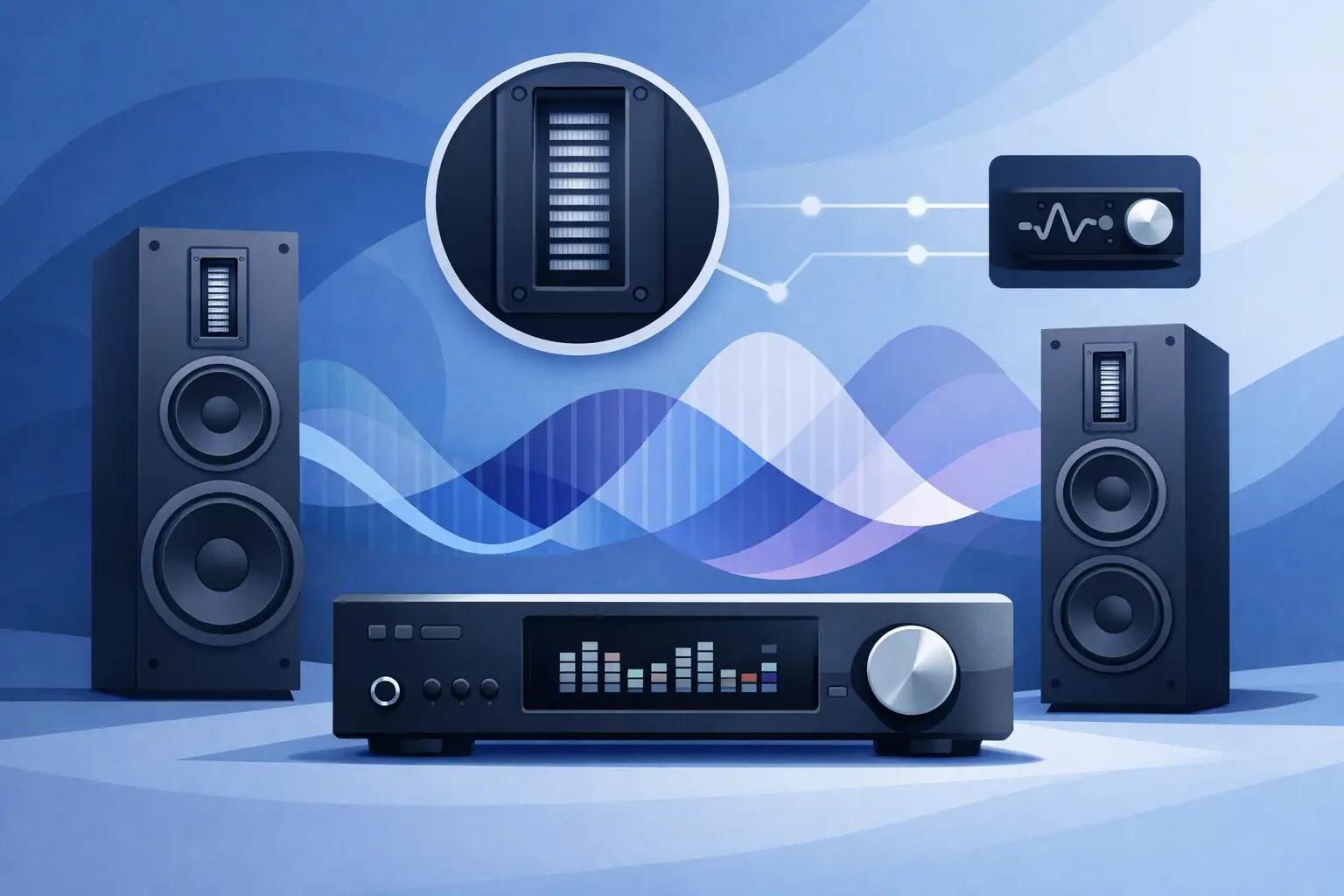
A ribbon tweeter will not make a modest amplifier sound worse than it is. It will simply make the amplifier easier to hear. That distinction matters when choosing the best amplifier for ribbon tweeters, because the right answer is not a single wattage figure, circuit topology, or fashionable brand name. It is an amplifier that remains composed into the loudspeaker’s real load, preserves low-level information, and has the control to let a fast, low-mass transducer sound natural rather than etched.
For serious systems, the decision starts with the entire loudspeaker, the room, and listening habits. A ribbon tweeter is part of a crossover network, not an isolated amplifier load. The amplifier responds to the impedance and phase behavior of the complete speaker, including its bass and midrange sections. The goal is to select an amplifier whose electrical authority and musical character suit that whole system.
What the Best Amplifier for Ribbon Tweeters Must Do
Ribbon tweeters are valued for transient precision, exceptionally low moving mass, and an ability to reveal fine harmonic and spatial information. A cymbal should have metallic texture rather than a splash of white noise. A vocal should retain breath and articulation without the leading edges becoming exaggerated. These qualities make amplifier choices more consequential.
The amplifier must first be stable. Many high-performance loudspeakers present impedance curves that vary substantially with frequency, and the electrical phase can add another demand. An amplifier rated at an impressive power figure into 8 ohms may be far less convincing when the speaker asks for current into a lower or more reactive region. Look beyond the headline rating to evidence of a well-executed power supply, meaningful current delivery, and a specified ability to operate into 4-ohm loads.
This does not mean an amplifier must double its output exactly every time impedance halves. That metric has become a convenient shorthand, but it cannot describe transformer capacity, protection behavior, thermal design, or the quality of the output stage. What matters is whether the amplifier remains controlled and unstrained when music becomes dense. Orchestral climaxes, electronic bass transients, and close-miked piano can expose a component that is running out of grip long before its rated output suggests it should.
Noise performance deserves equal attention. Ribbon systems can retrieve ambient cues and recorded hall decay with unusual clarity. An audible noise floor, coarse volume control, or gain structure that leaves the preamp operating at the bottom of its range can reduce that advantage. In a quiet room, listen for the blackness between notes as carefully as you listen for treble extension.
Current Delivery Matters More Than an Inflated Wattage Number
Power is necessary, particularly in larger rooms or at realistic concert levels. Yet the best choice is rarely the amplifier with the largest number on its front panel. A conservatively rated 100-watt amplifier with a substantial supply and stable output stage can outperform a lightly built 250-watt design when the speaker presents a difficult passage.
Start with the loudspeaker manufacturer’s recommended power range, then consider room volume and distance from the listening position. A compact, acoustically treated room may reward a refined 60- to 100-watt amplifier. A large open-plan space, a low-sensitivity speaker, or regular high-level listening may justify 200 watts or more. Headroom is useful not because music is played continuously at extreme volume, but because musical peaks are brief and demanding.
Avoid confusing excess power with safety. Any amplifier can damage a tweeter if driven irresponsibly, but clipping is often the greater danger. When an underpowered amplifier reaches its limits, it produces high-frequency distortion that can be especially punishing to a treble driver. An amplifier with adequate reserve, used with sensible volume control, is usually the safer and more convincing option.
Assess the Loudspeaker, Not the Tweeter Alone
A ribbon tweeter may be capable of extraordinary extension, but its crossover frequency and network design determine how it interacts with the rest of the speaker. A loudspeaker with demanding bass sections will ask more of the amplifier than a similarly sensitive design with an easier impedance profile. Ask for the minimum impedance, impedance curve if available, sensitivity, and recommended amplification range.
This is particularly relevant with high-resolution ribbon loudspeakers such as those built around the Clarisys Audio approach. The amplifier should not merely reproduce treble detail. It should establish the low-frequency foundation, dynamic contrast, and midrange coherence that give the ribbon’s speed a believable musical context.
Choose a Topology by Execution, Not Stereotype
Class A, class AB, tube, and class D amplifiers can all partner successfully with ribbon tweeters. Broad stereotypes are less useful than listening and engineering evidence.
A well-designed class A amplifier can offer exceptional tonal density, low-level continuity, and ease through the treble. Its trade-offs are heat, weight, energy use, and frequently limited output power. For efficient loudspeakers in a moderate-sized room, those compromises may be entirely worthwhile. For a low-sensitivity system in a large room, the available headroom must be evaluated honestly.
High-quality class AB designs remain a dependable choice for ribbon-equipped systems because they can combine generous current, wide bandwidth, and strong dynamic reserve. Their character varies widely. Some sound incisive and highly damped, while others prioritize tonal saturation and a more relaxed upper midrange. Neither presentation is automatically correct. The room, source components, and listener preference decide whether a more incisive or more forgiving balance is appropriate.
Tube amplification can bring dimensionality and harmonic richness that many listeners find compelling with ribbons. The pairing works best when the output transformer, taps, and speaker load are well matched. A tube amplifier with limited current capability can lose bass control or sound dynamically compressed with a demanding loudspeaker. Powerful push-pull designs or carefully matched tube monoblocks are often more suitable than assuming any low-powered single-ended design will be enough.
Modern class D has earned its place in serious high-fidelity systems. The best examples offer speed, low noise, substantial power, and excellent control without the physical bulk of traditional high-current amplifiers. However, implementations differ in their input stages, output filters, load behavior, and voicing. Audition the specific amplifier rather than accepting either the old criticism that class D is sterile or the equally simplistic claim that topology no longer matters.
Gain, Control, and System Balance
An amplifier can be electrically capable and still be a poor system match. Excessive gain may make the usable range of the volume control too narrow, increase audible hiss at the listening seat, and encourage operation with the preamplifier near its lowest settings. Insufficient gain, conversely, can limit maximum output from a low-voltage source.
Consider the preamplifier and source as part of the decision. A revealing ribbon system benefits from a quiet, well-matched front end. If the preamplifier has a highly transparent but lean presentation and the room has many reflective surfaces, an extremely incisive power amplifier may push the system toward glare. If the room is heavily damped and the source is warm, a more open, immediate amplifier may restore life and air.
Speaker cable selection should be treated with the same restraint. Use well-made cable of sensible gauge and appropriate length, with secure terminations. Do not use cable changes to compensate for an amplifier that lacks current delivery or a room that needs acoustic attention.
Audition With Material That Reveals Control
A quick demonstration with a polished female vocal can be flattering but incomplete. Bring recordings that expose different aspects of amplifier behavior: solo piano for decay and upper-register weight, large-scale orchestral music for composure, acoustic bass for pitch definition, and densely layered rock or electronic music for separation at higher levels.
Listen at more than one volume. At low levels, the system should preserve color, microdynamic movement, and image specificity. At realistic levels, it should become larger and more effortless rather than harder, flatter, or more forward. Pay special attention to the crossover region and upper midrange. If vocal sibilants detach from the voice, or cymbals become conspicuous instead of integrated, the issue may be amplifier character, room reflection, setup, or recording quality. It is not automatically a flaw in the ribbon tweeter.
The most satisfying amplifier will make a ribbon loudspeaker seem less like a highly resolved component and more like a complete musical instrument. When power, stability, gain, and voicing are in balance, the treble stops calling attention to itself and starts revealing the space, texture, and emotional scale already present in the recording.