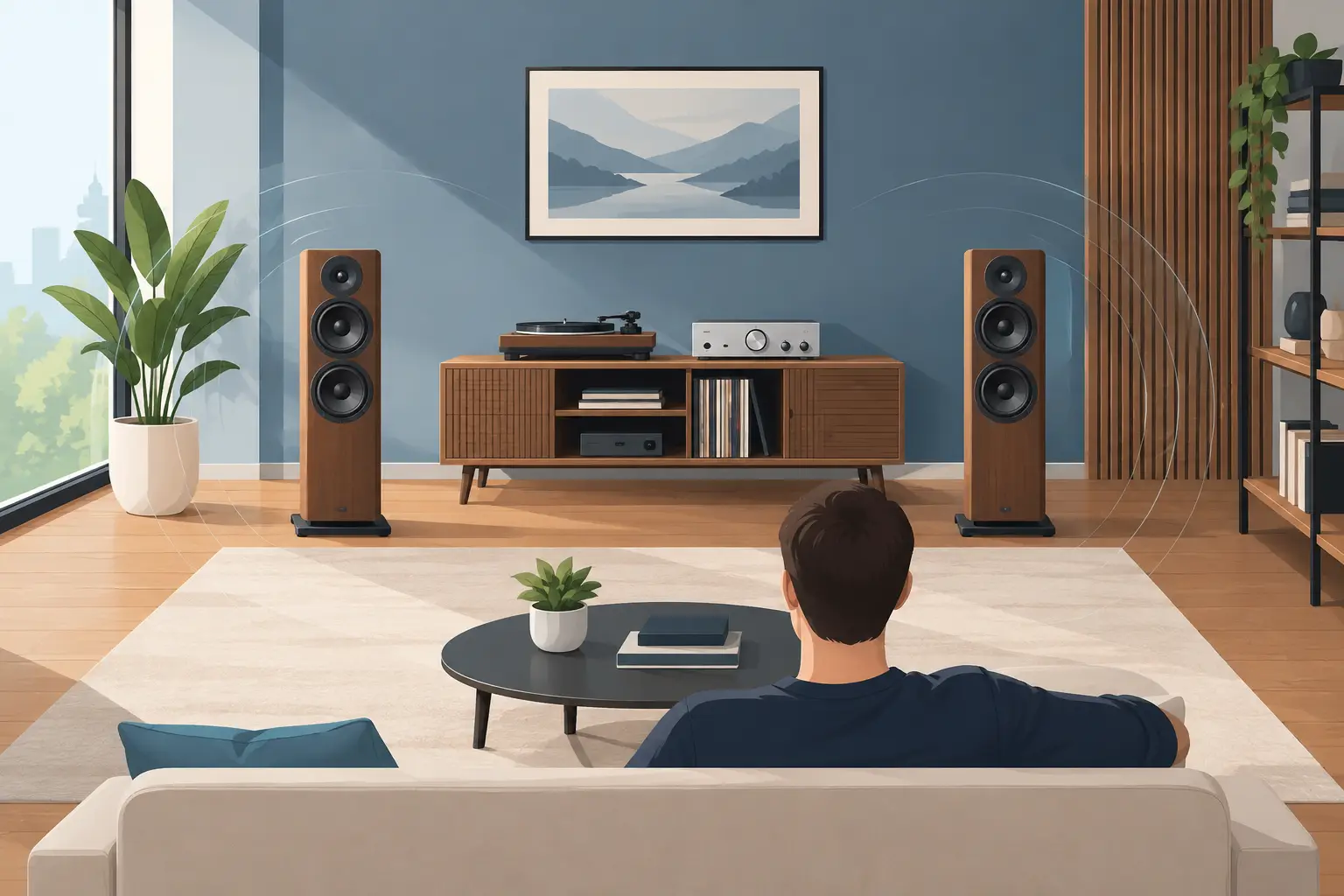
A serious system rarely disappoints because one component is objectively inadequate. More often, it disappoints because excellent components were asked to work against one another. This audiophile system matching guide focuses on the relationships that determine whether a system sounds coherent, dynamic, and emotionally persuasive in a real listening room.
The goal is not to assemble the most prestigious list of components. It is to build a chain in which loudspeaker load, amplifier behavior, source quality, room acoustics, and listening priorities support the same musical outcome. A system that measures well on paper can still sound constrained, bright, or undernourished if those relationships are ignored.
Start With the Loudspeaker and the Room
For most systems, the loudspeaker and the room establish the largest part of the final presentation. Their interaction affects tonal balance, bass weight, imaging, scale, and fatigue more profoundly than a cable change or a minor specification advantage elsewhere in the chain.
Begin by considering room volume, speaker placement options, and listening distance. A large floorstanding design may produce effortless scale in a generous room but overload a smaller one, particularly below 100 Hz. Conversely, a compact speaker in a large, open-plan space may sound refined but lack the physical authority required for orchestral works, live recordings, or full-range electronic music.
Ribbon loudspeakers deserve particular care here. Their speed, low moving mass, and ability to resolve fine dynamic shading can make them exceptionally revealing of placement and room symmetry. A reflective sidewall near one speaker, an asymmetrical opening, or a listening seat pushed hard against the rear wall can blur the image that the speaker is capable of producing.
Before selecting electronics, establish whether the speakers can be placed with reasonable freedom from front and side walls. Aim for symmetry where possible, and leave enough distance behind the listening seat to avoid excessive bass buildup and early reflections. The exact dimensions depend on the room and speaker, but placement flexibility is a genuine system component, not an afterthought.
Sensitivity Is Only One Part of the Load
Speaker sensitivity is useful, but it does not tell the entire amplifier-matching story. A loudspeaker rated at 90 dB sensitivity may still demand serious current if its impedance falls low or its phase angle becomes difficult across parts of the frequency range.
Look beyond the nominal impedance figure. Consider the impedance curve, minimum impedance, electrical phase behavior, and the manufacturer’s recommended amplification range. An amplifier that sounds graceful with an easy 8-ohm load may lose grip when presented with a loudspeaker that drops below 4 ohms in the bass or lower midrange.
This does not mean that bigger power is always better. It means that adequate current delivery and stable behavior matter as much as the wattage printed on the front page of a specification sheet. The right amplifier should retain composure as musical density rises, preserving bass definition, image stability, and treble ease at realistic listening levels.
Audiophile System Matching Guide: Choose the Amplifier by Behavior
Amplifier selection should begin with how the loudspeaker behaves, then move to the character and capability you want from the system. Power ratings provide a starting point, not a verdict.
A high-current solid-state amplifier can be an excellent choice for speakers with demanding impedance behavior, wide bandwidth, or substantial bass capability. Its strengths often include bass control, dynamic headroom, low noise, and the ability to maintain authority when the orchestra reaches a climax or a recording contains deep, sustained bass.
Tube amplification can be equally compelling when its output transformer, power supply, and operating points suit the speaker. A well-matched tube amplifier can bring exceptional dimensionality, harmonic richness, and microdynamic expression. But tube wattage should not be treated as interchangeable with solid-state wattage, and certain low-impedance loads will ask more of a tube design than its specifications initially suggest.
The useful question is not whether tubes or transistors are superior. Ask whether the amplifier remains controlled and unforced with your loudspeakers at your preferred level. Audition with music that contains sustained bass, complex vocal harmonies, large-scale dynamic contrasts, and quiet instrumental textures. If a system sounds impressive only on sparse recordings or only at low volume, the match is not yet complete.
Preserve Headroom
Clipping is not always obvious. It can arrive as flattening dynamics, hardening upper frequencies, collapsing depth, or a sense that the music becomes smaller as it grows louder. Amplifier headroom protects against these effects.
For a dedicated listening room and moderate levels, a carefully chosen amplifier with modest rated power may be entirely sufficient. For a large room, long listening distance, low-sensitivity speakers, or recordings with wide dynamic range, additional power and current capacity provide useful margin. That margin is often heard not as sheer loudness, but as relaxation.
Source Components Set the System’s Resolution Ceiling
A loudspeaker cannot recover information that the source fails to preserve. Yet source matching is not simply a matter of purchasing the most expensive DAC, turntable, or streamer available. The better question is whether the source offers the resolution, tonal stability, timing, and noise performance needed to reveal what the rest of the system can do.
With digital playback, pay attention to clocking implementation, analog output stage quality, power supply design, and the practical reliability of the streaming platform. A sophisticated DAC can be undermined by a noisy network environment, poor isolation, or software that makes discovery and playback frustrating. Ownership experience matters because the best system is the one you will use often enough to understand deeply.
With analog playback, cartridge compliance, tonearm effective mass, phono gain, loading, and turntable isolation must be considered as a group. A moving-coil cartridge paired with an unsuitable phono stage can sound thin, noisy, or dynamically restrained despite the quality of both products. Setup accuracy is part of the component’s performance, especially with vinyl.
Avoid compensating for a weakness elsewhere by selecting a source with an exaggerated tonal character. A bright system does not become genuinely balanced because the source is deliberately soft; it becomes less transparent. Correct the underlying mismatch where possible.
Gain Structure and Noise Matter More Than They Seem
A system may contain individually quiet components and still produce audible hiss, hum, or an awkward volume-control range. This is usually a gain-structure problem.
If the preamplifier has very high gain and the power amplifier reaches full output with little input voltage, the volume control may become too sensitive. You may find normal listening occurs between 7 and 8 o’clock, leaving little room for precise adjustment. Excessive gain can also expose background noise, especially through highly resolving loudspeakers.
Balanced connections can help reject noise over longer cable runs, but the presence of XLR sockets alone does not guarantee a fully balanced circuit or a better result. Use the connection method supported by the design and by the practical needs of the installation. Proper grounding, sensible cable routing, and compatible gain are more valuable than chasing connector types.
Let the Room Finish the System, Not Fight It
Even a carefully matched electronics chain cannot overcome major acoustic problems. Hard floors, large glass surfaces, bare walls, and sparse furnishings can produce excessive brightness and confused imaging. At the other extreme, overtreated rooms can sound dry, compressed, and deprived of natural air.
Treat the first reflection points where practical, manage bass through speaker placement and room-aware bass control, and use furnishings intelligently. A thick rug, bookshelves, curtains, and carefully positioned absorption or diffusion can improve the listening experience without turning a living space into a laboratory.
Bass deserves special attention because room modes are powerful and persistent. Moving speakers or the listening chair by a small amount can create a larger improvement than changing a component. If deep bass remains uneven, consider measurement as a diagnostic tool. Measurements do not replace listening, but they can identify problems that the ear recognizes before it can explain them.
Evaluate With Familiar Music and Clear Priorities
Auditioning becomes more productive when you know what you are listening for. Use recordings you understand well, across several genres, and listen for continuity rather than isolated hi-fi effects. Does a vocal remain stable as the arrangement grows? Does a kick drum have pitch as well as impact? Do strings retain texture without becoming brittle? Does the system preserve low-level detail without making ordinary recordings unpleasant?
A component change should improve more than one impressive trait. Greater treble detail that also reduces body, or stronger bass that obscures rhythmic definition, may not represent progress. The best matches tend to make more recordings involving, not just a handful of audiophile favorites spectacular.
For major decisions, take time. A short demonstration can reveal obvious incompatibility, but long-term satisfaction comes from a system that remains convincing across changing moods, genres, and volume levels. Seek informed dealer support, study technical documentation, and use a familiar room whenever possible.
The final measure is simple: when the system is properly matched, your attention moves away from equipment and toward the performance. That is the moment worth building for.