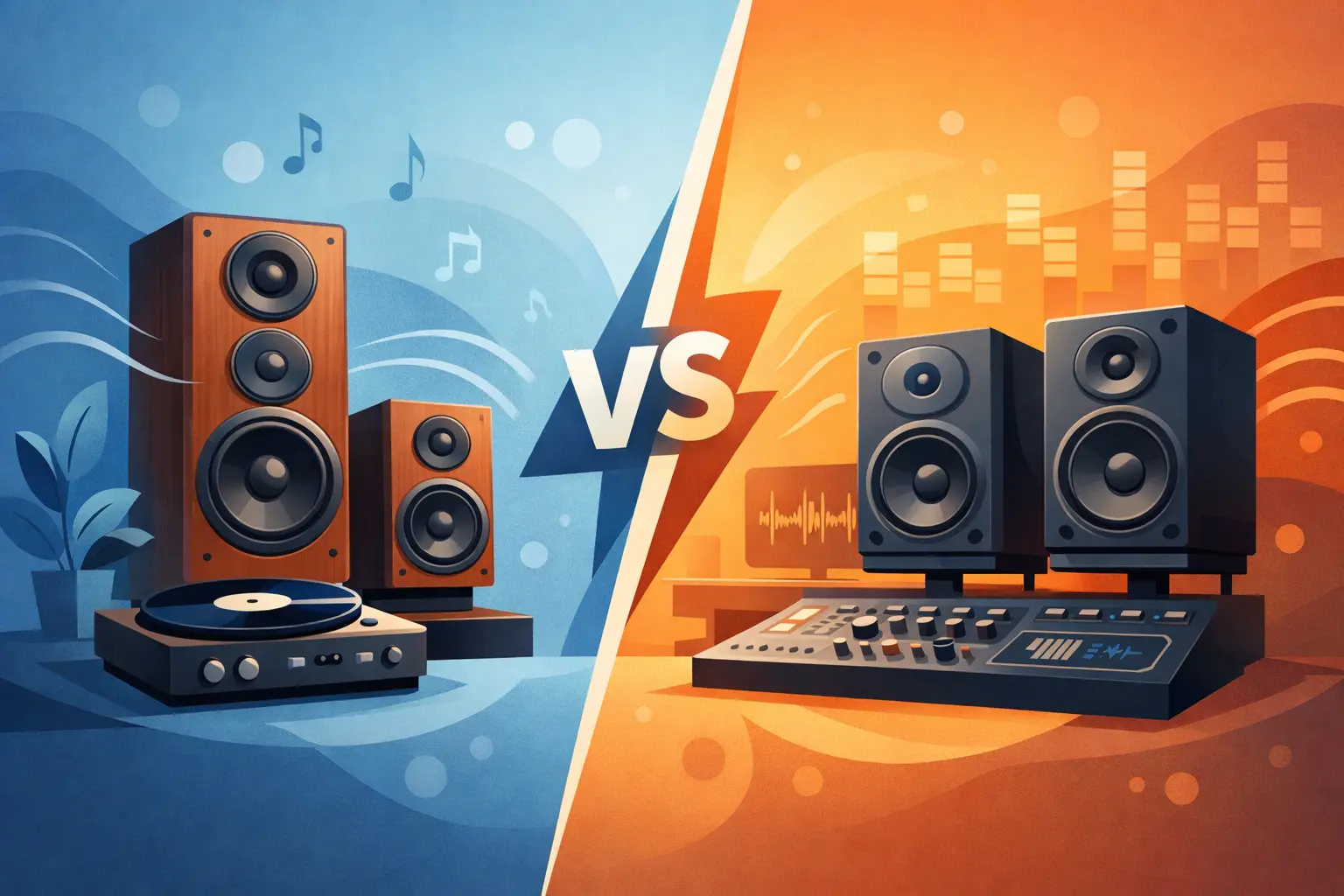
A pair of loudspeakers can measure flat, reveal fine detail, and still leave a music lover cold. That apparent contradiction sits at the center of the audiophile speakers vs studio monitors discussion. These products often share impressive engineering, serious drivers, and a commitment to low distortion, but they are designed around different listening priorities. Choosing well starts with understanding the job each speaker is intended to do.
Audiophile Speakers vs Studio Monitors: Different Briefs
Studio monitors are professional tools. Their primary task is to help an engineer make reliable decisions about a recording: a vocal level that is half a decibel too high, an over-compressed kick drum, a harsh vocal sibilant, or a low-frequency buildup that will cause trouble on other playback systems. A monitor must expose problems without flattering them.
Audiophile loudspeakers are built for the final listener. Accuracy remains essential, especially in the high-performance category, but the objective extends beyond forensic inspection. The speaker must reproduce the scale of an orchestra, the body of a cello, the spatial cues of a well-made recording, and the shifting dynamics of a live performance in a domestic room. It is asked to make an album feel complete, not merely easy to evaluate.
This is not a simple distinction between "accurate" monitors and "pleasant" hi-fi speakers. Fine audiophile systems are capable of exceptional neutrality, while many professional monitors are designed to be engaging and practical rather than uncompromisingly revealing. The real difference is context: nearfield production work at a console versus long-form listening in a dedicated room or carefully assembled living space.
Listening Distance Changes the Design Equation
Most studio monitors are used in the nearfield, typically three to six feet from the listener. At that range, direct sound reaches the ears well before major room reflections. This gives the engineer a more consistent reference and reduces the room's influence, though it never eliminates it. Compact cabinets, controlled directivity, and close placement are logical choices for this environment.
Audiophile speakers are usually heard from farther away. The listening position may be seven, ten, or more feet from the loudspeakers, allowing the drivers to integrate in space and the soundstage to develop across the room. The speaker, room, and seating position become a system. Cabinet size, bass alignment, driver spacing, dispersion, and crossover behavior all matter differently at this distance.
A large three-way monitor can certainly work in a home, but it needs appropriate distance to integrate and enough space for its bass output. Likewise, a compact audiophile stand-mount can excel in a small room, but it may not create the full-scale dynamics demanded by a large listening space. The label on the product matters less than whether its intended geometry matches the room.
Nearfield clarity is not the same as musical scale
Nearfield monitoring can produce startling focus. A singer may appear precisely centered, and small edits or tonal defects are easy to identify. Yet a speaker optimized for close work can feel spatially constrained when heard from across the room, particularly if its drivers do not integrate smoothly at the longer listening distance.
Conversely, a reference loudspeaker designed for domestic listening may sound less explicit at a desk because the listener is sitting inside the intended driver integration distance. It may also energize nearby walls and desktop surfaces in ways the designer never intended. Neither result indicates poor performance. It indicates a mismatch between application and placement.
Voicing, Dispersion, and What “Neutral” Means
Neutrality is frequently treated as a single target, but it has several dimensions. On-axis frequency response is one. Off-axis behavior is another. Dynamic behavior, distortion, transient decay, and how a speaker interacts with a room also affect whether it sounds balanced over time.
A studio monitor may prioritize a tightly controlled direct response at a known listening position. Some designs use waveguides to align dispersion and improve consistency around the crossover region. Others favor active amplification and digital signal processing to optimize driver control in a compact package. These are sensible solutions for professional environments where repeatability is valuable.
Audiophile loudspeakers often place greater emphasis on the relationship between direct and reflected sound in a room. A speaker that measures smooth only on-axis but changes character dramatically off-axis can sound inconsistent once room reflections enter the picture. Well-executed ribbon speaker technology, for example, can deliver exceptionally low moving mass and fast transient behavior while demanding careful attention to vertical listening height, dispersion, crossover design, and room setup.
The goal is not a particular sonic signature. It is coherence: treble that retains air without becoming detached from the midrange, bass that has weight without obscuring pitch, and an image that remains stable when an arrangement becomes complex. Clarisys Audio systems are intended for listeners who view this coherence as an engineering outcome rather than a decorative effect.
Active and Passive Architectures Lead to Different Ownership Experiences
Many studio monitors are active. Each driver has its own amplifier channel, and the crossover operates before amplification. The manufacturer controls the amplifier-driver relationship, which can improve consistency and simplify setup. For an engineer, this is efficient: connect a source or interface, set levels, and begin working.
The trade-off is that electronics, amplification, and loudspeaker live in the same enclosure. When an internal amplifier or power supply needs service, the speaker may require specialized attention. Upgrade paths are also more limited. You may change the source, room correction, or monitor itself, but not the power amplifier driving the tweeter or woofer.
Most high-end audiophile speakers are passive, leaving amplification as a separate system decision. This adds complexity and cost, but it offers meaningful control. A listener can select an amplifier for current delivery, tonal balance, noise performance, and load compatibility. The system can evolve over years without replacing every component at once.
Passive speakers are not automatically superior, nor are active monitors automatically less sophisticated. An active design can achieve remarkable precision, while a poorly matched passive speaker and amplifier can underperform badly. The question is whether you value an integrated professional tool or a system whose components can be individually optimized.
Bass Is Where Rooms Make Their Demands
Low frequencies do not respect product categories. A studio monitor with a 7-inch woofer may offer cleaner, more usable bass in a small untreated room than a floorstanding audiophile speaker extending an octave lower. More extension is not always more music if room modes turn bass lines into a single swollen note.
For a mixing room, monitors are commonly paired with acoustic treatment, calibrated placement, and sometimes a subwoofer system designed for measurement-led integration. In a home listening room, the same discipline pays dividends. Speaker placement, distance from boundaries, seat position, and bass management can make a larger improvement than swapping components of similar quality.
Do not assume that a monitor's compact size makes it easier to place. Rear ports, high-output bass tuning, and desktop reflections can cause real problems. Similarly, do not assume that a full-range loudspeaker must sit far from every wall. The correct placement depends on the speaker's radiation pattern, bass alignment, and the room itself.
When Studio Monitors Are the Right Choice
Studio monitors make excellent sense for a producer, musician, mastering engineer, or listener who works at a desk and values immediate analytical feedback. They are also compelling for a secondary system, especially where space is limited and the listening distance is short. A capable pair on proper stands, positioned symmetrically and away from the desk where possible, can be deeply satisfying.
They can be a less natural choice for someone building a dedicated two-channel system around long listening sessions, physical media, and carefully selected amplification. Their convenience may come with constraints in soundstage scale, ultimate dynamic ease, serviceability, or system tailoring. Those constraints vary greatly by model and price point.
When Audiophile Speakers Earn Their Place
Audiophile loudspeakers become compelling when the room and the listener support their strengths. If you want to hear the recorded acoustic around a piano, follow the microdynamic shading of a string quartet, or feel a full orchestra expand without the image flattening at higher levels, a speaker designed for room-based listening has a distinct advantage.
That advantage requires commitment. Proper setup is not optional at this level. Start with a stable stereo triangle, equal distances to the listening position, and a clear path between the speakers and the seat. Adjust toe-in deliberately, then listen to familiar recordings over several sessions rather than making judgments from a single spectacular track. Fine loudspeakers reveal setup errors with the same honesty that makes them rewarding.
There is also no reason a serious music system cannot reveal recording flaws. A great hi-fi speaker should not conceal compressed masters or poor microphone placement. It should simply preserve enough tonal color, scale, and temporal coherence that even imperfect recordings remain worth hearing.
The better question is not whether you want a studio monitor or an audiophile speaker. Ask where you listen, how far away you sit, how much control you want over amplification, and whether your priority is making records or living with them. Let those answers determine the loudspeaker, then give it the room, setup, and source quality required to show what it can do.