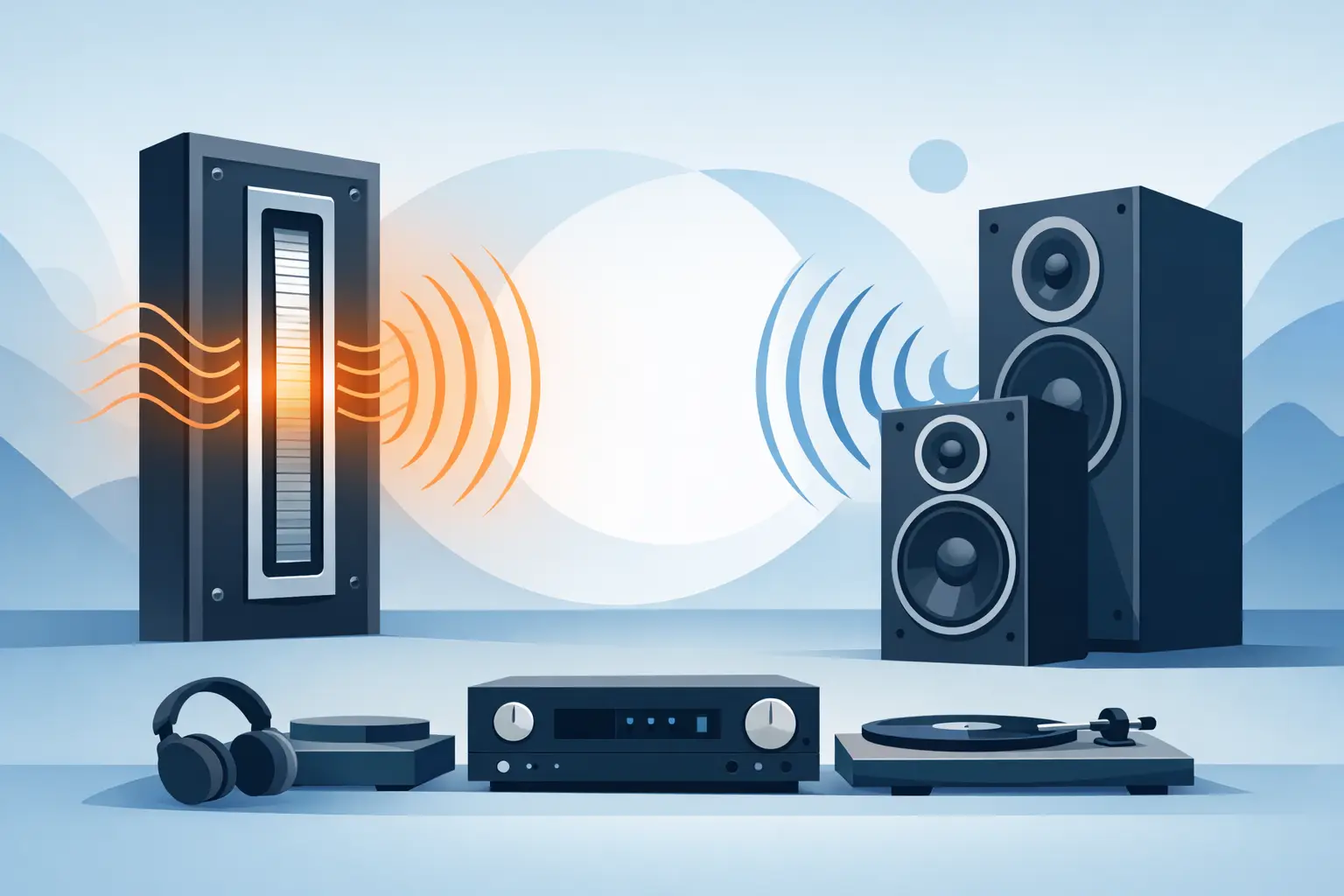
A well-set-up ribbon speaker can make a familiar recording feel newly resolved. Cymbals have less hash, string tone carries more texture, and spatial cues arrive with a kind of ease that conventional designs often struggle to match. That is why the question "are ribbon speakers better" keeps coming up among serious listeners. The honest answer is not a blanket yes. It is yes for certain priorities, certain rooms, and certain system philosophies.
For an audiophile building a reference system, the real question is not whether ribbon speakers are universally superior. It is whether their strengths align with what you value most in reproduced music.
Are ribbon speakers better in the ways that matter most?
Ribbon speakers have earned their reputation for speed, transparency, and low perceived coloration. At their best, they reproduce transient information with striking precision because the diaphragm is extremely light. That low moving mass allows the driver to start and stop quickly, which can preserve delicate details that define realism - the leading edge of a piano note, the shimmer of brushed cymbals, the breath around a vocal line.
This is where many listeners hear an advantage immediately. A good ribbon can sound less mechanical than a typical dome tweeter, especially at higher frequencies where breakup behavior, resonance control, and stored energy become more audible. If your listening priorities center on openness, microdetail, and treble refinement, ribbon technology can offer a very compelling path.
But better is context-dependent. A speaker is not a tweeter in isolation. It is a complete acoustic system interacting with a room, an amplifier, crossover topology, cabinet design, and listener expectations. A superb ribbon implementation can outperform many conventional designs. A poor one can sound thin, bright, or dynamically constrained.
What ribbon speakers do exceptionally well
The technical appeal starts with the ribbon element itself. In a true ribbon, the diaphragm is often both the radiating surface and the conductor, suspended in a magnetic field. Because it is so light, it can respond to signal changes with remarkable agility. That contributes to the sense of speed many experienced listeners associate with top-tier ribbon designs.
Another strength is low-level resolution. Good ribbon speakers can reveal harmonic structure and ambient information without sounding etched. The best examples do not simply sound brighter. They sound cleaner. There is a difference. Bright speakers push treble energy forward. Refined ribbon speakers tend to reduce obscuring artifacts, so detail emerges naturally.
Dispersion characteristics also matter. Many ribbon designs have wide horizontal dispersion and more controlled vertical behavior. In a carefully arranged listening room, that can support a broad, stable soundstage with strong image specificity. Instead of hearing a tweeter calling attention to itself, you hear instruments occupying believable positions in space.
For listeners focused on acoustic music, jazz ensembles, chamber works, well-recorded vocals, and high-resolution source material, these qualities can be decisive. The reproduction of texture, air, and transient truth is often where ribbons make their strongest case.
Where ribbon speakers are not automatically better
Ribbon speakers are not magic, and they come with trade-offs that experienced buyers should evaluate seriously.
First, system matching matters. Some ribbon-based loudspeakers present amplifier demands that are less forgiving than mainstream dynamic designs. Sensitivity, impedance behavior, and crossover complexity vary widely, but the general point stands - if the speaker is not paired with the right electronics, the result may fall short of its potential.
Second, room placement is often more critical. Because of their radiation pattern and revealing nature, ribbon speakers tend to reward careful setup and expose poor acoustics quickly. In a compromised room with minimal treatment and limited flexibility in placement, a ribbon design may not deliver the result its engineering suggests.
Third, not every listener prefers ultimate openness over warmth or punch. Some audiophiles value macrodynamic impact, dense tonal saturation, or a more forgiving balance on average recordings. A well-designed cone-and-dome system may satisfy those priorities better, especially in larger spaces or mixed-use rooms.
Durability and playback habits can also enter the conversation. Ribbon elements require precise engineering, and while premium manufacturers design for reliability, ribbons are still specialized transducers. Buyers looking for party-level abuse tolerance are usually shopping in the wrong category altogether.
Are ribbon speakers better than dome tweeters?
This comparison comes up constantly, and it deserves a nuanced answer. Ribbon tweeters often outperform dome tweeters in perceived speed, openness, and fine treble articulation. That is the classic ribbon advantage, and when executed well, it is very real.
Yet high-quality dome tweeters remain excellent transducers. The best soft domes can sound smooth, natural, and tonally convincing. The best metal domes can deliver extension and precision with impressive control. In a complete speaker system, crossover design, driver integration, and cabinet behavior may have a larger audible effect than driver type alone.
A ribbon tweeter can sound extraordinary if it is integrated properly with the midrange and bass sections. If integration is poor, you may hear a beautiful top end sitting above a disconnected or uneven presentation. By contrast, a great dome-based speaker can feel more coherent from top to bottom, even if it does not match the last degree of ribbon delicacy.
So are ribbon speakers better than dome designs? Sometimes clearly yes. Sometimes not at all. The implementation decides the outcome.
Full-range ribbon systems versus hybrid designs
Not all ribbon speakers are built around the same concept. Some use ribbons only for high frequencies, paired with conventional midrange and bass drivers. Others extend ribbon technology much further across the frequency range.
Hybrid designs can offer an accessible path into ribbon treble performance while preserving familiar bass weight and amplifier compatibility. They often appeal to listeners who want some of the ribbon signature without fully committing to a more specialized architecture.
Full-range ribbon systems pursue a different ambition. When designed properly, they can produce an unusual sense of continuity through the critical vocal and instrumental bands. That coherence is one reason seasoned listeners often gravitate toward them after years with conventional multiway speakers. The presentation can feel less segmented, less driver-specific, and more like a single acoustic event.
This is also where engineering rigor matters most. Large ribbon systems demand serious control of structure, magnetic geometry, crossover execution, and room interaction. At the premium end of the market, that discipline separates genuinely reference-grade products from designs that merely look exotic.
How to tell if ribbon speakers are better for your system
Start with your listening priorities, not the category hype. If you care most about inner detail, transient precision, image focus, and the sense of air around instruments, ribbon speakers deserve close attention. If your library leans toward natural recordings and you already invest in careful setup, the case becomes stronger.
Then assess your room honestly. Ribbon speakers tend to reward a dedicated listening environment more than casual placement in a visually driven living room. If you can optimize speaker position, listening distance, toe-in, and at least some acoustic treatment, you are much more likely to hear what the design is capable of.
Electronics are next. Premium ribbon designs should be auditioned with amplifiers known for control, composure, and tonal integrity. A revealing transducer will not flatter edgy front ends or unstable amplifier behavior. The more transparent the speaker, the less room there is to hide upstream compromises.
Finally, listen for integration rather than spectacle. A strong demo can impress with sparkling highs, but long-term ownership depends on balance. The best ribbon speakers do not call attention to their ribbon character every few seconds. They simply remove obstacles between the recording and the listener.
So, are ribbon speakers better?
For many serious audiophiles, yes - especially when the goal is higher resolution, faster transient response, and a more open, less congested presentation. In the right room, with the right electronics, a well-engineered ribbon speaker can sound exceptionally lifelike and emotionally persuasive.
But the better answer is more disciplined than that. Ribbon speakers are better when the design is executed at a high level, when the system around them is equally considered, and when the listener values the qualities ribbons do best. They are not automatically better for every room, every amplifier, or every taste.
That is what makes this category so rewarding. It resists easy answers and rewards careful listening. If your standard is not just more sound, but less between you and the music, ribbon speakers are worth hearing on serious terms.