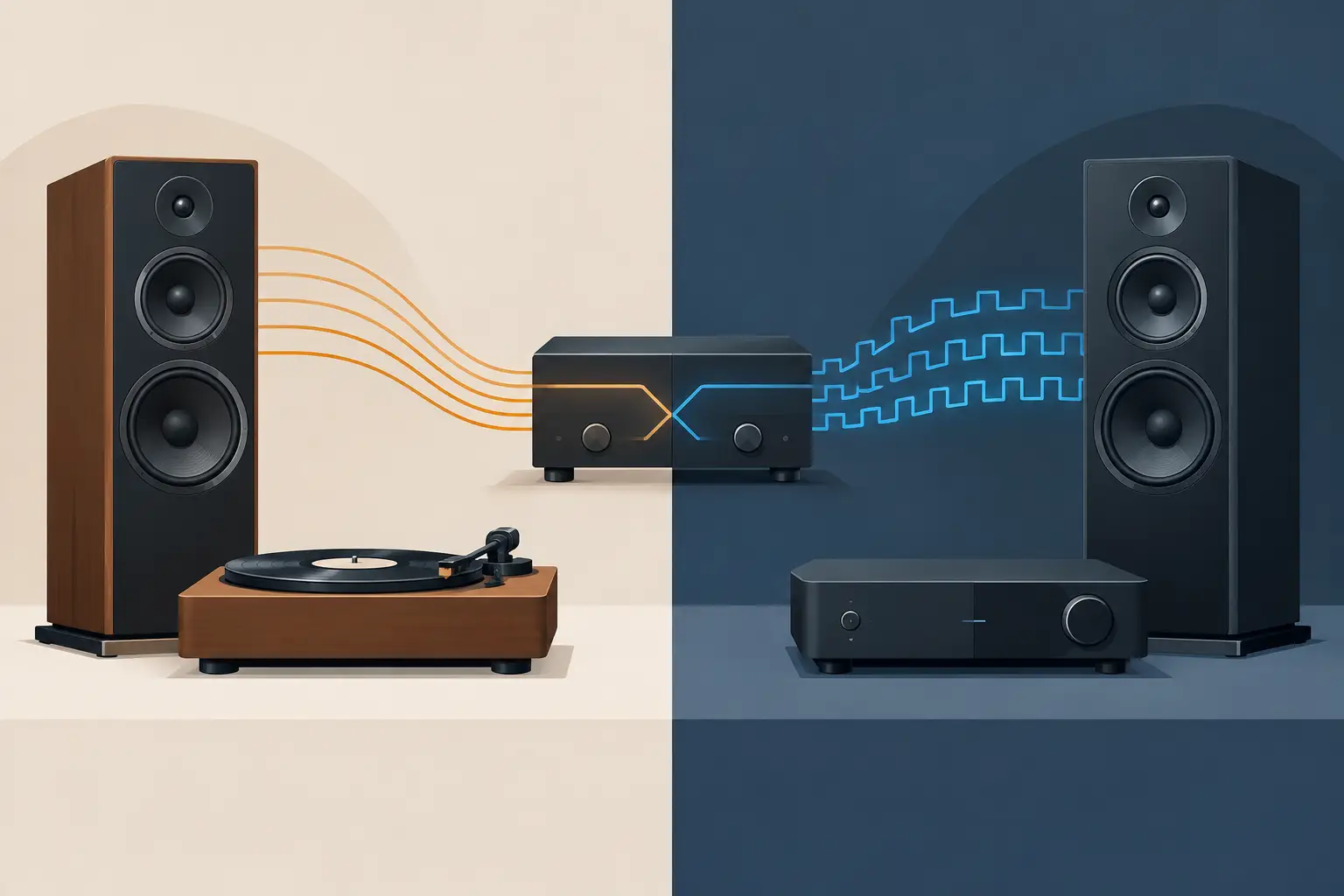
A crossover is not a background detail in a serious loudspeaker system. It determines how each drive unit is asked to work, how their outputs meet, and whether music arrives with convincing scale and coherence. The analog versus digital crossover question therefore deserves more than a reflexive answer based on convenience, feature count, or fashion. Either approach can produce exceptional results. The better choice depends on the loudspeaker architecture, amplification, room, and above all, the standard of execution.
What a Crossover Actually Controls
A crossover divides the audio spectrum between drivers. In a multiway loudspeaker, that may mean directing low frequencies to woofers, midrange information to a dedicated panel or driver, and upper frequencies to a ribbon. Its task is not simply frequency allocation. It also manages level matching, acoustic slopes, phase behavior, driver protection, and the overlap region where two transducers reproduce the same musical event.
That overlap region is where engineering becomes audible. A poorly considered crossover can flatten dynamics, blur image focus, or make a system sound disconnected as instruments move from one driver to another. A well-resolved design lets a voice remain solid, a piano retain its harmonic structure, and a cymbal occupy stable space without drawing attention to the loudspeaker itself.
The terms can cause confusion. An analog crossover may be passive, located after the power amplifier inside the loudspeaker, or active, located before separate amplifier channels. A digital crossover uses digital signal processing, commonly called DSP, before digital-to-analog conversion and amplification. These are different architectures, not merely different parts selections.
Analog Versus Digital Crossover: The Core Trade-Off
The analog versus digital crossover decision is often framed as purity versus precision. That is directionally useful, but incomplete. An analog network can be elegantly direct and highly transparent when its components, topology, and driver integration are properly developed. A digital system offers unusually fine control over frequency response, delay, filter shape, and level, but introduces conversion stages and relies on the quality of its processing and output chain.
Neither category excuses poor engineering. A digital crossover cannot repair a driver operating beyond its comfortable range, cabinet resonances, or an unsuitable room. Likewise, a passive analog network is not automatically more musical because it avoids DSP. Inductor saturation, capacitor quality, resistor behavior, component tolerances, and changing impedance all affect its result.
The real question is where control is most valuable and what compromises the system can accommodate.
Where Analog Crossovers Excel
A passive analog crossover remains the most common approach in high-end loudspeakers for sound reasons. It allows a conventional system architecture: one stereo amplifier, speaker cables, and loudspeakers whose internal network handles the division of labor. For an owner who has carefully selected a power amplifier, this preserves a familiar and satisfying path from source to speaker.
The best passive networks are voiced around actual driver behavior, not an idealized electrical diagram. Their designers account for impedance shifts, acoustic roll-off, dispersion, sensitivity, and the physical offset between acoustic centers. This work is painstaking, especially when integrating a fast, low-mass ribbon with drivers that have different radiation patterns and transient character.
An analog network also avoids an additional analog-to-digital and digital-to-analog process for analog sources. For listeners with a carefully assembled turntable front end, tape machine, or analog preamplifier, that continuity has practical as well as philosophical appeal. The signal remains analog from source through amplification.
There are limits. Passive components operate between the amplifier and drivers, where voltage and current are significant. Their values must be chosen with care, and they cannot provide independent amplifier control over each driver. Complex equalization and exact time alignment are possible only within narrower boundaries than in DSP. The parts themselves can also become a substantial part of the loudspeaker's cost when high-grade components are required.
What Digital Crossovers Make Possible
A digital crossover works upstream, splitting and shaping the signal before it reaches individual amplifier channels. This active architecture permits direct control of each driver or driver group. Filter frequency, slope, output level, polarity, and delay can be adjusted with far more precision than a typical passive network permits.
That precision is especially useful when the system must solve a complex integration problem. DSP can apply driver equalization, compensate for acoustic offset through delay, and create steep or specialized filter profiles without the large reactive parts required in a passive design. In a fully active speaker, each amplifier can be selected for the load and frequency band it serves. Bass can receive high-current amplification, while a ribbon section can use an amplifier chosen for low noise and finesse.
Digital processing also gives a manufacturer repeatability. Once the crossover configuration has been established, every production pair can receive the same settings. Advanced platforms may support room-specific adjustment, protection limits, preset management, and firmware refinements. For an owner with an acoustically difficult room, the ability to make measured, controlled adjustments can be genuinely valuable.
Yet digital flexibility has its own demands. The DSP implementation, clocking, converter stages, gain structure, and amplifiers all become part of the audible system. More boxes and more channels may be required, particularly with externally active systems. A poorly implemented digital front end can sound etched, constrained, or dynamically uninvolving despite impressive graphs. And while home-audio latency is normally not a concern, signal routing and system configuration become more involved than connecting a single stereo amplifier.
Phase, Timing, and the Listening Test
Digital crossovers are frequently credited with perfect time alignment. They can certainly provide highly accurate delay control, but time alignment alone does not guarantee a natural result. The crossover must still respect off-axis response, directivity, driver behavior near the crossover point, and the way the loudspeaker interacts with the room.
Similarly, analog crossovers are sometimes dismissed as phase-compromised by definition. That is too broad. Designers can achieve excellent acoustic summation through measured driver integration and carefully selected slopes. The outcome should be assessed at and around the listening position, not judged solely by the schematic.
Listen for continuity rather than isolated hi-fi effects. On a well-recorded vocal, does the image retain its center as the singer moves through different registers? Does a snare drum have both attack and body? On dense orchestral material, can the system preserve instrumental placement when the music becomes loud? These questions reveal more than a specification sheet alone.
Ribbon Speakers Raise the Standard
Ribbon technology makes crossover decisions particularly consequential. A ribbon's low moving mass can reveal transient detail and microdynamic shading with unusual ease. It can also expose grain, phase irregularities, and mismatched levels from the rest of the system. Integration must preserve the ribbon's speed without making the transition to adjacent drivers sound like a change in texture.
Protection matters as well. Ribbons have clear operating limits, and the crossover must prevent excessive low-frequency energy from reaching the ribbon element. A passive network can provide this protection through properly engineered high-pass filtering. An active digital system can apply precisely defined high-pass filters and level limits, potentially with additional monitoring strategies. In either case, protective measures must remain inaudible under normal listening conditions.
For a high-resolution ribbon loudspeaker, the question is not whether analog or digital is more sophisticated. It is whether the crossover preserves tonal integrity, dynamic freedom, and spatial coherence at realistic listening levels.
Choose the Architecture That Fits the System
A passive analog loudspeaker is often the right answer for listeners who value amplifier choice, straightforward installation, and a mature, carefully voiced speaker-amplifier relationship. It is also compelling when the designer has invested deeply in the network and the owner wants the fewest possible signal stages.
A digital active system may be the stronger choice when maximum adjustability, room adaptation, exact driver control, and compact system integration are priorities. It can be particularly persuasive in installations where amplifier matching and speaker setup need to be controlled as one complete engineering package.
There is also a middle ground. An analog active crossover can divide the signal before separate amplifiers without digital conversion, while some loudspeakers use limited DSP for correction but retain conventional amplification and connections. Architecture is a spectrum, not a binary contest.
Before choosing, consider how much control you will actually use. A digital platform with extensive adjustment is valuable only if it is measured, implemented, and maintained with discipline. A passive loudspeaker with an expertly developed network can be more rewarding than a configurable system that is never properly set up.
The most satisfying choice is the one that makes the crossover disappear. When a ribbon, midrange, and bass system speak with one voice, the listener stops evaluating technology and returns to the performance.